Kim Chung-young's Suwon Microscope (136) The Story Behind Gwonseon District Office's Opening and Building Construction [Part 1] (Former Gwonseon District Chief Kwon In-taek)
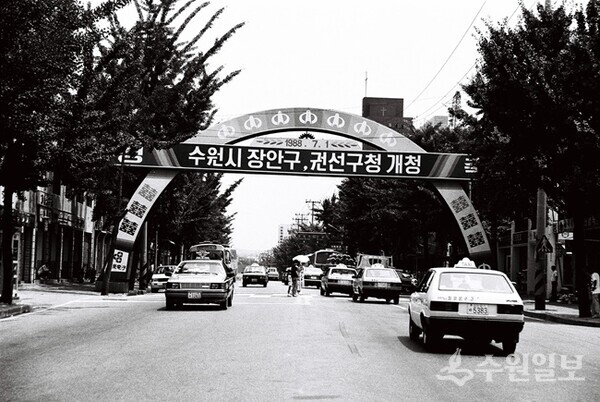
On July 1, 1988, the district office system was implemented for the first time in Suwon, with Jangan-gu established in the north and Gwonseon-gu in the south. Suwon's population had reached 543,724, meeting the conditions under Article 3, Section 3 of the Local Autonomy Act, which stipulates that "cities with a population exceeding 500,000 that are neither metropolitan cities nor special cities may establish general administrative districts rather than autonomous districts."
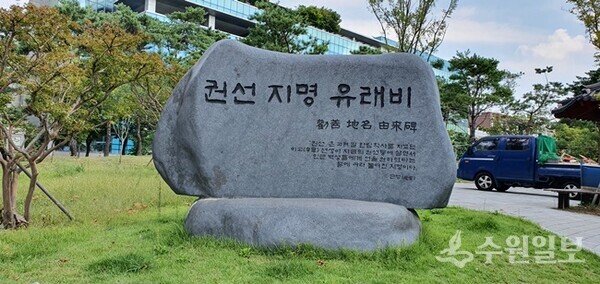
The district names were chosen using representative place names symbolic of Suwon.
Jangan-gu derived its name from Jangnaemun Gate. The place name Gwonseon originated from Lee Go (李皐), a scholar in the Hanlin Academy during the late Goryeo period, known as Mangcheon (忘川). When Goryeo began to decline, Scholar Lee Go returned to his home and lived at the foot of Paldal Mountain, later moving to Jeoksari (赤寺里) where he established a private academy and taught his students about gwonseon (勸善 – encouraging goodness), practicing it himself. Given his filial piety, the nation granted him the place name "Gwonseon-ri."
With the implementation of the district office system, Suwon prepared by launching preparation committees for both Jangan-gu and Gwonseon-gu offices approximately 20 days before the opening (June 11, 1988), to prepare buildings, personnel, and equipment.
At the time, the late Park Gye-min was assigned as the overall chief responsible for Gwonseon District Office's opening. The late Lee Mal-bong, a section chief, was appointed as the preparation committee director, while Kwon In-taek, who was serving as the secretary at Jeongja-dong, was assigned as the operations team leader. After the district office opened, Park Gye-min was appointed as the first district chief, Lee Mal-bong as the first general affairs section chief, and Kwon In-taek as the first general affairs clerk, playing pioneering roles in the birth of Gwonseon District Office.
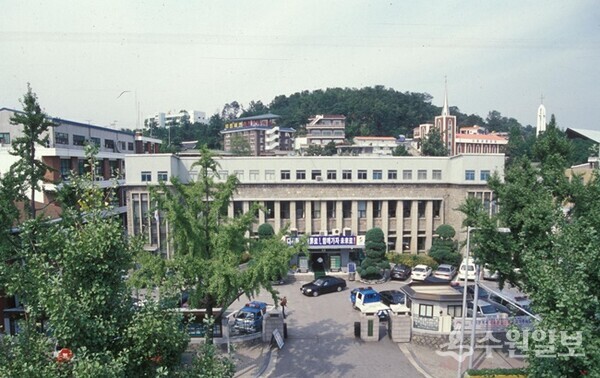
The newly established Gwonseon District's office building was decided to be the former city hall building located in Gyodong, which had served as Suwon City Hall until December 31, 1986. However, the former city hall building, constructed during the Japanese colonial period, was in such severe disrepair that it was unusable without extensive renovation work.
Not only was there little time to prepare for the opening, but the preparation process was enormous in scope. Despite day and night efforts, departments did not even have desks and furniture installed. As the opening date approached, two days before the opening, Mayor Yoo Seok-bo and city officials visited to inspect the opening preparations. Scaffolding installed for painting the exterior walls and repairing deteriorated sections remained in place.
The surroundings were cluttered with construction debris and in poor sanitary condition, with scattered trash piled high.
Upon discovering that even the nameplate for the opening ceremony venue had not been installed, the inspection team reached a consensus that the Gwonseon District Office opening should be postponed and only Jangan-gu should open.
However, invitations had already been sent to the Gyeonggi Province Governor and other guests as well as district residents, and the ceremonial program had been contracted. Operations team leader Kwon In-taek insisted that since invitations for the opening ceremony had already been sent, postponing it would be difficult, and he would take responsibility to complete everything so the opening could proceed as scheduled. At the time, senior officials criticized him for being stubbornly obstinate. Overcoming these difficulties, the opening ceremony was held as planned.
The preparation committee held coordination meetings with related organizations and departments to establish detailed time-based plans. Construction companies removed the temporary scaffolding installed outside using heavy equipment through overnight work, and at dawn, all staff were mobilized to deliver newly purchased furniture and equipment to each department and thoroughly clean and organize office floors.
On the opening day before dawn, sanitation workers and cleaning vehicles within Gwonseon District were mobilized to dispose of construction debris and trash within approximately two hours. With cooperation from the fire department, fire trucks were used to thoroughly clean the building exterior, stairs, and ceremony venue using high-pressure hoses. When event banners were attached on the morning of the opening at 8 a.m., the opening preparations were complete.
Upon hearing that opening preparations had been completed, comments emerged such as, "Were soldiers mobilized? I don't understand how preparations could be complete." After successfully holding the difficult and challenging opening ceremony, Kwon In-taek, the first general affairs clerk of Gwonseon District, earned the nickname "German soldier" from those around him.
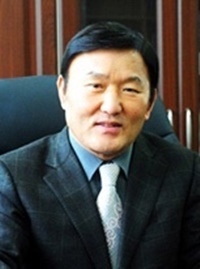
Following his role as the first general affairs clerk at Gwonseon District Office after its opening, he served as personnel clerk, tax section chief, and traffic administration section chief.
After serving as director of the Finance and Economy Bureau, he was appointed as the 16th Gwonseon District Chief in 2003, fifteen years after taking on the operations team leader position during the 1988 Gwonseon District Office opening initiative.
Following the implementation of the district system for Jangan-gu and Gwonseon-gu on July 1, 1988, Suwon's population increased to 714,272 by 1993. The administrative divisions of Jangan-gu and Gwonseon-gu were reorganized, establishing Paldal-gu, resulting in three districts.
Subsequently, as Suwon's population grew to 1,040,223 by 2003, the administrative divisions of Jangan-gu, Gwonseon-gu, and Paldal-gu were reorganized, and Yeongdeungpo-gu was newly established, making Suwon a four-district system. In this administrative reorganization process, the Gwonseon District Office building was left within Paldal-gu's jurisdiction.
As Gwonseon District residents had to visit the Gwonseon District Office located within Paldal-gu's administrative area to handle civil matters, an irrational situation emerged, making the relocation of Gwonseon District Office an urgent task.
Thus, Gwonseon District Chief Kwon In-taek was assigned the mission of securing a new district office building within his administrative jurisdiction. (To be continued)