Kim Chung-young's Suwon Microscope (137) Stories Behind the Opening of Gwonseon-gu Office and Building Construction [Part 2] (Former Gwonseon-gu Office Chief Kwon In-taek)
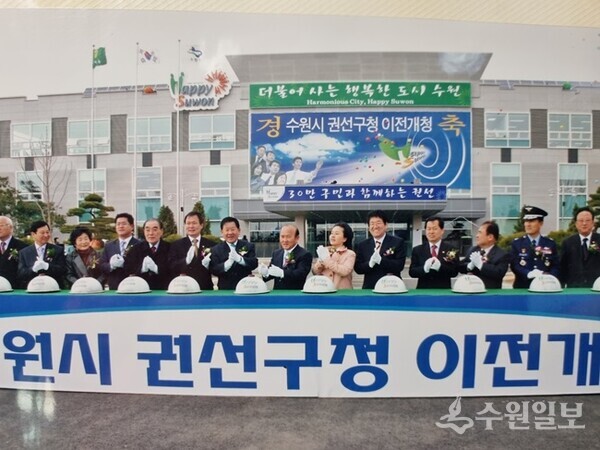
When Suwon's population exceeded 710,000 in 1993, following the establishment of Jangan-gu and Gwonseon-gu (July 1, 1988), Paldal-gu was newly created. Jangan-gu and Gwonseon-gu were reorganized through division. Subsequently, as Suwon's population exceeded 1.04 million in 2003, the three districts were reorganized and Yeongdeungpo-gu was newly established. As this series of processes progressed, the Gwonseon-gu Office became located within the jurisdiction of Paldal-gu.
At the time, Suwon City had the City Hall, Paldal-gu Office, and Yeongdeungpo-gu Office located in the East Suwon area. The site for the Gwonseon-gu Office was also located in the west side, with approximately 6,000 pyeong already secured across from the agricultural and marine products wholesale market in Gwonseon-dong.
Mayor Kim Yong-seo, elected in the third civil government term, promoted the construction of Gwonseon-gu Office in the West Suwon area in consideration of regional balance and balanced development.
In 2005, a plan was established to create Gwonseon Administrative Town in Taepdong, Gwonseon-gu, and construct the Gwonseon-gu Office building. At this time, Gwonseon-gu Office Chief Kwon In-taek requested 10,000 pyeong of land, citing that the site was too small. Suwon City, considering overall balance, decided to allocate 8,000 pyeong for the office site and separately create 2,000 pyeong of green space around the office. Accordingly, the Gwonseon-gu Office secured land that could accommodate the future construction of a community center.
The biggest challenge in constructing the office was securing the budget. The Suwon City budget operations department requested that the construction cost be set at 5.5 billion won. After multiple countermeasures meetings and negotiations, an additional 1 billion won was secured, bringing the total to 6.5 billion won. With the conviction to build the most efficient and proper office, Chief Kwon visited 11 newly constructed office sites (Gangneung, Bucheon, etc.) to compare their strengths and weaknesses and established meticulous plans. At this time, the case of Jangan-gu Office construction was referenced. Jangan-gu Office was built as a seven-story reinforced concrete structure on 10,000 pyeong of land with hundreds of billions of won invested, including the office, community center, and health center. In contrast, Gwonseon-gu Office planned a three-story building with 6.5 billion won, including the additional budget.
The issue was landscaping. Jangan-gu Office was constructed with a budget of 2 billion won, but Gwonseon-gu Office was allocated 900 million won despite having 40% more landscaping area than Jangan-gu Office, making it impossible to properly landscape.
'Necessity breeds ingenuity,' and landscaping trees were secured by receiving donations of trees from redevelopment project sites and densely planted landscaping trees from apartment complexes. Each ward carried out tree-planting campaigns symbolizing their respective wards. Furthermore, a donation and contribution campaign was launched, inspiring participation from related organizations and residents within the district.
Although landscaping trees were donated, the transplanting budget was insufficient. By requesting from each department of City Hall, 1 billion won was secured. Thus, a total of 8.5 billion won was invested in the construction of Gwonseon-gu Office. Trees donated by 12 wards were designated as 'Ward Citizens' Trees' and created a small performance venue symbolizing the four seasons. The venue was used for monthly roll calls, residents' performances, and as a recreational spot for children.
There were also improved cases through benchmarking. The cafeteria was placed on the third floor to prevent odors within the building, and the rest area and nursing room installed for women's welfare were the nation's first facilities. By expanding the office width from 6 meters to 8 meters, the efficiency of office use was enhanced. Water lines were installed in each department's pantry to resolve issues faced by female staff. In preparation for office shortage, a terrace was placed on the rooftop of the third floor to prepare for future expansion.
To shorten the construction period, work had to proceed during the winter season. To ensure smooth progress, vinyl was wrapped around the building exterior and three jet heaters were operated to shorten the construction period.
As the opening date approached, the massive moving of furniture became urgent, so a moving budget of 70 million won was divided by department, and each department contracted with Korea Express to simplify the implementation procedures.
Additionally, since the asphalt had not yet hardened, moving trucks had to be transported. By setting specific entry times for construction vehicles and moving trucks and proceeding with operations, successful relocation was completed according to schedule.
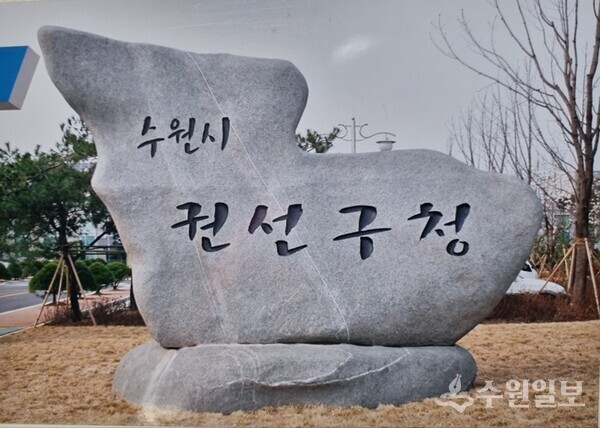
There is an anecdote regarding the construction of Gwonseon-gu Office. When installing a symbolic monument in front of the main entrance of Gwonseon-gu Office, the budget of only 20 million won was insufficient to purchase a proper monument. After making inquiries, a suitable natural stone was found that had been carried away by flooding in the Boryeong area of South Chungcheong Province. After multiple negotiations with the owner, a symbolic monument was installed within budget.
Another story involves the preparation of commemorative tree planting for the completion ceremony. With a budget of 10 million won, it was not easy to obtain two good trees. After inquiries, suitable trees for commemorative planting were found, but when the price was checked, they cost 30 million won for two trees. Despite multiple visits, the owner was unyielding. Upon investigation, the actual owner was found to reside in the United States. After contacting the actual owner, commemorative trees were purchased for 10 million won.
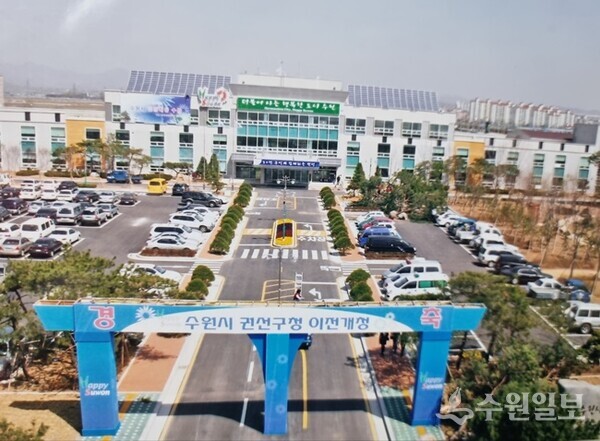
The office built through dedicated efforts began normal operations on March 28, 2006, with a successful celebration performance commemorating the office relocation.
Former Gwonseon-gu Office Chief Kwon In-taek received the 'Integrity Service Award' jointly organized by the Ministry of Interior and JoongAng Ilbo during his tenure and was selected as an 'Honest Person of 2003.' He received the 'Red Ribbon Medal of Honor' and is recognized as an exemplary civil servant.

Some witnessed the dedication to the construction of the new office day and night despite insufficient budget. While facing ridicule with remarks like 'Will the office become yours now that it is newly built?', applause is given to former Gwonseon-gu Office Chief Kwon In-taek and the staff who worked with him for bringing the Gwonseon-gu Office to completion.