Yi Byung-hee's 100th Birthday ② Building Suwon's Future and Reviving Its Past
Editor's Note
2026 marks the 100th anniversary of the birth of Baek-woong Yi Byung-hee. Having served seven terms as a National Assembly member from Suwon, he left significant marks on Suwon's growth through the relocation of the Gyeonggi Provincial Government, the restoration of Hwaseong Fortress, and the attraction of businesses. Behind these accomplishments lay his dedication to connecting the central government and businesses with public administration and the local community. News S retraces the time that Yi Byung-hee and Suwon spent together as we mark his 100th birthday.
In the early 1960s, Suwon was a city in Gyeonggi Province, but it was not the center of Gyeonggi.
The appearance of Hwaseong Fortress, which represents Suwon, was also different from today. Through the Japanese colonial period and the Korean War, the fortress walls and facilities were damaged in many places, and the areas around the fortress were rapidly changing through urban development.
It was before the two identities that explain Suwon today—'administrative city' and 'historical and cultural city'—were both properly established.
Following Yi Byung-hee's political footsteps, there is a moment where two different times meet.
One was bringing the Gyeonggi Provincial Government, which was in Seoul, to Suwon.
Even after Seoul and Gyeonggi Province were separated in 1946, the Provincial Government remained in Seoul. Suwon and Incheon competed for the relocation site. At that time, Incheon was Gyeonggi Province's representative city with a port and industrial base, while Suwon emphasized its geographical centrality and transportation.
Attracting the provincial government was not simply about bringing in one administrative agency. Civil servants and related institutions followed, and roads, residential areas, and commercial districts were formed. Above all, it was about having the symbolic status of 'Gyeonggi Province's central city.'
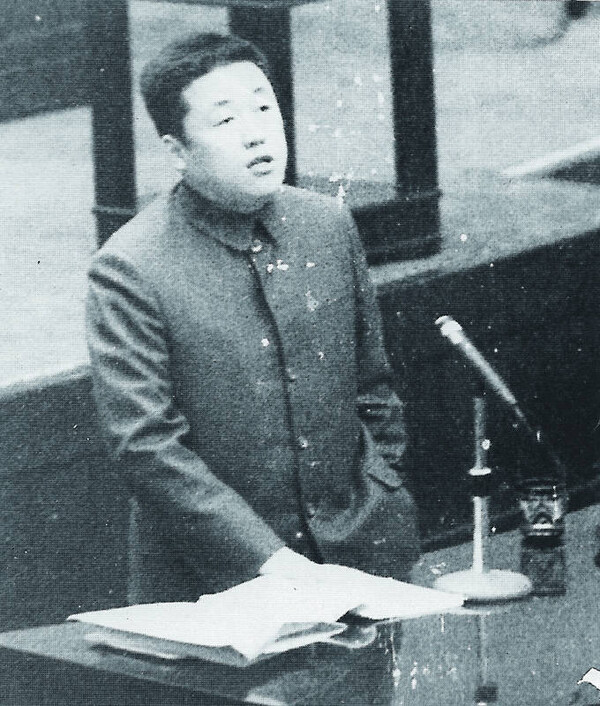
The competition between Suwon and Incheon escalated into a recruitment campaign that was a matter of local pride. Coincidentally, at the center of it were two politicians who were classmates from the 8th class of the Korea Military Academy. Yi Byung-hee from Suwon and Yu Seung-won from Incheon each threw themselves into attracting the provincial government, making the competition even fiercer.
In this process, a famous anecdote about Yi Byung-hee remained. He visited Park Chung-hee, Chairman of the Supreme Council for National Reconstruction, with his head shaved to push through the relocation of the provincial government to Suwon. It is also said that at that time, Yi Byung-hee pleaded with Chairman Park, "Brother, if we don't move the provincial government, I will die." This shows how much he staked his political fate on attracting the provincial government.
Did his efforts pay off? It did not take long for a conclusion to be reached.
In December 1963, the Supreme Council for National Reconstruction passed a bill to change the location of the Gyeonggi Provincial Government to Suwon.
Did his efforts pay off? It did not take long for a conclusion to be reached.
In December 1963, the Supreme Council for National Reconstruction passed a bill to change the location of the Gyeonggi Provincial Government to Suwon. The following October, a groundbreaking ceremony for the new provincial government building was held below Paldalsan, and in June 1967, the Gyeonggi Provincial Government relocated from Seoul to Suwon.
It was a turning point when Suwon rose to become the undisputed administrative center of Gyeonggi Province.
With the arrival of the provincial government, related institutions and people gathered in Suwon. Surrounding roads, residential areas, and commercial districts changed. The Gyeonggi Provincial Government building located below Paldalsan became a space symbolizing Suwon and Gyeonggi Province for more than half a century.
Having established the character of an administrative city through the relocation of the provincial government, in the 1970s Suwon looked in the opposite direction.
It was about recovering Suwon's identity.
Hwaseong Fortress was begun by King Jeongjo in 1794 and completed in 1796, but it was greatly damaged through the 20th century. Through the Japanese colonial period and the Korean War, some facilities were destroyed or disappeared, and fortress walls were crumbling in many places.
The 1970s were an era of development in South Korea. It was a time when building roads and factories and constructing new buildings took priority over preserving the old.
In such a period, plans to carry out a major restoration of Hwaseong Fortress were materialized.
In 1973, Yi Byung-hee, who was Minister at Large at the time, promoted plans to restore and maintain cultural heritage related to King Jeongjo, including Hwaseong Fortress, the royal tombs of Yung and Geun, and Yongju Temple at the national level.
According to recollections of Lim Su-bok, who handled the practical affairs at that time, Yi Byung-hee had plans drawn up to maintain not only the fortress walls but also cultural heritage related to King Jeongjo. Through this process, the 'Hwaessan Grand Filial Piety Complex Plan' was created and materialized as a national-level project through presidential approval.
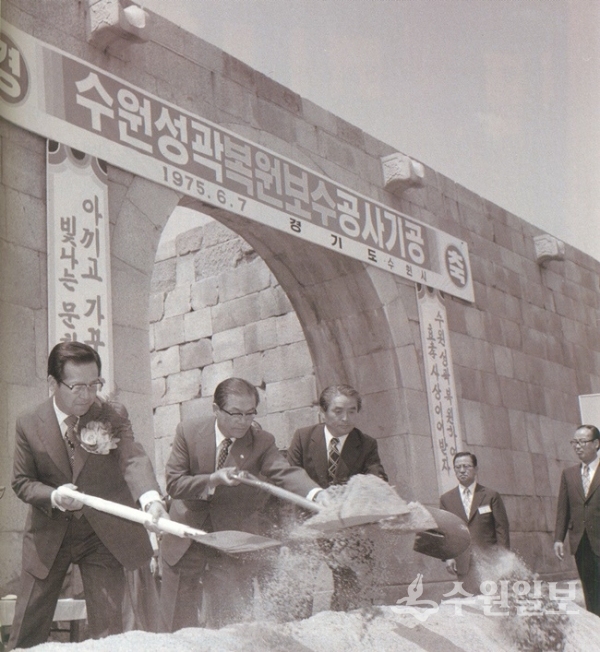
In 1974, Gyeonggi Province prepared the 'Suwon Fortress Restoration and Purification Plan,' and the following year, a groundbreaking ceremony for the restoration and purification project was held at Jangan Gate. Subsequently, a major restoration project to revive the fortress walls and major facilities proceeded until 1979.
An important basis for the restoration was the 'Hwaseong Construction Records,' left from the time of King Jeongjo. Because the construction process, materials, labor, and construction methods were recorded in detail at the time Hwaseong was built, damaged facilities could be restored to their original forms as closely as possible.
The restoration that began in the 1970s continued in subsequent generations. Additional restoration and maintenance continued, and Hwaseong Haenggung (the temporary royal palace) also regained its appearance through the efforts of citizens and Suwon.
And in 1997, Hwaseong Fortress was inscribed as a UNESCO World Heritage Site.
The Gyeonggi Provincial Government and Hwaseong Fortress. They opened the future and embraced the past.
The provincial government from Seoul was moved to make Suwon the center of administration, and the crumbling fortress walls were revived to recover how Suwon began as a city.
In building a new Suwon, the old Suwon was preserved.
In the blueprint of the city that Yi Byung-hee drew, both future and past coexisted.
전시언 기자 yourside@news-s.kr