Stock Losses and Soaring Real Estate in Crosshairs…Jang Dong-hyuk Declares War on Lee's Economic Policies
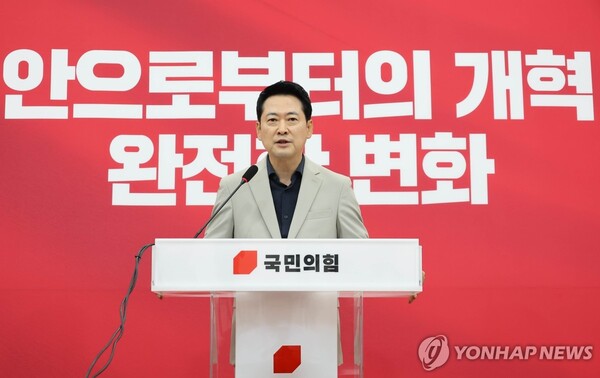
Jang Dong-hyuk, leader of the People Power Party, has launched an all-out offensive against the Lee Jae-myung administration's economic policies, simultaneously targeting the single-stock leveraged exchange-traded fund (ETF) crisis and real estate market instability.
At a press conference at the National Assembly on the 2nd, Leader Jang raised suspicions that lobbying by Mirae Asset played a role in the resignation of former Presidential Chief of Policy Kim Yong-beom, characterizing the related controversy as the "Lee Jae-myung Administration's ETF Gate."
He argued that "Chief Kim could not have caused such a massive accident alone" and called for investigations into the involvement of the entire policy line, including the Blue House, the Office for Government Policy Coordination, the Financial Services Commission, and the Financial Supervisory Service. He stated that the investigation scope should include whether President Lee Jae-myung issued directives and clarify the involvement and responsibility of related officials.
Leader Jang cited the fact that former Chief Kim and Lee Chan-jin, head of the Financial Supervisory Service, both have sons working at Mirae Asset Securities, as well as allegations of a meeting between former Chief Kim and Mirae Asset Chairman Park Hyun-joo. He also announced plans to call former Chief Kim as a general witness at parliamentary inspection and to push for a parliamentary inquiry and special prosecution.
The controversy surrounding single-stock leveraged ETFs is expanding to issues of credibility in the Korean stock market. Bloomberg pointed out that daily rebalancing of the product could amplify volatility in the underlying securities and reduce the investment appeal of the Korean stock market. The sharp decline of related products and large-scale forced liquidation of accounts held by young investors have further fueled debates over whether the government's product introduction and risk management were appropriate.
Leader Jang also sharpened his criticism of the Lee Jae-myung administration's real estate policies. Although the government announced and then withdrew its plan to reduce the basic deduction on aggregate real estate tax for non-resident owners of single properties within 29 days, it has maintained its policy direction of strengthening tax burdens, such as reducing long-term holding special deductions. He argued that frequent policy changes are fueling market confusion and distrust.
Market observers have expressed concerns that the tax increase could create a balloon effect, increasing inventory in Gangnam-area properties while stimulating prices for lower-priced housing in Gangbuk and suburban Gyeonggi Province areas, as well as jeonse rental markets. Analysis suggests that since the tax reform, rush sales have increased in Gangnam-area properties, while record-high transactions have continued in Gangbuk and suburban Gyeonggi areas, indicating regional polarization.
Leader Jang criticized the rising burden on actual homebuyers as housing and jeonse prices continue to climb amid high interest rates and tax burdens. He characterized ETF investment losses and real estate market instability as failures of the Lee Jae-myung administration's economic policies, emphasizing that "to change economic policy, ultimately the administration must be replaced."
전시언 기자 yourside@news-s.kr