Gyeonggi Province Requests Austerity Measures from 31 Municipalities Including Reduced Provincial Subsidies
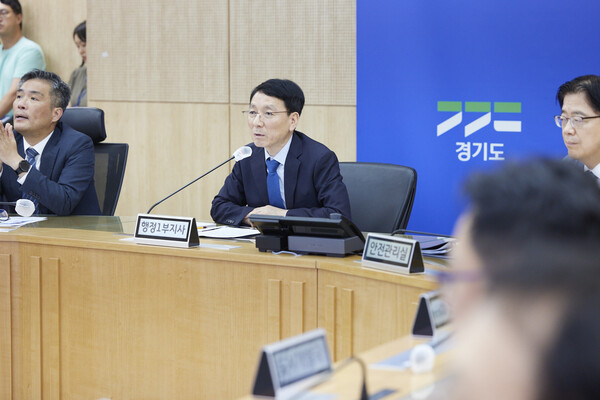
Amid difficult financial conditions, Gyeonggi Province has requested cooperation from 31 municipalities and counties to compile the 2027 main budget with intensive expenditure restructuring measures while concentrating resources on residents' safety, livelihoods, and broad-area affairs.
Kim Sung-joong, First Vice Governor of Gyeonggi Province, held a video conference on March 3rd at the Gyeonggi Province Government Complex Emergency Situation Room attended by leaders from 31 municipalities and counties regarding 2027 main budget compilation.
The conference was organized with the intention of transparently sharing the province's unprecedented financial difficulties with municipalities and counties while seeking solutions together.
Acquisition tax, which accounts for approximately half of the province's tax revenue, decreased by about 25.9% from 11 trillion won in 2022 to approximately 8 trillion won in 2026. In particular, Gyeonggi Province faces structural constraints including having the highest burden rate for legally mandated expenditures such as adjustment transfer payments nationwide and being ineligible for ordinary transfer tax benefits as a local government not receiving ordinary transfer tax distribution, resulting in less than 10% of the total budget being available for independently executed projects.
In response, during this conference, Gyeonggi Province reiterated its plan to review all projects except legally mandatory ones from scratch regarding expenditure restructuring and to sunset duplicative and overlapping projects. The province also shared principles including not compiling budgets for projects with poor execution records as a rule, minimizing provincial government burden on new and expanded national treasury subsidy projects, and minimizing support for non-legally mandated transfer payments to the education office.
For budget compilation, the province decided to concentrate resources on residents' safety and livelihood projects including disaster and emergency response, public safety, economic recovery for low-income earners, job creation, and welfare, while maintaining minimum investments for the future.
In particular, the province plans to prioritize resource allocation to broad-area transportation, environment, and industrial infrastructure as well as key provincial government initiatives, while discontinuing provincial projects that overlap or duplicate national government affairs, focusing capabilities on broad-area affairs, which are the province's core responsibility.
Additionally, the province requested cooperation regarding projects pursued jointly with municipalities and counties. The province will apply a standard subsidy rate of 30% to municipal and county subsidy projects exceeding 30% and will gradually adjust provincial government support for national treasury subsidy projects lacking legal grounds for provincial burden, while emphasizing it will communicate sufficiently in advance and seek direction together rather than unilaterally notifying municipalities and counties.
Vice Governor Kim Sung-joong stated, "Today's conference is an occasion to transparently share the difficult financial reality with municipalities and counties and pool our collective wisdom," and added, "If the province and municipalities and counties cooperate within the single framework of finances, we can certainly create a budget that protects residents' lives while preparing for the future."