Ajou University Hospital Regional Trauma Center Marks 10 Years of Achievement…Challenges Ahead as Hub Trauma Center
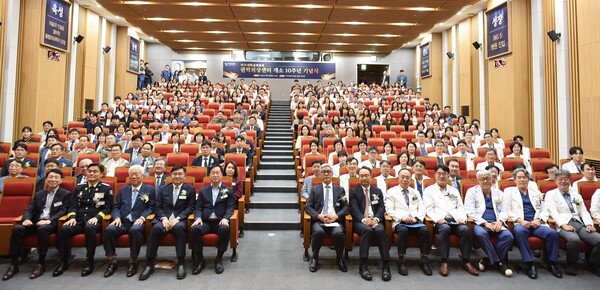
Ajou University Hospital Regional Trauma Center held a '10th Anniversary Ceremony of the Regional Trauma Center' on the 8th at the Annex Grand Hall of Ajou University Hospital.
The ceremony was organized to review the footsteps and achievements of the Regional Trauma Center, which has protected the lives of severely traumatized patients in the southern Gyeonggi region over the past 10 years, and to share the future direction of development in severe trauma care systems.
The event was attended by Kim Seon-yong, Chairman of Daewo Foundation, Kim Seong-joong, First Vice Governor of Gyeonggi Province, Seo Gil-jun, Director of the National Medical Center, Lim Jae-hyun, Standing Director of Daewo Foundation, Han Sang-wook, Head of Ajou University Medical Center, and Cho Jae-ho, President of Ajou University Hospital.
Ajou University Hospital's severe trauma care began in 2002 when Korea's first severe trauma patient care system was established. In 2011, it successfully treated Captain Seok Hae-gyun, the 'Hero of the Gulf of Aden,' raising public awareness of the importance of severe trauma care, and in 2016, it opened Korea's first standalone regional trauma center building, establishing a systematic foundation for severe trauma care.
Over the past 10 years, the Regional Trauma Center has positioned itself as a critical trauma medical safety net in southern Gyeonggi by protecting the lives of severely traumatized patients 24 hours a day, 365 days a year. Currently, it operates a trauma treatment system that encompasses the entire process from patient transfer to emergency surgery, critical care treatment, and rehabilitation, treating approximately 4,000 trauma patients annually. Among these, about 1,300 are severely traumatized patients.
Furthermore, it operates a 24-hour aerial transport system using doctor helicopters and fire department helicopters. Recently, in cooperation with the Gyeonggi Province Fire Service Headquarters, it launched the '119 Medic One Emergency Unit,' where medical personnel directly board 119 emergency vehicles to provide treatment to severely traumatized patients, strengthening on-site response systems to secure the golden hour for trauma patients.
Treatment outcomes have also significantly improved. Through continuous improvement of the care system and expansion of specialized personnel, the hospital has reduced the preventable mortality rate to 2.6 percent. In addition, it participates in the American College of Surgeons (ACS) Trauma Quality Improvement Program (TQIP), continuously evaluating and managing treatment outcomes according to international standards. In the 2024 presentation by the American College of Surgeons, it recorded excellent treatment outcomes at the top 1 percent level among approximately 500 trauma centers in the United States.
Ajou University Hospital Regional Trauma Center is using the 10th anniversary as an opportunity for new growth, planning to further strengthen severe trauma care capabilities and infrastructure. Going forward, it will proceed smoothly with renovations of the Regional Trauma Center and expansion of trauma-dedicated beds, while strengthening support for specialized personnel and facilities and equipment. Through these efforts, it plans to establish a care environment that can provide faster and more systematic treatment to severely traumatized patients.
In addition, it will challenge the government's hub trauma center construction project. It plans to enhance specialized care capabilities for the most severely traumatized patients and expand linkages with medical institutions and related agencies such as fire departments within the region, solidifying its position as the central hub of the regional trauma care system and a national key trauma center.
Han Sang-wook, Head of the Medical Center, said, "The past 10 years have been a time when medical professionals, the government, local governments, and fire and emergency medical institutions have worked together to protect the lives of severely traumatized patients," and added, "Based on the experience and achievements we have accumulated, we will continue to fulfill the mission of the Regional Trauma Center to protect the lives and safety of the nation and contribute to the development of Korea's severe trauma care system."