Now is the Era of Culture The Age of Dopamine, the Question of 'Cinema's Raison d'Être' Posed by Lee Chang-dong
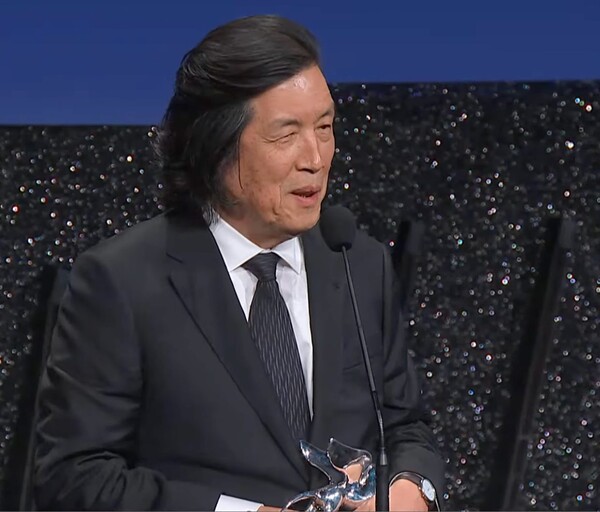
Director Lee Chang-dong's new film 'Possible Love' won the Silver Lion for Best Director at the 83rd Venice International Film Festival. It is a major award achievement garnered exactly 24 years after the director won the award in 2002 with the film 'Oasis'.
The Venice Film Festival, which boasts the longest history among the three major film festivals in the world, is not merely a place to celebrate commercial success. It is the most acute arena for verifying the aesthetic experiments of the era and the artistic dignity of cinema as a medium. The fact that Lee Chang-dong won the jury prize at that venue once again confirms the unique position that the name Lee Chang-dong holds in world cinema history.
On the 12th (local time) at the closing ceremony of the 83rd Venice International Film Festival held at Palazzo del Cinema on the Lido in Venice, Italy, the director's remarks were composed rather than exultant, and pained rather than grandiose.
"We are living in an era where the meaning of labor is fading and human relationships are increasingly disconnected. I created this film to ask what cinema can do and should do in such a time. I accept this award as a sign of hope that I will continue to pose such questions."
The Age of Dopamine: Questioning 'Cinema's Reason to Exist'
This remark transcends mere humility or ceremonial gratitude. In an era where algorithms and short-form content pour out stimulation, it is a master's declaration not to reduce cinema to mere 'content for consuming time,' and the ethics of a creator who refuses to turn a blind eye to the tragedy of our time—where labor is alienated under the pressure of capital and efficiency, and communication with others is severed. The Silver Lion was defined not as praise for a completed achievement, but as a whip lashing the director to continue posing uncomfortable yet necessary questions to the times.
A Master Driven to OTT Capital: A Bitter Portrait of Korean Cinema
Behind this weighty subject lies a bitter facet of the Korean film industry. Even the master filmmaker representing Korean cinema found it difficult to secure production funds in the domestic investment environment, and the harsh reality of today's film industry is that he had to abandon 'theatrical films' and rely on global OTT capital. Amid the waves of cinema's crisis and investment stagnation, it starkly reveals the limits to which Korean film capital has been driven, unable to accommodate artistic challenges and the attempts of masters.
Paradoxically, 'Possible Love,' born of streaming capital, tells the story of two couples—a pair of laid-off workers and a pair of documentary filmmakers—meeting and confronting their different lives and hidden desires. The reason the Venice critics awarded this work, which asks "Can we truly understand others in fractured relationships?," both the Silver Lion and the International Federation of Film Critics Award (FIPRESCI) is clear. Regardless of the source of capital, the work itself proves the necessity of why cinema as a medium must exist.
Reasons to Gather Before the Screen Again
Recently, the Korean film industry stands at a cruel crossroads of declining audiences and production contraction. In a reality where investment stagnation forces even masters to turn to streaming platforms, this director's award transcends the mere dimension of national prestige. It is a response from the entire Korean film industry to the question "Why must we still gather before the screen and watch cinema?" and a recovery of pride.
Twenty-four years ago, Lee Chang-dong, who impressed the world with the presence of Korean cinema, is once again asking about the survival and essence of cinema as an art form at the same venue in 2026. Now it is our turn to contemplate our answer to that echo: "I will endlessly question what cinema can do."