Kim Woo-young Gwanggyo Column Why Has This Sacred Zelkova Tree on the Hwaseong Fortress Wall in Haengung-dong Failed to Become a Protected Tree?
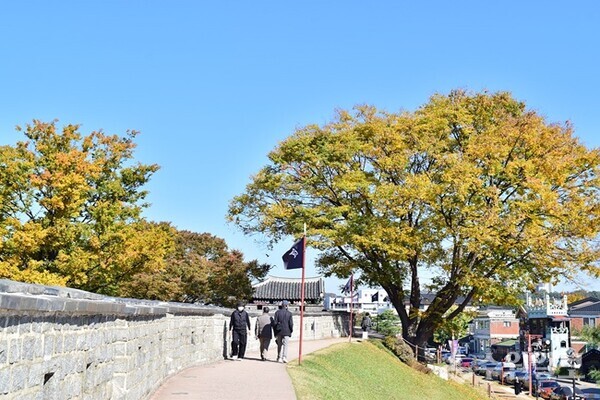
Midway along the Hwaseong Fortress Wall connecting Jangmun Gate to Hwaseo Gate stands a colossal zelkova tree. Though its trunk circumference at breast height reaches 4.5 meters, making it imposingly massive in appearance, it has yet to be designated as a protected tree.
During my years at Suwon North Middle School, I briefly lived in a corrugated iron-roofed alcove behind a rice mill connected to an auto repair shop outside Jangmun Gate. A friend's house, which I occasionally visited, had this tree in its backyard.
After entering a different high school, I never saw that friend again. His father was said to be a traffic police officer. I was impressed watching him occasionally arrive on a traffic police motorcycle, commonly called a sidecar.
Even then, this zelkova tree was enormous.
In 2014, poet Shin Kyeong-rim published a poetry collection titled 'Second Floor of the Photography Studio,' which includes a poem called 'The Zelkova Tree Again.'
After many years passed and I returned to my hometown,
the zelkova tree in front of my hometown house had grown as before.
I soon realized I had grown old and fallen ill,
that my eyes had already dimmed and my ears had grown deaf,
yet I did not grieve.
In eyes seeing the zelkova tree grown again,
the world was so beautiful.
With eyes dimmed and ears deafened,
all things in the world became even more beautiful.
It was the same for me. Having now passed sixty and seventy years of age, with eyes emptied of desire, this tree appears ever more massive. Moreover, it carries such confident bearing. It is beautiful. Unlike old trees that show cavities or broken branches, this one displays no such marks—it appears healthy. The tree seems to be over 200 years old.
Its location on the fortress wall between Jangmun and Hwaseo Gates makes it resemble a stalwart general protecting Hwaseong. Or perhaps—could it be that the city deity of the UNESCO World Heritage site Hwaseong has manifested in benevolent form?
Particularly at dusk, when viewed from below the fortress, it evokes not fear but warmth. Its harmony with the fortress wall and Haengung-dong village delights the eye.
I am not alone in this feeling. Whether day or night, young people sit beneath the tree, laughing brightly and resting, or using it as a backdrop for photographs—their behavior reveals the benevolent energy of this tree.
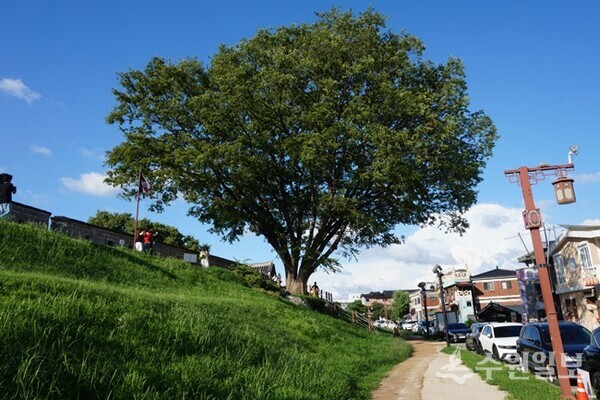
This zelkova tree surely witnessed the joys and sorrows of Suwon residents who lived within the fortress. Does it remember my childhood friend being born there, or how he and I scampered like squirrels through the crumbling gaps in the fortress wall?
But why does this zelkova tree stand on the fortress wall rather than at the village entrance, in the neighborhood center, or before an administrative building?
Hwaseong is an inner-backing style (內托式) fortress wall built with stone on the outer face and filled with earth inside.
According to Dr. Han Dong-min, director of the Suwon Independence Movement Memorial Hall, trees were planted during construction to prevent the earth-filled inner backing from collapsing. Various historical records show evidence of tree planting around fortress walls and installations.
In 2019, the Suwon City Research Institute published 'Storytelling Research on Plant Resources Related to Suwon.' Research Director Kim Eun-young notes that "King Jeongjo's tree-planting projects in Suwon were conducted mainly in the Hyungneung area, but according to the 'Hwaseong Fortress Construction Record (華城城役儀軌),' tree planting occurred in Paldal Mountain, Maehyang-dong, throughout the inner backing of the entire fortress, on both sides, Daecheon, outside the fortress at Yongryeon, Gwan-gil, and north of Younghwajung—seven times total in spring and autumn from Gabin year (1794) to Jeongsa year (1797)." Here, inner backing refers to the interior portion of the entire fortress wall, and Daecheon refers to the Suwon Stream banks.
The same book catalogs trees planted around fortress installations: Korean ash, willow, peach, mulberry, pine, and plum trees. However, no records indicate zelkova planting. Perhaps only the most frequently planted species were recorded, causing zelkova to be omitted. Or perhaps it was planted later.
Old photographs show trees standing densely in rows atop the fortress. Particularly in the 1940 black-and-white film 'Tuition,' shot in Suwon and featuring Hwaseong Fortress, trees densely planted appear on the fortress wall and around the Yeonmudae parade ground, Changyong Gate, and Hwaseo Gate.
'Tuition' was filmed with Maehyang Elementary School in Haengung-dong, Paldal-gu, Suwon (now Maehyang Girls' Middle and High School) as its backdrop. Produced by Lee Chang-yong of Korea Film Company and jointly directed by Choi In-gyu and Bang Han-jun, it starred Jeong Chan-jo and Kim Jong-il.
Shot entirely in Suwon, this rare footage preserves what the city looked like at that time.
In June 2014, the Korean Film Archive acquired a 35mm print from China's Film Archive, underwent restoration, and released it in theaters and on DVD in 2015. I watched it at a screening held by Suwon City Hall.
Most of those many trees that appeared in the film or were photographed in old images have vanished. Straight trees were felled by the Japanese, and some were cut by war refugees during the Korean War to build shelters or used as firewood for heating and cooking.
Hwaseong's fortress wall was also heavily damaged at that time. Refugees settling beside the fortress took stones and bricks from the wall to build houses. There are even accounts that refugees dismantled the kitchens of Reungneung and Gyeongneung Tombs to use as firewood.
Though the majestic tall pines atop the fortress wall disappeared, this zelkova tree survived without being felled. Perhaps even in those coldest, hungriest times, no one could bring themselves to touch such a sacred tree.