Choi Hyung-guk's Historical Pencil (11) Sukjong, Consoling Soldiers Even During Illness
When one thinks of Sukjong, what comes to mind is factional politics. Through three instances of factional shifts during his 46-year reign, Sukjong became a monarch befitting the description of being "a master of politics and the grave of his officials." Just as one would sweep away and replace a layer of grilled meat on a grill, whenever Sukjong sensed even the slightest whiff of rot in power, he unfailingly conducted a "political overhaul." In this way, Sukjong's royal authority appeared to grow ever stronger.
At the beginning of Sukjong's reign, which started in a world of the Southern Faction, descendants of the Eastern Faction who revered the king as heaven, the Western Faction members watched eagerly for any opportunity. Centered around Prime Minister Heo Jeok, the Southern Faction gathered power, but the Southern Faction split into the Pure Southern and Turbid Southern factions over the issue of punishing Song Si-yeol, the Western Faction's eternal mentor. Moreover, Heo Jeok himself disposed of the Pure Southern faction. Then came the Gyeongsin Factional Shift in 1680, which struck the Southern Faction hard from behind. The Southern Faction, which had controlled the three highest ministers and six senior officials until yesterday, was confined to a small room, and the Western Faction took their place. However, less than ten years later, the Gisa Factional Shift of 1689 saw the Southern Faction regain power. If there is a character most often depicted as a villainess in historical television dramas, Hui-bin Jang (禧嬪張氏) would certainly be within the top five. Jang Ok-jeong (張玉貞), more commonly known as "Jang Hee-bin," gave birth to a prince when the king's primary consort, Lady Min, could not bear a child. That son later became King Gyeongjo.
In that process, the Southern Faction actively supported making Hui-bin Jang's son crown prince and regained power. Naturally, the Western Faction, which opposed the matter, had to retreat to their small room once again. Queen Min, who had Western Faction support, was deposed and expelled from the palace.
Then, with the final factional shift—the Gapsu Factional Shift of 1694—the situation reversed dramatically. Lady Min, who had been expelled from the palace, was reinstated as Queen Inhyeon, Queen Jang was demoted back to Hui-bin, and the Southern Faction was sent into long exile far from Seoul. Through these three factional shifts, one conviction grew stronger: only the "king" survives.
What Sukjong most devoted his attention to during this period was his soldiers. In the "General Discourse on Military Techniques" section of the 『Illustrated Manual of Martial Arts』, the story of Sukjong is described most beautifully. Around 1714, in Sukjong's later years, the king frequently fell ill. While the ailing Sukjong lay on a mat in his private quarters, he would separately summon the guards and warriors around him and offer them drinks, saying they suffered greatly. Sukjong, who had often spent time with warriors shooting arrows at Chundangdae in the back garden of Changdeokgung Palace, sought them out even more as his own body weakened.
The soldiers who received the wine from Sukjong all shed tears and were moved by his grace. In fact, it is recorded that everyone who read the passage wept. Subsequently, Sukjong summoned the Byeolgunjik (Special Military Personnel) to the courtyard in front of Daejojeon Hall at Changdeokgung Palace, which served as both the central chambers and sleeping quarters, and commanded them to display equestrian martial arts, boldly riding their horses across the open space. On that day's test, they employed very small targets called "small straw effigies targets," which were smaller than those used in regular training, to appreciate the refined art of equestrian archery.
In particular, the "Byeolgunjik" who participated that day were a symbol of loyalty. They were descendants of military officers who faithfully accompanied Prince Bongnim (who later became King Hyojong) when he was taken as a hostage to Shenyang during the Second Manchu Invasion of Korea. They were called the "Eight Valiant Military Officers." They were eight men: Park Bae-won (朴培元), Shin Jin-ik (申晉翼), O Hyo-seong (吳孝誠), Jo Yang (趙壤), Jang Ae-seong (張愛聲), Kim Ji-ung (金志雄), Park Ki-seong (朴起星), and Jang Sa-min (張士敏). Upon Hyojong's accession to the throne, they were formally established as the official royal bodyguard unit. Their descendants were recorded in history as the king's closest bodyguard unit symbolizing "loyalty" until the nation of Joseon fell.
On January 8, 1720, Sukjong celebrated his sixtieth birthday. Then, in June of that year, he ascended to heaven. Even then, what remained most in his heart were the military officers who had grown old with him. Court officials around him persistently dissuaded him from dispatching elderly generals and commanders to positions like "Gwnim," that is, Regional Military Commanders or Naval Commanders, which were top field positions.
However, Sukjong empowered elderly military officers by citing the historical precedent of Guangwu Emperor of the Han Dynasty, who praised General Ma Yuan, who subjugated the Southern Barbarians, saying, "Old but vigorous indeed, this old man." At the end, regarding the practice of using age as a criterion for judgment, Sukjong criticized it as "short-sighted," and firmly decreed that the matter of age should never be discussed again.
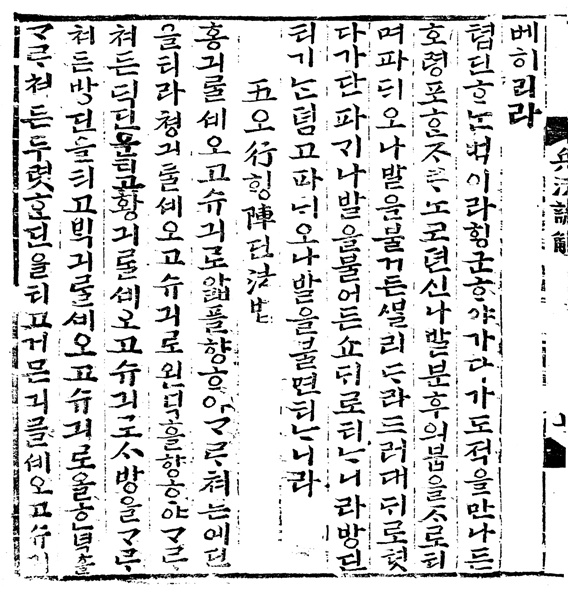
Furthermore, Sukjong was the first to create military treatises in Korean, or Eonhae, for soldiers unfamiliar with Chinese characters and distributed them to the troops. That Korean military treatise is 『Jinbeoponhae』. Military officers of captain rank and above learned and used Chinese characters, but common soldiers often had limited knowledge of Chinese characters and used only the Korean Eonhae version.
In the Joseon Dynasty, military treatises made in Eonhae existed before this as well. Typically, a Chinese text version would first be created and then retranslated into Korean to create an Eonhae version. However, 『Jinbeoponhae』 was created in Korean from the start and distributed in a way that was easy for soldiers to read.
Looking at some passages: "오ᄒᆡᆼ딘법-홍긔ᄅᆞᆯ 셰오고 슈긔로 앏플 향ᄒᆞ야 ᄀᆞᄅᆞ쳐는에 딘을 티라 쳥긔ᄅᆞᆯ 셰오고 슈긔로 왼디고을 향ᄒᆞ야 ᄀᆞᄅᆞ쳐든 딕딘 운티고 황긔ᄅᆞᆯ 셰오고 슈긔로 ᄉᆞ방을 ᄀᆞᄅᆞ쳐든 방딘을 티고 ᄇᆡᆨ긔ᄅᆞᆯ 셰오고 슈긔로 올흔녁훌 ᄀᆞᄅᆞ쳐든 두렷한 딘을 티고 거믄긔를 셰오고..."
This passage explains the "Five Elements Formation," which was also easily utilized in the late Joseon period. It describes raising flags of the five directional colors, including red, and using small hand flags held in hand to command various formation changes.
When watching battle scenes in historical television dramas, the depiction typically focuses on generals commanding soldiers solely by shouting at the top of their voices. However, the unfortunate part is that historical records like this exist, yet they are not actively utilized. With just one small hand flag and one large banner, soldiers can move. In fact, there are many more precise methods of command. It is always regrettable to see this overlooked.
In any case, Sukjong's special consideration for soldiers remained in the hearts of the troops for a long time. Even after King Jeongjo ascended to the throne, stories of Sukjong remained like legends in military camps for a long time. No matter how much the world changes or how much political power shifts, those who remained in the military camps, the soldiers' loyalty, was unwavering. Rather, it must remain unwavering. Even if the world splits in two, "loyalty" must be directed solely toward the nation and its people.