Choi Hyung-guk's Historical Sketch (19) Baek Dong-su, A Warrior of Joseon, Meets Jeongjo
Yae (Wild and Famished) Baek Dong-su (白東脩), The Reality of a Rough and Starving Martial Artist
When times are troubled, one yearns for good people. When good people gather and pursue good works, a good world unfolds. When a king recruits talented people and implements good policies, the lives of the common people improve. Yet creating such a truly good world is difficult. So it was in the Joseon period. In any age, ignorance of the value of people brings the same hardship.
Upon ascending the throne, Jeongjo immediately undertook military training reforms and compiled Byeonghakseong (兵學通) (1776), a manual of military formations. His hope was that soldiers of the Five Military Divisions (五軍營), the central military force of the late Joseon period, would be unified through more stable formation training. However, in attempting to establish unified formation training, he discovered that individual soldiers possessed varying levels of martial skill. Naturally, the next step was to standardize the martial arts that each soldier needed to master. Thus, in April 1790, Illustrated Manual of Martial Arts (武藝圖譜通志) was created to unify the martial arts practiced by soldiers.
The martial artist responsible for the practical martial arts techniques was none other than Yae (Wild and Famished) Baek Dong-su (白東脩). The cognomens used by Joseon people carried profound meaning. Among them, the cognomen that best expressed Baek Dong-su was "Yae (野餒): wilderness-ya, hunger-tae"—meaning a person who would not yield his resolve even while starving in a harsh wilderness. His other cognomen, "Injaejae (靭齋)," aligned with this meaning. So "in (靭)," meaning resilient and tough...
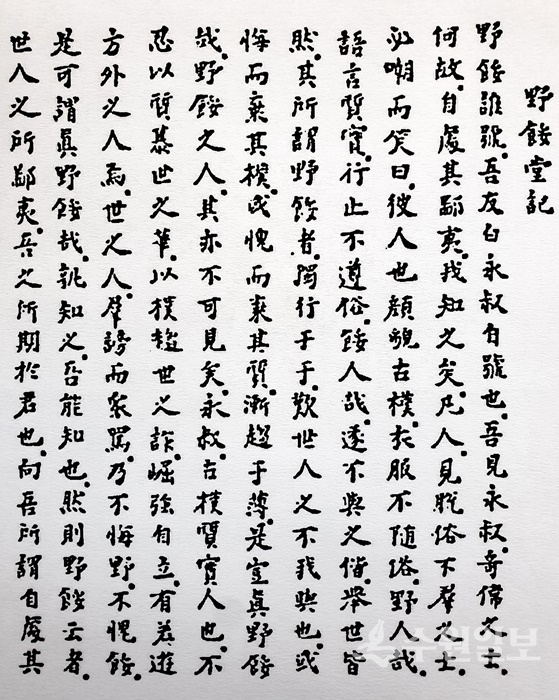
The relationship between Baek Dong-su and Yi Deok-mu was that of brother-in-law and sister's husband. Cheongjangkwan Yi Deok-mu, who married Baek Dong-su's elder sister, explained the true meaning of his "cognomen" in his collected works with a short essay titled "Records of the Wild and Famished Hall (野餒堂記)." Although both came from poor illegitimate backgrounds, they demonstrated deep empathy for each other's lives.
"Yae (野餒)—whose cognomen is this? It is the self-given cognomen of my friend Baek Young-suk (白永叔: Young-suk being the courtesy name of Baek Dong-su (白東修)). When I observe Young-suk, he is an extraordinary and excellent scholar. Yet why does he embrace foolishness and baseness? I understand the reason. Generally, when people see a scholar who stands apart from worldly pursuits and does not mingle with the crowd, they must ridicule him, saying, 'This person has a simple and plain appearance, and his garments do not follow worldly fashion—he is truly a person of the wilderness (野人). His speech is plain and sincere, and his deportment does not follow worldly fashion—he is truly a famished person (餒人).' For this reason, they do not associate with him.
Since the whole world is thus, such a one called 'Yae' acts alone in hardship, and sighs and regrets that people do not associate with him. He abandons or is ashamed of his simplicity, discards his substance, and gradually pursues superficiality—is this truly the essence of Yae? One who is truly of Yae nature is indeed rare to behold.
Young-suk is ancient and substantial in character. He does not admire worldly splendor through his substantiality, nor does he pursue worldly cunning through his antiquity. He stands firm and upright, like one dwelling in another world. Therefore, though all the world reviles and disparages him, he does not regret the wilderness within him, nor is he ashamed of his famishment. Is this not what may be called true Yae? Who could understand such a thing? Only I understand it well. Then is not 'Yae' what the world regards as trifling, yet what I await from you with unfading hope?"
Baek Dong-su was "a person of the wilderness" and "a famished person." He was like a seeker treading a path alone, enduring hunger in harsh fields. In a way, he reflected the sad reality of his age. The sorrow of a half-yangban, of illegitimate birth, would not be forgotten even in death.
His great-grandfather was Baek Si-gu (白時耉), a renowned general who served as Military Commissioner of Hamgyeong, Hwanghae, and Pyeongyang provinces. His grandfather was Baek Sang-hwa (白尙華), born to a concubine. Naturally, his father, Baek Sa-gong (白師宏), was also born to a concubine, as was Baek Dong-su himself. That blood was transmitted across generations, and that bondage naturally gave birth to "Yae (野餒)."
Sometimes, Parting Brings Opportunity
In 1771 (the 47th year of King Yeongjo's reign), at the age of twenty-nine, Baek Dong-su passed the regular military examination. Yet the world recognized him not. He merely held his military examination certificate in hand, awaiting the day of official appointment, but the world offered no opportunity. Thus Baek Dong-su quietly departed with his family to Girinheup in Inje, Gangwon Province, seeking to shake off, if only for a time, the shackles of a troublesome world.
A life on the road is filled with longing. Yeonam Park Ji-won, a master-like figure of the Baektap faction who knew Baek Dong-su's abilities better than anyone, heard this news and left a short letter. Reading it, one encounters sorrow woven throughout.
"Injaejae (靭齋) Baek Dong-su (白東修) is descended from a general's family. Among his ancestors was one who devoted himself to loyalty, sacrificing his life for the nation, so that even now the literati regard him with sorrow. Baek Dong-su writes seal script and clerical script well, is familiar with institutions and systems, and at a young age is skilled at riding horses and shooting arrows, having passed the military examination. Though he has not enjoyed the fortune of his time and has not gained rank and stipend, his resolve to be loyal to the king and die for the nation is worthy of inheriting his ancestors' achievements and brings no shame before the literati.
Alas! Why does such a Baek Dong-su lead his entire family away to the land of Gangwon Province? Baek Dong-su once examined for me a house site at Yeonam Gorge (燕巖峽) in Geumcheon (金川), Hwanghae Province, a place so deep in mountains and difficult of passage that walking all day one would meet not a single person. Standing in a reed marsh, the two of us established words, took up whips to distinguish that lofty ridge, saying, 'There we could build a fence, plant mulberry trees, and if we burned the reeds to clear fields, in a year we could harvest a thousand sacks of millet.' Testing the matter, we set fire to fagots, and as the wind carried the flames, pheasants cried out in alarm and flew away, and fawns bolted from before our feet. Rolled up sleeves on both arms, I chased after them, was blocked by a stream, and returned. Looking at me and laughing, he said, 'Human life is less than a hundred years. How could we speak so narrowly of dwelling between trees and stones, farming millet, and hunting pheasants and rabbits?'
Now Baek Dong-su says he will live in Girinheup, carrying a calf on his back to raise it for plowing fields, and lacking soybean paste, will make soybean sauce by fermenting mugwort to sustain himself. How could the harshness and isolation of such a place be reckoned the same as Yeonam Gorge? Yet I myself now wander at a crossroads, unable to decide my own course. How could I then dissuade Baek Dong-su from leaving? Rather do I regard his resolve as admirable and do not mourn his poverty.
That his departure is thus pitiful, yet I did not pity it—one may infer that for one who has not yet departed there is even more cause for pity. His musical pitch is bold and grand, as if one were hearing the sound of Gao Jianli's (高漸離) bamboo lute."
—Preface presented to Baek Dong-su entering the mountain valleys of Girinmyeon (麒麟面), Inje—
<Yeonam Collection (燕巖集), Volume 1, Yeonhyangak Selection Edition (煙湘閣選本)>
An expert recognized by Park Ji-won himself. Baek Dong-su, whose writings were distinguished and whose martial skill was even more excellent, was forgotten by the world, like his self-given cognomen "Yae (野餒)." There is no need for further elaboration; the exchange of letters between them alone suffices to provide ample understanding.
It was Jeongjo himself who ended Baek Dong-su's self-imposed seclusion and brought him out into the world. Of course, the sincere recommendation of his brother-in-law Yi Deok-mu played a part. Thus Baek Dong-su became an assistant commander of the Jangnyong Division and worked with his friends on Illustrated Manual of Martial Arts (武藝圖譜通志), the last martial arts manual of Joseon. How thrilling such work must have been! For someone to recognize one's worth makes the world itself a blessed life. That alone is enough.