Choi Hyung-guk's Sword Dance (22) Xiang Yu the Hegemon and Emperor Liu Bang of Han in the 'Muyedobotongji'
- Metaphorical Methods of Martial Arts Postures and Ancient Tales
The long spear (長槍) is the first martial art to appear in the 'Muyedobotongji'. With a total length of one jang and five cheok, it converts to approximately 4 meters and 60 centimeters in modern measurements—an extremely long spear. So occasionally, I receive the question, "Does one person really use such a long spear?" The answer is yes; it is a weapon used by a single person. In the same era, the Western world and Japan frequently utilized long spears exceeding 5 meters.
Particularly, when foot soldiers deployed in collective long spear formations with their shoulders pressed together, a gigantic 'forest of spears' was literally created. When held simultaneously toward the front and shaken against fiercely charging enemy cavalry, it evokes the image of a hedgehog displaying its spines. Therefore, a certain number of long spearmen were always included in foot soldier units during the traditional period.
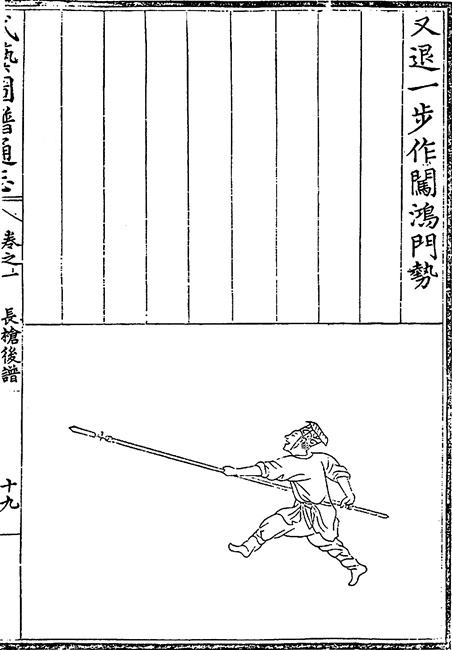
Among the various movements of the long spear, there exists a posture name called 'Tumhongmunse (闖鴻門勢)'. This posture involves raising the spear head that was lowered, stepping back, and aiming at the opponent. The Hongmen (鴻門) that appears here is a place name from the 'Chu-Han Contention' (楚漢志) where Liu Bang (劉邦), the Han Emperor, and Xiang Yu (項羽), the Conqueror of Chu, met. It was a strategically important military location located east of Tong County (潼縣) in Shaanxi Province (陝西省) in present-day China.
Thus, the posture name represents the movement of 'tumching (闖)' through 'Hongmen'. The character tum (闖) is sometimes interpreted as meaning 'to peek', but it is a pictographic compound with the character for horse (馬) squeezed between two characters for gate (門). Thus, it represents the meaning of a fast-running horse charging forth from a great gate and passing through. The original meaning is 'to charge forward', and it also carries the meanings of 'to advance courageously' and 'without hesitation'.
However, understanding this historical anecdote allows one to express the posture's movements more easily. The story goes as follows: In December 207 BCE, just before the Chu-Han struggle for supremacy at the end of the Qin Dynasty, Liu Bang and Xiang Yu, who were competing for supremacy, met at a place called Hongmen (鴻門) near Xianyang, the capital of the Qin. This is referred to as the Hongmen Feast (鴻門宴) or the Hongmen Assembly (鴻門之會).
A banquet was held at the military camp of Xiang Yu stationed at Hongmen, and Liu Bang attended as a guest that day. However, Fan Zeng, a vassal of Xiang Yu, plotted to kill Liu Bang there. At that moment, a hired assassin appeared—Xiang Zhuang (項莊), a cousin of Xiang Yu. His sword skills were exceptional. Fan Zeng's plan was for Xiang Zhuang to offer a toast; once the cup was empty, to request a sword dance and, seizing the opportunity, to sever Liu Bang's head.
Soon the banquet reached its height, and Xiang Zhuang addressed Liu Bang: "There is nothing particularly entertaining at a military feast like this, so might I perform a sword dance to liven the spirits (軍中無以爲樂 請以劍舞)?" Unaware that his own head was about to fly, Liu Bang readily agreed, and Xiang Zhuang drew his sword and displayed his swordsmanship magnificently. At times like an angry storm, at times like quiet mist, he gradually approached Liu Bang's neck. However, noticing this air, Liu Bang's aide Xiang Bo slyly slipped in and, the moment the sword flew, ingeniously obstructed it.
Once, twice... each time the sword approached Liu Bang's neck, the atmosphere of the banquet grew colder. Now Liu Bang himself had come to understand the situation. At that moment, Liu Bang's fierce general Fan Kuai burst through the door like lightning. And, naturally appearing to protect his lord Liu Bang, he drew his sword and danced. Xiang Yu, delighted by his boldness, praised Fan Kuai and offered him a large vessel of wine. Then Fan Kuai drank the entire vessel in one gulp. An instant shotgun! Xiang Yu, intoxicated by Fan Kuai's spirited demeanor, commanded that Liu Bang be released. Xiang Yu's attendants regretted it, but there was nothing they could do. Had Liu Bang's head been severed that day, perhaps the legendary 'Xiang Yu the Hegemon' would not have died so pathetically.
In that story, Fan Kuai's act of breaking through the tightly guarded gates of Hongmen and rushing in to protect his lord Liu Bang is embodied in this posture. After pressing the opponent deeply and attacking, one steps back while firmly aiming the long spear at the opponent's neck. It is the movement of charging through the gap of an iron fortress-like gate and then retreating while reinforcing defense. In the sequence of long spear postures, 'Cheongnyongheonjosse (靑龍獻爪勢) - Eomgeomse (馬奄劍勢) - Tumhongmunse (闖鴻門勢)' are connected in this manner.
The blue dragon charges through the Hongmen gate with claws extended, piercing deeply, then steps back to shield the opponent's blade aimed at the lord, and steps back once more to protect the lord while raising the spear blade. The long spear sequence concludes with the final posture of 'Yachathamesae (夜叉探海勢)'.
- Twin Swords' Xiangjanggimusse (項莊起舞勢) and Hangohwanpasangse (漢高還霸上勢)
The Hongmen Feast story explained above connects to the final posture of twin swords in the 'Muyedobotongji', called Xiangjanggimusse (項莊起舞勢). As its name suggests, this is the posture where 'Xiang Zhuang' initiates the sword dance. This beginning is positioned as the final scene of the sword dance aimed at Liu Bang's neck, thus adorning the conclusion of twin swords. Explained through connected twin sword postures, it is as follows:
The final posture of twin swords consists of Jijoyeomiksse (鷙鳥斂翼勢) - Janggeomsugwangse (藏劍收光勢) - Xiangjanggimusse (項莊起舞勢). A fierce hawk, like a fierce bird, gathers its breath as it retracts its wings (jijoyeomik), then conceals the sword and hides the light as it rapidly crosses both swords diagonally and slashes (janggeomsugwang), and finally, as if delivering a final blow to the enemy commander, 'Xiang Zhuang's sword dance' unfolds with the left sword washing over the right in a single slash (xiangjanggimu).
In mounted twin swords, there is also a posture containing an anecdote of Han Emperor Liu Bang (漢高祖). This is the Hangohwanpasangse (漢高還霸上勢). It is a posture where one rides vigorously while wielding both swords in cross strokes and tucks the left sword between the right armpit. As its name suggests, it represents Liu Bang's return to his military camp at Basan (霸上). The historical account goes as follows:
When Liu Bang contended with Xiang Yu for supremacy, Liu Bang's army entered Xianyang, the capital of the Qin Dynasty, first and became so enchanted with its magnificent appearance that they wished to settle there permanently. However, behind him, Xiang Yu, who ambitiously prepared for supremacy under heaven, glared with piercing eyes. Yet numerous treasures, beautiful women, sturdy walls... it all appeared as though it had been prepared for Liu Bang, and in that moment, his eyes turned.
Had Liu Bang remained in Xianyang, intoxicated by such luxury, it is possible that within mere months, he would have been cut in two by Xiang Yu the Hegemon's sword. However, the legendary strategist Zhang Liang (張良) was at Liu Bang's side. In fact, Zhang Liang was the one who had previously sensed the situation at the Hongmen Feast and dispatched Fan Kuai. He initially mentioned that Fan Kuai should go outside the palace and organize the military camp, but Liu Bang was so captivated by the magnificent palace that he did not hear.
Then Zhang Liang stepped forward. He forthrightly advised that they should return to the military camp at Basan (霸上), a strategic military stronghold, and demonstrate frugal and strong conduct to the soldiers, for this would set the example for the lord. At that moment, he left the famous saying, 'Bitter medicine is unpleasant to the mouth but beneficial to the disease'. Hearing these words, Liu Bang reflected. He then turned his back on the magnificent palace of Xianyang and returned to the dusty military camp at Basan. The soldiers who followed him genuinely responded to Liu Bang's frugality. With that sincerity, they defeated the army of Xiang Yu, which was several times stronger in combat power, and later became the first emperor of the Han Dynasty, which unified China for the second time following the Qin. Xiang Yu, who dreamed of being the Conqueror of Western Chu but did not heed the counsel of his loyal servants, lost his life; Liu Bang, who appeared weak but heeded the counsel of loyal servants, conquered the world.
The Hangohwanpasangse (漢高還霸上勢) carries such meaning. A movement of having to return despite regret. Though it is a sword one wishes to strike downward at an opponent, one must tuck a sword into the ribs so that the remaining sword can move more freely.
As such, the posture names in martial arts manuals created during the traditional period, including the 'Muyedobotongji', contain various metaphors and historical tales. Therefore, to properly execute the relevant posture, one must completely understand its meaning for expression to be possible. However, if one excessively extends the interpretation of meaning, one encounters another problem. The method of martial arts study is to carefully seek out how ancestors recorded the relevant martial arts postures, and how to implement their meanings.