Choi Hyung-guk's Editorial (24) The Sharp Swordsmanship of Joseon, Ye-do and Joseon Se-beop
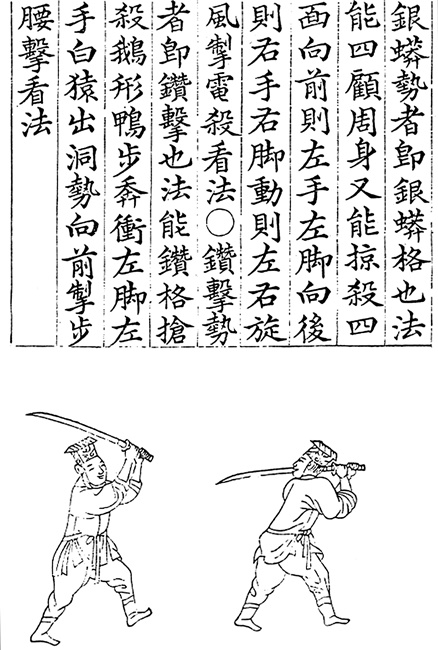
"鑽擊勢者 卽鑽擊也法 能鑽格搶殺鵝形鴨步奔衝 左脚左手 白猿出洞勢 向前掣步 腰擊 看法"
In interpretation: "Chan-gyeok-se (鑽擊勢) is the technique of striking by drilling. This method can penetrate and cut with a drilling guard, moving in a goose shape and duck-stepping posture while striding. Using the left leg and left hand, one performs the baek-won-chul-dong-se, moves forward with a rapid step, and strikes the waist with a body strike. Observe the technique."
In describing the movement, one assumes the chan-gyeok-se posture as shown, then using the left leg and left hand, performs the baek-won-chul-dong-se and strikes the waist with a body strike. The baek-won-chul-dong-se refers to lightly lifting the right foot from the chan-gyeok-se position, lowering the sword to the lower rear left of the body, then rotating it (rolling the blade forward in a counterclockwise manner) to raise it upward as if cutting, lifting it over the left shoulder. Immediately following this is a strike to the waist with a body strike. The movement is completed with these two postures.
- A Broader Perspective on Ye-do
The world is not the realm of martial arts fiction. In martial arts novels, it is not the case that with one sword movement from a master, countless enemies fall like withering leaves. Furthermore, even on the battlefield, it is rare for a general to cleave an enemy in two with a single strike, no matter how brilliantly the sword blade flashes. Armor was worn to prevent this. Only through thorough and repetitive basic training does a true master emerge.
The sharp swordsmanship of Joseon, Ye-do (銳刀).
Within it lies the foundation and essence of Joseon swordsmanship. Notably, however, 『Muyedobotongji』 contains two different types of Ye-do (銳刀). The reason is as follows. Originally, Ye-do existed in two forms: the twenty-four individual sword techniques (commonly called Joseon Se-beop) that directly quoted the content of 『Mubeoji (武備志)』written by Mao Yuanyi (茅元儀), and a series of connected long tul forms that had been practiced in Joseon armies. The former content from 『Mubeoji』 was organized into 24 postures of 'Ye-do-bo (銳刀譜)'. To this were added four unique postures from 'Ye-do-chong-bo' as an 'addition (增)'.
Mao Yuanyi of the Ming Dynasty compiled extensive military science over 15 years and published 『Mubeoji (武備志)』 in 1621. The reason was very simple. Filled with tremendous patriotic fervor, he set aside all other work to devote himself entirely to compiling a military treatise to revive the declining Ming Dynasty.
After examining approximately 2,000 military texts and personally reorganizing them, the compilation totaled 240 volumes. From military instruments (軍器) used by soldiers to warships (兵船) for combat, it can be regarded as a vast military encyclopedia explaining troop formations (陣形) and military martial arts training alongside illustrations. It even included strategically important maps.
Because it is such an encyclopedic resource, 『Mubeoji (武備志)』 was consulted when constructing Suwon Hwaseong, designated as a UNESCO World Heritage Site. Among its contents, scholars including Jeong Yagyong specifically cited the section on Chinese fortress construction. Notable examples include the No-dae (弩臺), a combat facility behind Seojangdae, the highest point of Suwon Hwaseong, and the Oseong-ji (五星池), five holes drilled above the Jangan-mun Ongseong to defend against fire attacks.
Though the discussion has digressed briefly, the work's importance is such that Mao Yuanyi's biography is also included in the preface of 『Muyedobotongji』. In any case, the original citation in 『Mubeoji (武備志)』 states '호사자득지 조선기세법 (好事者得之 朝鮮其勢法)', meaning 'the enthusiasts obtained these techniques from Joseon'. This was modified to be referred to as 'Joseon Se-beop (朝鮮勢法)' in subsequent sentences.
It carries the meaning that "the Chinese brought Joseon swordsmanship." These Joseon sword techniques newly compiled by Mao Yuanyi in China as 'Joseon Se-beop (朝鮮勢法)' were then re-imported to Joseon under the name 'Ye-do (銳刀)'. Therefore, it is preferable to use the term 'Ye-do (銳刀)' rather than 'Joseon Se-beop (朝鮮勢法)'.
The long connected posture form practiced by Joseon armies before the compilation of 『Muyedobotongji』 was later separately organized under the name 'Ye-do-chong-bo (銳刀總譜)'. Generally, in the descriptions of other martial arts contained in 『Muyedobotongji』, the individual bo (譜) from the front is directly connected and appears in the form of a chong-bo (總譜) at the end, but in the case of Ye-do, there is another form of 'connected-se (chong-bo)' that appears as an entirely different sword technique. Though this may be a somewhat difficult topic, it becomes apparent when one looks closely.
By way of explanation, it is slightly similar to the cultural adaptation of 'LA Galbi' (ribs). After the Korean War, first-generation Korean-American immigrants to Los Angeles, USA, missed galbi. American food culture, which grills raw meat called 'steak' as is, and modest financial circumstances gave birth to 'LA Galbi'. Korean-style galbi, cut into pieces with a slicer to be convenient for single-bite consumption and marinated to be suitable as a rice side dish, was reorganized in America.
The original Korean-style galbi, which required carving one piece at a time with a knife, could not bear the labor costs and was simply chopped into small pieces with a slicer. In that process, the Korean flavor of sweet and salty marinades was realized in Los Angeles, America. As this style of short ribs was re-imported to Korea, it was named 'LA Galbi'. Just as 'LA Galbi' is the taste of Korea realized in America, 'Joseon Se-beop', the taste of Joseon swordsmanship realized in China, was incorporated into 『Muyedobotongji』 under the name 'Ye-do'. And to this were added the long sword techniques originally practiced by Joseon armies, separately documented in 'Ye-do-chong-bo' at the end.
Mao Yuanyi searched for usable Chinese sword techniques within the Ming Dynasty, but they had long since disappeared. Therefore, he brought sword techniques from Joseon and organized them in 『Mubeoji』. That is why he named them 'Joseon Se-beop'. Since the 'Ye-do' originally practiced by Joseon armies shared similar basic movements, 『Muyedobotongji』 included both when it was compiled.
The Joseon Se-beop (Ye-do 24 postures) organized in 『Mubeoji』 consists of simple movements worthy of being called 'initial study (初習)', the most fundamental in sword training—primarily folding movements of the blade followed by attacks, or ways of aiming after attacking, extremely simple postures.
The overall sentence structure of Ye-do describes the appearance of the posture in question (the first stopping posture), then explains the possibilities of what parts or attacks can be executed using this method (mention of core attack techniques—the attack method of the second appearing 'se'). It then explains the actual movement, describing which hand and foot are used when moving from the first posture to the next posture, how (the second posture) one moves and which footwork is used to complete the final posture. Finally, it concludes with 'gan-beop (看法)', meaning to observe the method.
Examples include movements where one attacks immediately after a change in the aiming position from the first posture, movements where one blocks an opponent's attack in the first instance and immediately attacks, or movements where after a first attack (opponent's defense) one immediately aims or attacks in a second instance. Therefore, strictly speaking, the basic movement of Ye-do 24 postures is completed in two actions. Individual basic offense and defense techniques become 'Ye-do 24 postures (with 4 additional postures)', and the continuous tul-form movements utilizing these techniques become the so-called 'Ye-do-chong-bo'.
Thus, it is fair to say that the most distinctly Joseon form of Joseon swordsmanship is contained in 'Ye-do' and 'Ye-do-chong-bo'. The reason is that from a foreign perspective, the most formidable Joseon sword technique was 'Ye-do', and the sword technique continuously practiced by Joseon soldiers was 'Ye-do-chong-bo'. Without close examination, anyone can find the content confusing.
- How Should We Interpret the Hangul Annotated Version?
『Muyedobotongji』 was produced in Classical Chinese, comprising 4 volumes in 4 books. The problem is that documents compiled in our country in Classical Chinese lack punctuation. Should one punctuate incorrectly, the translation can become nonsensical and strange. The same applies to Hangul. In fact, due to the simple problem of punctuation, Classical Chinese sometimes results in Japanese names being literally interpreted as Chinese characters, where '~田' or '~村' become interpreted as 'a certain field' or 'a certain village'.
To overcome these limitations, His Majesty King Jeongjo ordered that a Hangul annotated version ('eon-hae-bon') be compiled together with 『Muyedobotongji』. It was decided that illiterate soldiers who could not read Classical Chinese could easily interpret and decipher the annotated version. The problem is that the 'eon-hae' used here is Hangul from the late 18th century, which would have been easy for soldiers at that time to read, but differs from the Hangul currently in use, creating the situation where another layer of annotated translation is necessary. This is the task of translating 18th-century Hangul into present-day Hangul.
This is also a considerably complex matter. For example, there is the matter of translation regarding the Chinese character 'chan (鑽)', which appears simultaneously in the most well-known sword technique, Bon-guk-geom, and in Ye-do. In Bon-guk-geom there is 'chan-ja (鑽刺)', and in Ye-do there is 'chan-gyeok (鑽擊)'. In the annotated version, it is marked as 'bibeoyeo (비븨여)'. To rub, to rub and thrust, to rub and strike... beyond translation, how should one restore this to a physical movement? What should be rubbed, how should it be rubbed, and why should it be rubbed—explanations of these points are necessary. If such questions are not resolved, continuous confusion will compound.
To solve this problem, one must consult dictionaries from around 1790, when 『Muyedobotongji』 was compiled. This is similar to how today, to confirm the meaning of a word, one consults a Korean or English dictionary. There is a book called 『Jae-mul-bo (才物譜)』. It is a book of the type 'yeo-seo-ryoo (類書類)' compiled in 1798 (22nd year of King Jeongjo) by Yi Man-yeong (李晩永), a scholar of the late Joseon period. In 『Jae-mul-bo (才物譜)』, it states 'chan (鑽)—cheon-gwang (穿光)', and afterward, in the explanation of 'chan-gung (鑽弓)', it says 'bibae hwal (비븨 활)'. (『才物譜』卷6, 「物譜一」 財貨.)
'Chan-gung (鑽弓)', also called 'bibae-hwal (비비활)' or 'hwal-bibae (활비비)', is a tool used with a fire-starting bow in which the string of the bow is wound around the shaft of an awl, one hand holds a pressure tool (made of hard material like wood or stone with minimal friction) placed on top of the shaft, and the other hand pulls and pushes the bow like playing a violin or sawing. As the bow is wound and pulled on the string, this movement naturally transforms into a rotating motion of the shaft, causing the awl blade to be rubbed and drilling a hole through friction.
If one removes the awl blade and directly rubs wood in this manner, it becomes a 'bibae-hwal (비비활)', used for starting fire. Therefore, the phrase in the annotated version explaining 'chan-gyeok' as 'bibeoyeo ti-neun (비븨여 티ᄂᆞ)' corresponds to 'striking the blade in a rotating manner like an awl'. This explanation is added because the sword used in Ye-do is fundamentally a double-bladed sword style.
For example, such an expression appears when one is instructed to use the left blade of a double-bladed sword, then use the left blade again. At this point, the hand holding the sword naturally moves as if rotating an awl. Simply put, it is a counterclockwise rotation of the blade. Should the opponent's sword block it, the sword tip moves in a counterclockwise rotating manner.
Following this, there are related books to examine together. 『Hunmong Jahoe (訓蒙字會)』 and 『Yeok-eo Yuhae (譯語類解)』, a Chinese vocabulary dictionary made by Shin Yi-haeng and others at the Saro-won (사역원) of late Joseon. The name 'bibae (비븨)' also appears here, and in 『Mul-myeong-go (物名攷)』, a sort of vocabulary dictionary created by Yu Hui (柳僖) in the Sunjo era (1820s) by collecting various object names and explaining them in Hangul or Classical Chinese, there appears a tool called 'bubui (부비)'. In these explanations, the Chinese character 'chan (鑽)' invariably appears. Even today, in places where wood is worked, such as construction or furniture making, 'bibae (비븨)' or 'bubui (부비)' is used as the name for a tool called 'bibae-songgot (비비송곳)', an awl shaft held between both palms, rotated (rubbed) to drill holes.
A single Chinese character 'chan (鑽)' requires such complex explanation just to be understood. There are countless such carefully approached words and Chinese characters in 『Muyedobotongji』. This is why the path to correct martial arts restoration is difficult and complex. Though what appears is simple, one can achieve deep understanding only by discerning the essential meaning of each movement. This is true of worldly affairs as well.