Choi Hyung-guk's Historical Essays (25) Guan Yu, Crossing into Joseon as a Deity
- Guan Yu Raising His Crescent Blade
Guan Yunzhang stands majestically, crescent blade held high, his long white beard flowing.
The tales of Liu Bei, Guan Yu, and Zhang Fei from the 『Records of the Three Kingdoms』 are so widely known that they have been read as popular novels throughout East Asia, not just in China. In recent times, they have been adapted into films and television historical dramas, spreading their names across the globe. Among them, Guan Yu (關羽), called the "Saint of War" and depicted as a master of martial arts, is a figure of distinctive appearance and spirited character.
This admiration for Guan Yu abounded during the Joseon Dynasty as well. Since the Japanese invasions of Imjin, Guan Yu had become the spiritual center of faith among Ming Chinese troops who came to Joseon as relief forces. Throughout Seoul, shrines dedicated to the veneration of Guan Yu were positioned in the four cardinal directions. The name of Seoul's Line 1 Dongmyo Station actually derives from Donggwanwang Temple (東關王廟), the eastern shrine dedicated to Guan Yu. Even today, shrines honoring Guan Yu remain in several Southeast Asian countries and along South Korea's west coast.
More specifically, Gwanwang Temple (關王廟), the shrine dedicated to Guan Yu in Joseon, first appeared during the Japanese invasions of Imjin. However, for nearly a century it remained a place frequented mainly by those seeking personal blessings through Guan Yu's spiritual efficacy. When King Seonjo first visited, he merely followed the precedent of a king's visit to a martial temple. Subsequently, it was incorporated into the state rites system, with only minor sacrificial ceremonies conducted.
During the reigns of King Sukjong through King Jeongjo, this place acquired new national significance. Guan Yu was elevated to become an object of political veneration, serving as a medium to enhance loyalty to the king. This shift became distinctly evident beginning with Sukjong's reign. Sukjong impressed upon his officials the image of Guan Yu as embodying loyalty and respect for the Zhou Dynasty.
In the 『Records of the Three Kingdoms』, Liu Bei is depicted as valuing justice over expedient survival. Guan Yu and Zhang Fei witnessed Liu Bei's commitment to restoring the lost Han Dynasty, risking their lives in battle, and thus became sworn brothers with him. These three sworn brothers, bound by their oath in the Peach Garden, came to be recognized by contemporaries as generals upholding the "Doctrine of Shu Han Legitimacy," regarding Shu Han as the most legitimate of the states. Their remarkable deeds were widely disseminated in Joseon through Luo Guanzhong's popular novel 『Romance of the Three Kingdoms』. Sukjong felt this same admiration upon witnessing Guan Yu's exemplary conduct.
Sukjong established Gwanwang Temple, where he performed sacrificial rites, and constructed shrines dedicated to successive loyal ministers throughout Seoul, ensuring that the ideology of loyalty spread among both the military and civilian officials as well as the common people. Sukjong demonstrated such affection for Guan Yu that he even had poems of his own composition hung in the South and East Gwanwang Temples. He even overcame his ministers' opposition and personally visited Gwanwang Temple, where he presided over sacrificial rites leading the civil and military officials.
A record from Sukjong's reign survives: "Alas! The loyalty and righteousness of the Martial Marquis of An (Guan Yu) is truly rare throughout the ages. That I visited yesterday and gazed upon his portrait came from a sentiment rarely shared in this world, and was also to encourage the warriors. It was by no means undertaken for momentary amusement. Ah, you generals and soldiers must certainly follow this spirit, exert yourselves more in loyalty and righteousness, and protect the royal house. This is my wish."
Through the Gwanwang Temple ceremony, Sukjong urged his officials not to pursue only factional interests but to return to loyalty to the royal house and king. Whenever Sukjong traveled to the royal mausoleum of his predecessor, depending on its location, he would first stop at either the East or South Gwanwang Temple to offer sacrifices, and pressured the civil and military officials participating in the royal procession to swear oaths of loyalty.
Although Sukjong elevated Guan Yu to the rank of Marquis of An, a royal title, some civil officials resisted, as Guan Yu was of military origin. Sukjong's reign was a period of political turmoil, marked by several cycles of factional conflict between the Seorin and Namin. As king, Sukjong boldly embraced Guan Yu into Joseon as a figure commanding absolute trust.
Sukjong accentuated Guan Yu's loyalty not as blind obedience to the king, but as aspiring toward universal justice transcending the nation itself. Furthermore, Guan Yu was portrayed not merely as a general of exceptional military prowess, but as a commander who enjoyed reading various Confucian classics including the 『Spring and Autumn Annals』 and could sacrifice his life for righteousness. This became a powerful instrument of pressure not only on military commanders but also on civil officials of letters.
By expounding on the legitimacy and righteousness of the "martial" (武) represented by Guan Yu within domestic political reality, he demanded absolute loyalty from his officials. Subsequently, King Yeongjo and King Jeongjo established Gwanwang Temple as Joseon's martial temple, and utilized it politically to such an extent that the king would don armor himself before embarking on royal processions or excursions, first paying respects at the martial temple, and requiring officials to show similar reverence. Imagine the scene of the king clad in armor like Guan Yu at that place!
Furthermore, in 1896 (King Kojong 33), as King Kojong was preparing to establish the Korean Empire as an imperial nation, he elevated Guan Yu's temple ceremonies from minor sacrifices (小祀) to medium sacrifices (中祀) in the 『Great Korean Ritual Compendium (大韓禮典)』, which formally reorganized all state ceremonies, thereby officially publicizing Guan Yu's loyalty and righteousness.
- The Legend of Guan Yu Embedded in the Ogwan Chamjangse of the Crescent Blade
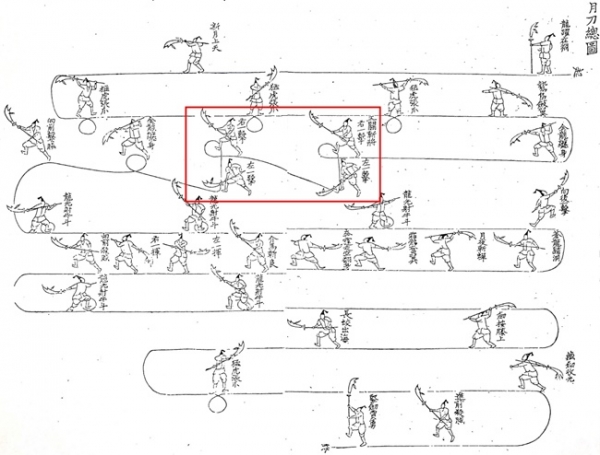
Among the martial techniques recorded in the 『Muyedobotongji』, the crescent blade (月刀) features a posture called Ogwan Chamjangse (Five Passes Beheading Generals Posture). This posture, in which the crescent blade is swung widely left and right to demonstrate the most explosive force, carries the story of Guan Yu. True to its name, it represents the posture in which Guan Yu beheads the commanders guarding five passes (五關).
It corresponds to a sweeping motion of the crescent blade, rotating widely to horizontally sever the neck from left to right, followed immediately by a diagonal downward sweep to knee level (向右回擊-掃左一擊). This scene, which vividly showcases Guan Yu's martial prowess and loyalty, relates to the historical narrative of "Beheading Six Generals at Five Passes" (五關斬六將). However, this account does not appear in the historical records 『Records of the Three Kingdoms』 but only in Luo Guanzhong's novel 『Romance of the Three Kingdoms』. It is likely an embellished account created to highlight Guan Yu's martial skill.
The situation at the time was as follows: Under Cao Cao's relentless attack, Liu Bei lost many soldiers and took refuge with Yuan Shao in Hebei. Zhang Fei withdrew to Mangtan Mountain. Guan Yu, persuaded by Cao Cao's general Zhang Liao, temporarily pledged his service to Cao Cao's forces.
At that time, Guan Yu imposed three conditions: first, that his submission was to the Han imperial house, not to Cao Cao; second, that Cao Cao must take good care of Liu Bei's two sisters-in-law; and third, that he could leave at any time upon learning of Liu Bei's whereabouts. After confirming Liu Bei's location, Guan Yu resolved to depart Cao Cao, taking the two sisters-in-law (Lady Gan and Lady Mi) with him to rejoin Liu Bei.
In the novel 『Romance of the Three Kingdoms』, Guan Yu is described as quietly leaving a letter for Cao Cao before departing. As he journeyed from Cao Cao's forces to Liu Bei, he broke through five heavily fortified passes, beheading in succession the commanders guarding each formidable stronghold with single strokes—a scene called "Beheading Six Generals at Five Passes" (五關斬六將). During this escape, Guan Yu traveled on horseback toward Luoyang.
At the first pass, Dongling Gate, he beheaded Commander Kong Xiu. At the second pass, Luoyang Gate, he killed Commanders Han Fu and Meng Tan with a single stroke. At the third pass, Sishui Gate, he killed Commander Bian Xi and assassins without exception. At the fourth pass, Xingyang Gate, he beheaded the prefect Commander Wang Zhi. Finally, at Huanghe Gate, the pass leading to the Yellow River, he beheaded Xiahou Dun's subordinate Qin Qi and crossed the Yellow River to return to Liu Bei.
However, in the historical records, Cao Cao merely expressed regret, saying "each person has their own master; do not pursue him," and sent no pursuit force. Had Guan Yu truly breached five strategically important passes and beheaded commanders, even Cao Cao would not have allowed such a formidable general to depart gracefully.
The diverse martial postures of the twenty-four techniques of the Muyedobo recorded in the 『Muyedobotongji』 are thus imbued with numerous stories and legends. Misunderstanding the context of these symbols and legends leads to entirely different conclusions. A saying goes: "When pointing at the moon with a finger to show someone, one sees only the pointing finger, not the moon itself." No matter how accurately one points at the moon with a finger, if one merely looks at the finger and claims there is no moon there, it is most awkward. Do not criticize the finger—saying it is unsightly or finding fault—but rather observe the moon. If one still cannot see the moon, then there is nothing more to say or do.