Choi Hyung-kook's Martial Arts (27) The Black Dog's Tail Strike in Hyeopdo and the Cicada-Cutting Strike in Woldo
- Interesting Metaphors Embedded in Martial Arts Postures
Praying mantis front leg attack! Eagle claw strike!
This is one of the phrases frequently heard in past Chinese martial arts films. Tanglangquan (Praying Mantis Style), which mimics the hunting movements of mantises, and Yingzhaoquan (Eagle Claw Style), a form martial art based on the movements of eagles using their talons to catch prey, are representative Chinese martial arts evocative of insects and fierce birds. However, among the 24 martial postures recorded in the Muye Dobo Tongji, there are many cases that include such analogies and metaphors.
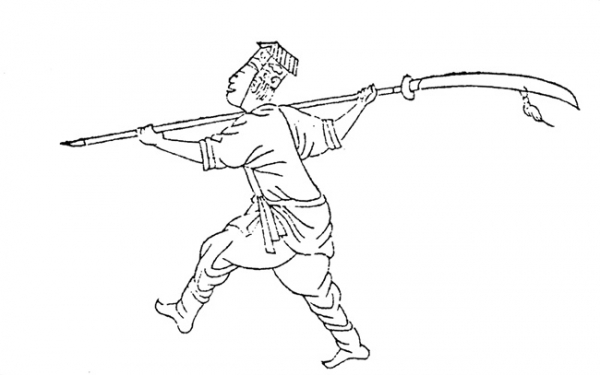
In the Muye Dobo Tongji, there is a martial art called 'Hyeopdo (挾刀).' Hyeopdo resembles a long haft with a narrow blade attached to it. Initially, Hyeopdo was disseminated under the name Hyeopdogon (夾刀棍). After the publication of Muye Jebo, the Muye Jebo Beonyeok Sogjip (武藝諸譜飜譯續集) was published in 1610 (the 2nd year of Gwanghaegun's reign) as part of reinforcing military martial arts, and it was recorded in this work.
This martial arts manual compiled martial techniques that had been continuously trained as warfare methods against Japanese invaders (御倭) during the Imjin War, such as quanfa (fist techniques) and Japanese swords, but had not been systematized in the specific form of techniques (譜). Additionally, as part of defensive strategies (防胡) to counter the militarily superior cavalry forces of northern enemies, large blade weapons such as Qinglong Yangyuedao (青龍偃月刀) and Hyeopdogon (夾刀棍) were added.
Hyeopdo retains the characteristics of Jangdo (長刀), an anti-cavalry weapon from the early Joseon period, which connects to the characteristics of Hyeopdogon and Gouchang (鉤槍), which became established for anti-cavalry purposes after the Imjin War. These were used to sever the legs of approaching enemy cavalry horses and to pull cavalry riders off their mounts with the hooks attached to the spear tips.
The core of Hyeopdo lies in two martial characteristics. First, Hyeopdo, like Hyeopdogon, centers on 'Ilza (一刺),' the basic spear technique of thrusting. The Hyeopdo forms were created by drawing motifs from spear techniques centered on thrusting.
Second, the intentional sophistication and bilateral symmetry of Hyeopdo forms that evolved after the 18th century. In particular, the unique characteristic of 'Eumyangshu (陰陽手),' which appears when using a long handle, appears regularly and symmetrically. This symmetrical characteristic can be viewed as an expression of modern body consciousness aimed at achieving balance in physical activities during form composition.
Bilateral symmetrical training represents a phenomenon that emerged through the establishment of modern body consciousness for balanced development of individual bodies. The body culture modernity can be observed in the Hyeopdo forms and training methods established in the late Joseon period. Through analysis of Hyeopdo postures, one can discuss the awareness and emergence of the so-called 'modern body.'
Among Hyeopdo postures, there is a posture called 'Ooryong Bawi Tae Sei (烏龍擺尾勢).' This movement is called 'Jwahoe Mi (左揮尾),' which involves swinging the mulgri (the end near the hilt) to the left and striking an opponent. This corresponds to the posture of withdrawing the thrust Hyeopdo and striking diagonally with the lower portion, the jun (hilt end). It pairs with 'Danphoong Jeon Shi Sei (丹鳳展翅勢)' at the rear (Jwahoe Mi / Ukhoe Yin). It resembles the motion of striking sideways with the rifle butt in bayonet technique. The 'Ooryong (烏龍)' appearing in this posture is a metaphor for a dog. Thus, when instructing Hyeopdo, I sometimes explain this as the 'dog's tail strike' posture.
Ooryong is the name of a loyal dog that appears in the story of Jang Yeon (張然) in the Chinese collection of tales Soushen Ji (搜神記). During the Qin dynasty in China, Jang Yeon lived in the Huiji region south of the Yangtze River (near Xiaohuang County in Zhejiang Province) and was conscripted for forced labor, leaving his home for an extended period. During his absence, his wife became involved with a slave. When Jang Yeon returned, fearing the discovery of this affair, the slave plotted his murder. Fortunately, a dog named 'Ooryong (烏龍)' that Jang Yeon kept threw itself in front of his master at the critical moment when the slave was attempting to kill him, thus saving his life.
After this, loyal dogs were called 'Ooryong (烏龍)' in China. For this reason, in other historical records, Ooryong symbolized a loyal dog. According to the section on 'Gou (狗)' in the Bencao (本草), it is said that in common parlance, dogs were called 'hwi' and 'yong.' Looking at volume 20 of Dongguk Isang Gukjeon Jipjip, the section on miscellaneous writings (雜著) and rhyming language (韻語), in <Instructions to Ban'ao>, dogs are described in this way:
'You have patterned fur, are you a descendant of Banho (槃縠—a character in mythology concerning the ancestors of southern ethnic groups living in China, the name of a fierce dog kept in the palace)? You are nimble and intelligent, are you a descendant of Ooryong (烏龍: the name of a loyal dog appearing in the Soushen Ji)? Your paws sound like bells, your snout is jet black, your joints are wide, and your sinews are taut. Your affection in yearning for your master is lovely, and your responsibility in guarding the gate is admirable. For this reason, I admire your courage and love your spirit, keeping you at home and raising you with favor. Although you are a lowly beast, you have received the essence of the Big Dipper, so in its brilliance and wisdom, which animal could equal you? Your master will give orders, so perk up your ears and listen. If you bark continuously without discipline, people will not fear you, and if you bite without discrimination, you will bring misfortune.'
Additionally, Bai Juyi (白居易: 772-846), a poet from the middle Tang dynasty, wrote, 'The black dog lies unalarmed (烏龍卧不驚), and blue crows fly in succession (靑烏飛相逐),' describing the appearance of a dog resting comfortably as the languid everyday life of a spring day.
-Cutting Cicadas on Moonlit Nights with Woldo
There is a martial art that stands shoulder-to-shoulder with Hyeopdo: Woldo. Woldo received its name from the shape of its blade, which resembles a crescent moon. Woldo was first trained in the Joseon military when it was disseminated by Ming forces during the Imjin War. Subsequently, during the reign of Gwanghaegun, it was officially disseminated to military camps when it was recorded in the Muye Jebo Beonyeok Sogjip (武藝諸譜飜譯續集).
Looking at Woldo in the first official historical records after the Imjin War, it appears in a memoir (啓文) from the 5th year of Injo (1627) regarding the reassignment of 6 instructors from the Hunryeondogam to the Eoyeongcheong to train them in martial arts. At that time, the Eoyeongcheong lacked talented personnel to teach new martial arts and found it necessary to bring instructors from the Hunryeondogam to train soldiers in the Eoyeongcheong.
The content is as follows:
The Eoyeongcheong reported, "On the 25th of this month, when Jo Lee Seo (李曙) held an evening audience, we received direct royal instruction to select strong men from among the Eoyeong forces and train them in the techniques of short weapons such as iron hammers (鐵椎), crescent polearms (偃月刀), and whip staffs (鞭棍). Upon withdrawal, we consulted with General Kim Jajŏm (金自點) and were about to commence instruction upon selection, but the techniques of crescent polearms and whip staffs necessarily require an instructor to teach. We request to exempt six capable instructors from the Hunryeondogam and reassign them, limiting their service to alternate training of soldiers until the military personnel are discharged." In this manner, the martial skill of Hunryeondogam soldiers was so superior during the late Joseon period that they were even dispatched as instructors to other military units.
Among the postures of Woldo, there is 'Wolya Chamson Sei (月夜斬蟬勢).' Translated directly, it means 'the posture of cutting cicadas on a moonlit night.' However, this posture is explained as 'striking twice with the right hand and left leg (以右手左脚 再叩).' Striking twice with Woldo refers to a movement of consecutive downward strikes.
Here, the cicada (蟬: seon) symbolizes regeneration or immortality. With Woldo, one strikes twice consecutively (再叩: jaegu) the cicada, an insect symbolizing regeneration (再生). An identical posture appears in whip staff forms, and it also features movement of striking or tapping twice (再叩).
Because cicadas undergo metamorphosis—nymphs emerge from the ground, shed their exoskeletons, spread their wings, and become adults—in Buddhism the cicada is primarily used as a symbol of 'liberation,' and in Taoism, as it sheds its shell and obtains a completely new body, it is accepted as a symbol of 'regeneration.' In Confucianism too, the cicada was regarded as a medium symbolizing virtue or integrity.
Particularly in ancient China, the cicada was understood to signify resurrection and regeneration, with jade cicada ornaments (玉蟬) being notably favored. Generally, the form worn on a hat is called a guan cit (冠蟬), those hung on or attached to clothing are called pei cit (佩蟬), and those placed in the mouths of the deceased to signify resurrection are called han cit (含蟬). These jade cicadas all carry meanings of regeneration and eternal life.
Thus, striking the regenerating cicada again is metaphorically embedded in the posture name. Understanding the culture of that time is necessary to comprehend the archetypal meaning of martial arts postures. Besides these, Japanese sword forms include 'Sansiyu (山時雨),' which instructs swift attacks like a sudden downpour in the mountains, and 'Yusŏngchul (流星出) Jwail-ta (左一打),' which instructs rapid, diagonal sword strikes like a falling star.
Thus, in martial arts postures, one can discern metaphor and analogy used in poetry. In a sense, is not our human life itself like a poem? Today, let us live as one would live a poem.