Kim Chung-young's Suwon Microscope (122) Hwaseong Royal Procession (2): Days 3-4, Rituals and Customs, Encouragement Events Held
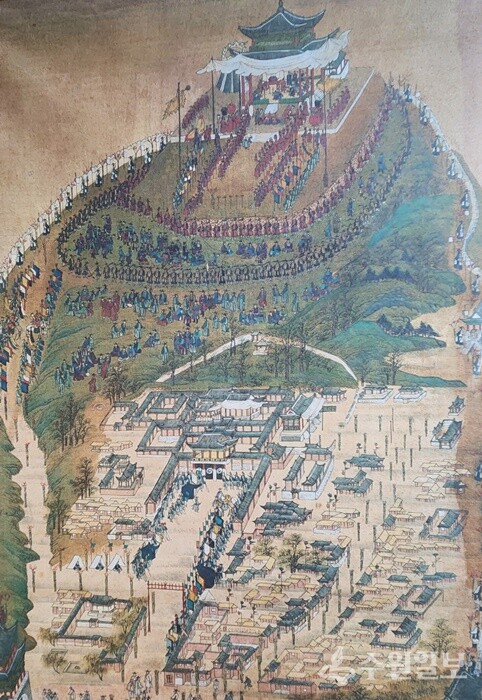
On the third day of the Hwaseong royal procession (Lunar February 11), planned events included, first, paying respects at the Daeseong Hall of Suwon Hyanggyo in the early morning; second, holding special civil and military service examinations; and third, conducting a dress rehearsal for the celebration banquet.
On the fourth day (Lunar February 12), events included paying respects at Hyungneungwon in the morning, daytime military training in the afternoon, and nighttime military training in the evening.
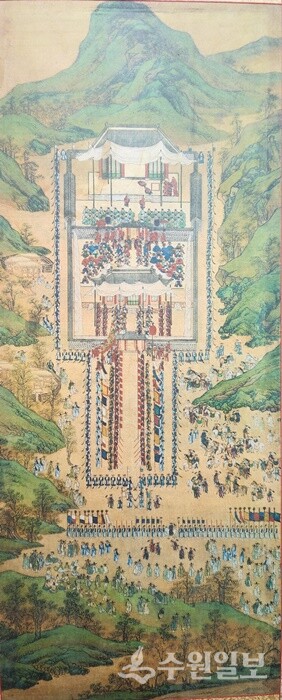
Lunar February 11 was the third day of the procession and the first day in Hwaseong.
King Jeongjo's first event in Hwaseong was to pay respects at the Daeseong Hall of the local confucian school. King Jeongjo, a scholar-king who loved learning, visited with the intention of promoting Confucianism. The Daeseong Hall housed spirit tablets of twenty-one Chinese sages from Confucius to Zhu Xi, and spirit tablets of fifteen Korean Confucian scholars from Seol Chong to Park Se-chae.
The visit to the Daeseong Hall took place in the early morning, around 5-7 a.m. (Myo Hour). As King Jeongjo left the temporary palace, he instructed Eastern Vice-Minister of Personnel Rhee Jo-won regarding preparations for the civil and military service examination to be held after visiting the confucian school.
Upon arriving at the confucian school, King Jeongjo paid his respects and inspected the interior. He then said, "The building is so dilapidated, the decorative paintings are peeling, and the chairs, tables, cushions, incense burners, and such are all in disrepair. Have them all repaired."
King Jeongjo asked the Confucian scholars present, "Did you all sit for today's examination? Or have your names been registered but do not meet the standards? Or have you come from other regions?" To which Western Vice-Minister of Personnel Rhee Ik-un replied, "There are 36 people in the courtyard, two of whom reside in Yongin and the rest in Hwaseong, but they did not take the examination due to having recently established residence."
King Jeongjo replied, "Whether from this region or another, whether registered or not, have all of them submit their credentials and take the examination. And write 'examiner from the confucian school' on the envelope." Thus he gave these candidates the opportunity to sit for the examination as well.
King Jeongjo returned to the temporary palace on horseback and proceeded to the examination hall for the special examination to be held during the Shin Hour (7-9 a.m.) at Nagnam Hall. The special examination was an arrangement to boost the morale of residents from nearby counties in celebration of Hyegyeongung's sixtieth birthday.
Eligibility for the examination was limited to Confucian scholars from Gwangju, Siheung, Gwacheon, and Hwaseong who were registered in the Confucian scholar roster and the confucian school register and whose names appeared on the household register. However, for Suwon residents, who were newer to the newly developed city, those who had not lived there long were also permitted to take the examination.
The examination question that day asked candidates to compose "Gyeongsang Cheoncheon Sesu Bu (a tribute wishing Hyegyeongung a long life)."
For the military examination, candidates were called forward one at a time to shoot arrows. Participants included 116 candidates from Hwaseong, Gwangju, Gwacheon, and Siheung who had passed the preliminary examination the previous day, 5 people from Gupo, and 16 military students from Hwaseong Prefecture whom King Jeongjo specially permitted to take the examination.
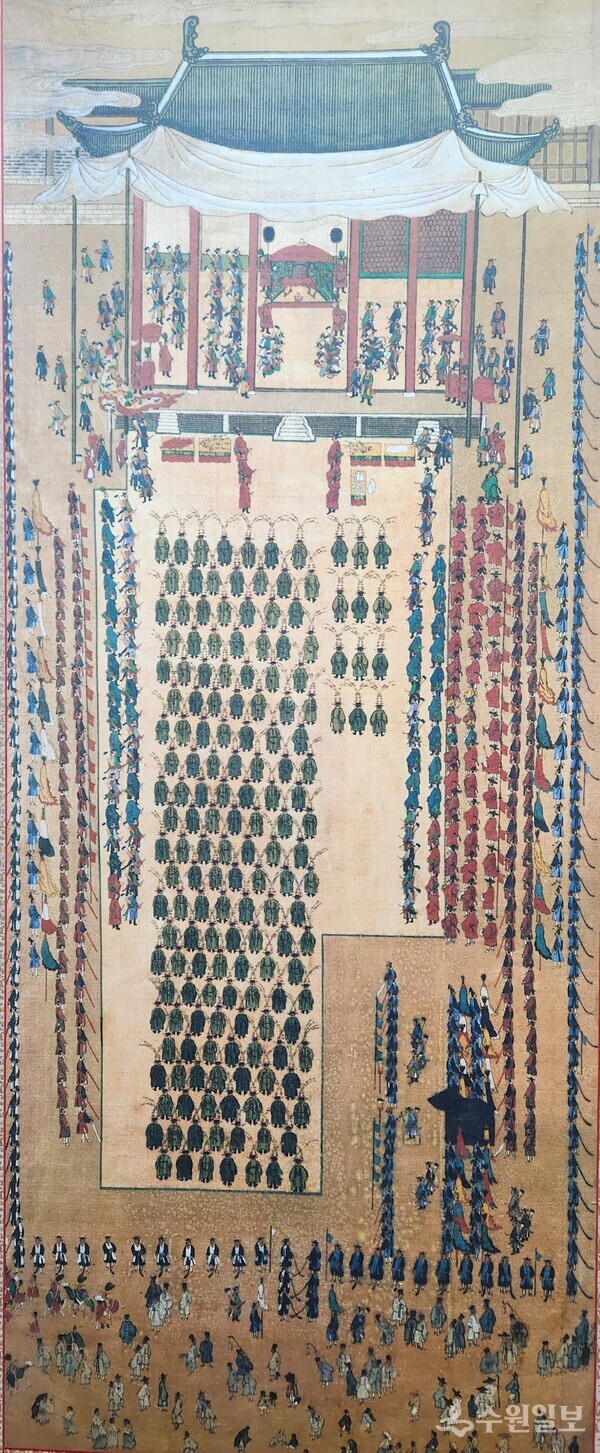
A total of 5 candidates passed the civil examination that day: in the highest rank, Saengyeon Choe Ji-sung from Hwaseong, 40 years old; in the second rank, Scholar Lim Jun-sang from Gwangju, 29 years old; in the third rank, Scholar Jung Soon-min from Gwacheon, 41 years old; Saengyeon Lee Yoo-ha from Siheung, 29 years old; and Jinsa Yu Sung-ui from Hwaseong, 33 years old.
A total of 56 candidates passed the military examination. In the highest rank was Chin-gun-wi Kim Gwan from Suwon, 37 years old; in the second rank were 5 candidates including Bu-sagwa Kim Chang-un from Gwangju, 34 years old; in the third rank were 50 candidates including Byeolmusa Song Deok-gwan from Suwon, 51 years old. These candidates were mostly soldiers belonging to the Jangyongwing, and the high pass rate helped boost their morale.
The announcement of civil and military examination passers, called Bangbang-ui (announcement of results), took place under King Jeongjo's presence, with credentials of passing such as hongpae (seal of passage), sagwa (gifted flowers), sajuya (gifted wine), bokdu (official crown worn by examination passers), and gwandae (official belt) being bestowed. Candidates in the highest rank were specially given a gae (a parasol-like flag).
The final event of that day was a dress rehearsal for the sixtieth birthday celebration held at Bongsudang. Since the birthday celebration was the main purpose of this procession, King Jeongjo, Hyegyeongung, and all participants engaged in the rehearsal. King Jeongjo's concern was that rather than selecting experienced kisaeng (female entertainers), they had selected seam workers and court physicians, and the female entertainers from Hwaseong were unfamiliar. After the rehearsal ended, Hyegyeongung gave various bolts of fabric as rewards to the female entertainers.
The fourth day, Lunar February 12 (the second day in Hwaseong). The first event of that day was scheduled to be a visit to Hyungneungwon, with two rounds of military training planned for afternoon and evening.
In the early morning of that day, King Jeongjo put on military garb and accompanied his mother to Hyungneungwon. The royal procession paused briefly for rest on the road in front of Sangryucheon Point. King Jeongjo offered his mother a rice gruel and instructed Shim Hwan-ji, who was both the royal pharmacist and Minister of Military Affairs, saying, "I notice mother's voice is uneven and she seems uncomfortable. Go ahead to the garden and have a bowl of samnyeong-cha (ginseng tea) prepared for mother and wait there." Upon arriving at Hyungneungwon and offering the samnyeong-cha to his mother, when she could not consume it due to her agitated state, he told her to wait a moment. As Hyegyeongung approached the tomb, profound sorrow overflowed and the sound of her weeping could be heard from outside.
How profound was the sorrow of seeing her son for the first time after he died locked in a rice chest at the age of 28? King Jeongjo offered the samnyeong-cha, but his mother could not consume it. King Jeongjo said, "When mother left the temporary palace, she promised to exercise restraint, but upon arriving here, her sorrowful heart has naturally burst forth. I feel the same way—how must mother's heart feel?" Upon reaching beyond the red-painted gate, he gazed at the tomb for a time and then ordered the return.
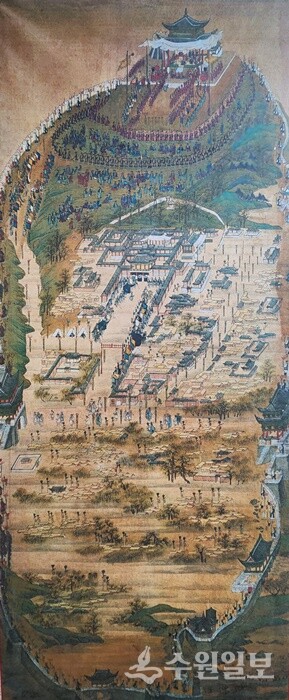
Military training was scheduled twice that day—during the day and at night.
Training conducted at the fortress is called Seongjo (城操), training during the day is called Jujo (晝操), and training at night is called Yajo (夜操). When King Jeongjo rode on horseback and ascended Seojangdae, Prime Minister Hong Nak-sung reported to him, "I have passed through this place on several occasions, but I did not know it was such strategically important terrain."
King Jeongjo received Hong Nak-sung's words and replied, "Protecting Wonchim is particularly important. We began this with careful budget consideration, but if we had not gained the advantage of geography, how could such a grand undertaking have been successful? I too was unaware of this."
Soon after King Jeongjo's orders were issued, military training began. Drums, trumpets, and metal instruments rang out, and fierce offensive and defensive maneuvers unfolded with war cries and cannon fire shaking the heavens. About 3,700 soldiers participated in that day's training.
That night, nighttime training was also conducted at the same location. For the nighttime training, torches were used, and residents within the fortress were instructed to hang a lantern each above their doors.
After the training concluded, King Jeongjo rewarded the soldiers with archery equipment and bolts of fabric. Through these training exercises, King Jeongjo was a true monarch who elevated the morale of his soldiers.
The 60th Suwon Hwaseong Culture Festival is being held in and around Suwon Hwaseong fortress with the theme of 'Suwon Dongnak (Water-harmony of Suwon)' from October 7-9, with various events in progress. We strongly encourage participation in the festival and careful consideration of King Jeongjo's intentions.