Kim Choong-young Suwon Microscope (122) Hwaseong Royal Inspection Tour (2) Days 3-4: 'Etiquette (禮)' and Custom, Encouragement Events Held
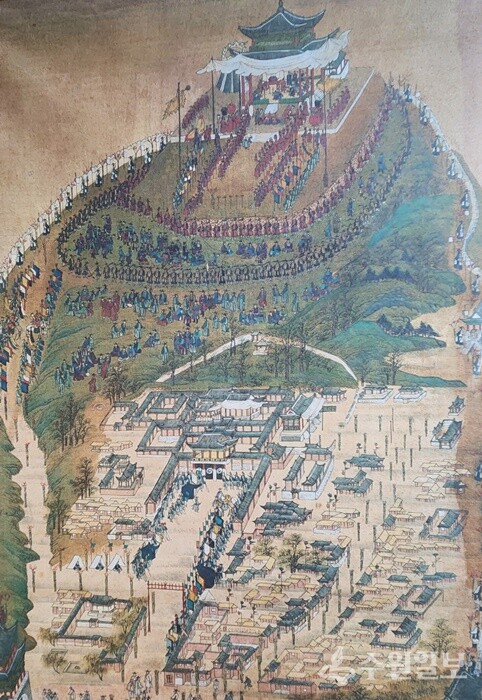
The events scheduled for the third day of the Hwaseong tour (Lunar February 11th) were: first, paying respects at the Daeseong Hall of Suwon Hyanggyo in the early morning; second, holding a special civil and military examination; and third, conducting a trial run of the state banquet.
The events on the fourth day (Lunar February 12th) included: visiting Hyungneung in the morning, daytime military training in the afternoon, and nighttime military training in the evening.
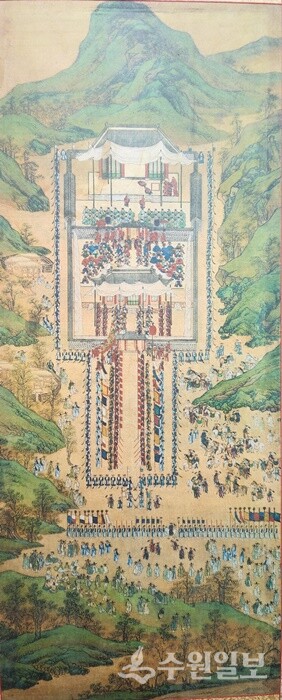
Lunar February 11th marked the third day of the tour and the first day in Hwaseong.
King Jeongjo paid respects at Daeseong Hall of the Hyanggyo as the first event in Hwaseong. King Jeongjo, who loved learning, visited with the intention of promoting Confucianism. In Daeseong Hall, the memorial tablets of 21 Chinese sages from Confucius to Zhu Xi and 15 Korean Confucian scholars from Seol Chong to Park Se-chae are enshrined.
The visit to Daeseong Hall took place in the early morning, during the Myo hours (5-7 AM). As King Jeongjo left the temporary palace, he instructed his deputy minister Lee Jo-won regarding preparations for the special examination that was to be held after visiting the Hyanggyo.
When King Jeongjo arrived at the Hyanggyo, after paying respects, he inspected the interior and said: 'The building is so dilapidated, the decorative paintings are peeling, and the chairs, tables, mats, and incense burners are all in poor condition. Have everything repaired.'
King Jeongjo asked the scholars there: "Did you all take the special examination today, or are you among those registered in the household register but not meeting the standard qualifications? Or did you come from another region?" The deputy minister Lee Ik-un responded: "There are 36 people in the courtyard, of whom two live in Yongin and the rest live in Hwaseong Province. However, since the year they built their houses was recent, they were unable to take the examination."
King Jeongjo said: "Whether from this region or another region, whether or not they are registered, let all of them be allowed to present their credentials and take the examination. And write 'scholars attending the temple affairs' inside the envelope." Thus, he gave them the opportunity to take the examination.
King Jeongjo rode back to the temporary palace and headed to the examination site at Naknamheon to hold the special examination during the Chin hours (7-9 AM). The special examination was a measure taken to boost morale among residents of nearby regions to celebrate Lady Hyegyeong's 60th birthday.
Eligibility to take the examination was limited to scholars from Gwangju, Siheung, Gwacheon, and Hwaseong who were registered in the Confucian scholar roster and the hyanggyo student roster and whose names appeared in the household register. However, for Suwon residents, who were in a new city, those who had not lived there for long were also permitted to take the examination.
The examination question that day was to compose 'A Poem Respectfully Presented Praying for Ten Thousand Lifespans for Lady Hyegyeong.'
For the military examination, examinees were called one by one to shoot arrows. These included 116 people from Hwaseong, Gwangju, Gwacheon, and Siheung who had passed the preliminary examination the previous day, 5 people from Gupo, and 16 special students from Hwaseong Province whom King Jeongjo had allowed to take the examination.
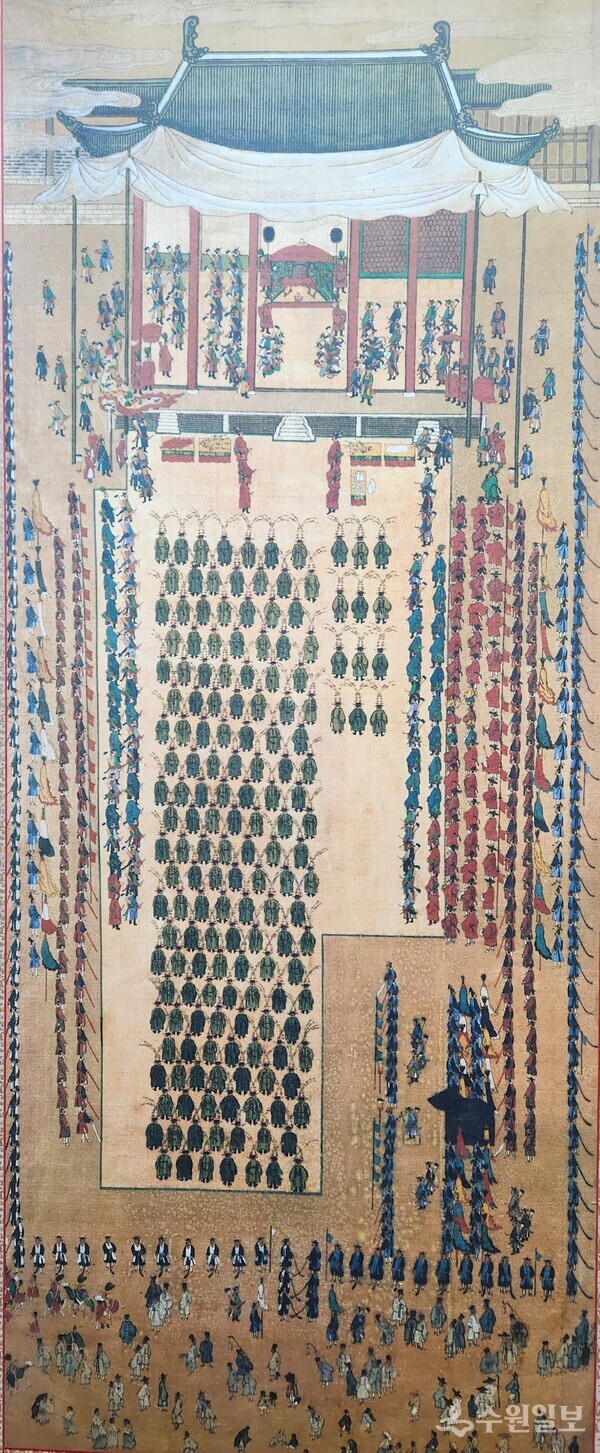
Five people passed the civil examination that day: First rank: Saengwon Choi Ji-seong (40 years old from Hwaseong), Second rank: Confucian scholar Lim Jun-sang (29 years old from Gwangju), Third rank: Confucian scholars Jung Sun-min (41 years old from Gwacheon), Saengwon Lee Yu-ha (29 years old from Siheung), and Jinsa Yu Seong-ui (33 years old from Hwaseong).
A total of 56 people were selected for the military examination. In the first rank: Qinyun Guard Kim Gwan (37 years old from Suwon); in the second rank: Inspector Kim Chang-un (34 years old from Gwangju) and 4 others; in the third rank: Special warrior Song Deok-gwan (51 years old from Suwon) and 49 others were selected. These were mostly soldiers belonging to the Jangryonggyeong, and their high pass rate helped boost their morale.
The announcement of successful candidates in the civil and military examination, called Bangbang-ui, was conducted under King Jeongjo's personal attendance, and gifts including 'Red certificates, flowers, wine, official caps, and regalia' were bestowed. The first-rank successful candidates were specially given ceremonial parasols.
The final event of that day was a trial run of the 60th birthday celebration held at Bongsudang. Since the 60th birthday celebration was the main objective of this tour, King Jeongjo, Lady Hyegyeong, and all participants took part in the trial run. King Jeongjo was concerned because skilled courtesans had not been selected, and besides the needlework specialists and court physicians, the female entertainers from Hwaseong Province were unfamiliar, causing worry. After the practice ended, Lady Hyegyeong gave various fabrics as gifts to the female entertainers.
The fourth day, Lunar February 12th (the second day in Hwaseong). The first event of that day was a visit to Hyungneung tomb, followed by military training twice—once in the afternoon and once in the evening.
In the early morning of that day, King Jeongjo, dressed in military uniform, accompanied his mother to Hyungneung. The royal procession rested briefly on the road in front of Sangnyu Cheonjeom. King Jeongjo served his mother a light rice gruel and ordered Shim Hwan-ji, the chief physician and Minister of Military Affairs, saying: "My mother's voice seems unsteady, which suggests she may not be well. Go ahead to Hyungneung and prepare a ginseng tea for my mother to drink and wait there." Upon arriving at Hyungneung, King Jeongjo offered ginseng tea to his mother, but as her spirits were not settled, he told her to wait a moment. When Lady Hyegyeong reached the tomb, her sorrow overflowed and her weeping could be heard outside.
It was the first time she faced her son after he was locked in the rice chest at age 28 and died. How overwhelming must her sorrow have been. Although King Jeongjo offered ginseng tea, she could not drink it. King Jeongjo said: "My mother said she would exercise restraint when leaving the temporary palace, but upon coming here, her sorrowful heart has erupted on its own. Even I experience this, so how must your heart feel?" Upon reaching outside the red railing gate, they gazed at the tomb for a while before returning.
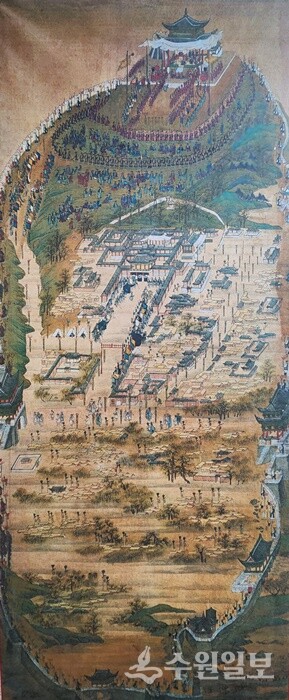
Two rounds of military training were scheduled for that day—one during the day and one at night.
Training conducted at a fortress is called fortress training, training during the day is called daytime training, and training at night is called nighttime training. When King Jeongjo rode up to Seo Jangdae, Prime Minister Hong Nag-seong reported to him: "I have passed through this place many times, but I did not know it was such a strategic stronghold."
King Jeongjo responded to Hong Nag-seong's words: "Protecting Hyungneung is particularly important. The construction was started with budgetary considerations, but if we had not gained the advantages of the geographic location, how could such a grand project have been completed successfully? I, too, did not fully realize this."
Soon after King Jeongjo's orders, the military training began. Drums, bugles, and signal horns sounded, and fierce offensive and defensive battles with war cries and cannon fire that shook the sky unfolded. About 3,700 soldiers participated in the training that day.
Night training was conducted at the same location that evening. Torches were used in the nighttime training, and residents were instructed to hang one lantern above their doors inside the fortress.
After the training ended, King Jeongjo distributed bows, arrows, and bolts of fabric as rewards to the soldiers. Through this training, King Jeongjo proved himself to be a true monarch who boosted his soldiers' morale.
The 60th Suwon Hwaseong Culture Festival is taking place from October 7th to 9th at Suwon Hwaseong with the theme of 'Suwon's Joy,' featuring various events. We strongly encourage participation in the events and contemplating the intentions of King Jeongjo.