Kim Chung-young's Suwon Microscope (123) Hwaseong Royal Progress (3) Fifth Day's 60th Birthday Banquet, Sixth Day Encouragement of Townsfolk and Participants
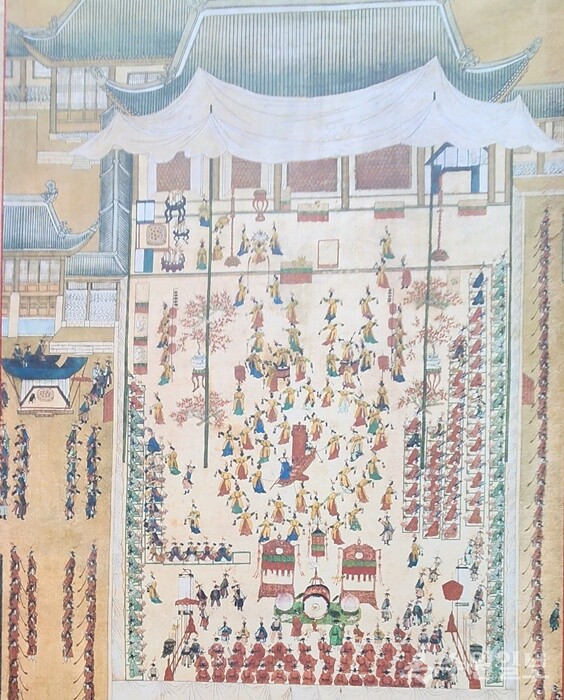
On the fifth day of the Hwaseong royal progress (lunar second month 13th), the highlight of the eight-day journey—the grand banquet ceremony (jinchanrye)—took place. On the sixth day (lunar second month 14th), the royal party organized a rice distribution event (sami) for the poor and a feast for the elderly of the region. This was followed by a tour of Hwaseong. In the afternoon, King Jeongjo held an archery competition with attending officials and offered words of encouragement. With this, the four-day itinerary in Hwaseong concluded.
The fifth day (lunar second month 13th) was the highlight of this progress—the 60th birthday celebration for the King's mother, Hyegyeongung Hong. The day was dedicated entirely to honoring the mother. The banquet began around 9 a.m. at Bongsudang.
A palanquin shelter was prepared in the Bongsudang courtyard, and seats for Hyegyeongung and King Jeongjo were arranged in front of the hall. Hyegyeongung's seat was laid with a lotus-patterned cushion, behind which stood a screen depicting the Ten Symbols of Longevity. King Jeongjo's seat was covered with a brocade cushion, with an ornately painted screen (jinchaebyeongpung) placed behind it.
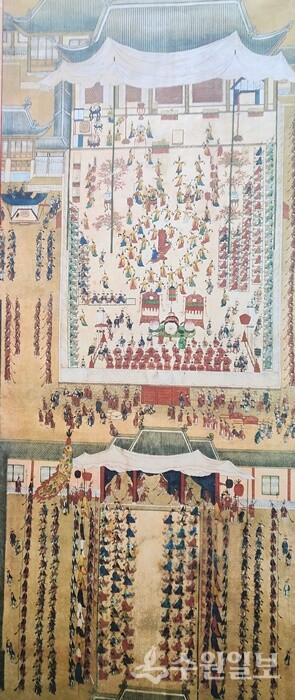
Trays bearing necessary items for the banquet were arranged, and articles to be presented to Hyegyeongung were set in place. Female officials (yeogwan), female attendants, and female musicians entered first and waited. Then Uibin, relatives by marriage, and accompanying officials dressed in military attire took their positions. The inner and outer court ladies stood in their places. Once the seating was arranged, the female officials informed Hyegyeongung that preparations were complete.
As Hyegyeongung and King Jeongjo appeared, the music Yeominnak was played. When they took their seats, incense rose and the music stopped. A handkerchief was presented to Hyegyeongung, and after the ceremonial offering of food and flowers, all bowed. King Jeongjo then presented a cup and offered congratulatory remarks (chisa). Hyegyeongung responded with a royal pronouncement (seonji): "Together with Your Majesty, I share in this auspicious occasion," and drank from the cup.
King Jeongjo went to the prostration area and performed three kowtows (ketou) of reverence, then sang "Cheonse cheonse cheoncheonse" (Long live, long live, forever long live). All participants joined in. King Jeongjo returned to his seat. A handkerchief, congratulatory remarks, and flowers were presented to him as well. Food and flowers were distributed to all participants, and dance and music performances ensued. After the trays were cleared, King Jeongjo and the participants went again to the prostration area, bowed to Hyegyeongung, and withdrew.
After the banquet concluded, King Jeongjo summoned all the Prime Minister and officials of the bureau to address them. He spoke to Chief State Councillor Hong Naksong and others: "From my youth, I have prepared for several years, and today's grand banquet is the fruit of that preparation. The weather is clear and my mother's health is robust—how can I adequately express this joy and auspiciousness?" He then ordered that food and flowers be distributed to all officials.
He had the scribes and various officials brought in, and instructed Haengjwa Seungji Mansu to compose a royal poem, commanding the attending officials to write poems in response.
He continued: "Today's ceremony is truly an auspicious occasion occurring once in a thousand years. My mother will reach her seventieth birthday in the coming year of Gapja. Let us await this repeated blessing ten years hence."
On the sixth day (lunar second month 14th), the Hwaseong royal progress had scheduled rice distribution to Hwaseong residents, a feast for the elderly in the morning, an inspection of Banghwasuryu Pavilion in the afternoon, and archery at Deukjung Pavilion in the afternoon.
For the rice distribution to Hwaseong residents, recipients were pre-selected. These included the four classes of people (samin)—widowers, widows, orphans, and those without descendants—and the destitute in need of relief (jinmin). Rather than distributing rice from a single location, it was distributed from four sites. In the city area, King Jeongjo personally visited Sinpungru Pavilion at the temporary palace to oversee the distribution (sami). In surrounding areas, secretaries were dispatched to regional granaries and storage facilities to distribute rice.
Of Hwaseong's population of 60,000, one-tenth—368 households—benefited from this distribution, demonstrating that it was not merely symbolic. King Jeongjo took his seat on the second floor of Sinpungru Pavilion. He instructed Dongbu Seungji Yi Jowon: "Go down and distribute the rice and gruel equally, and inform them that this rice and gruel carry my mother's will." King Jeongjo called for the gruel to be brought to him to verify it was warm, not cold.
King Jeongjo then addressed Haengjwa Seungji Yi Mansu: "Today's feast for the elderly is to show respect for the aged, so the elderly should not have to wait long outside. I will go to Naknamheon, and you remain here. When the common people arrive and wait, serve them gruel one by one. Should any arrive late, ensure they too do not receive cold gruel." In this manner, King Jeongjo's love for his people was profound.
The second event was a banquet in honor of the elderly.
Since the eight-day Hwaseong progress was dedicated to celebrating his mother's 60th birthday, it was necessary to honor the region's elderly. The invitation list for the elderly feast included State Councillor Hong Naksoon and fourteen other elderly officials from the capital, along with 384 elderly residents of Hwaseong.
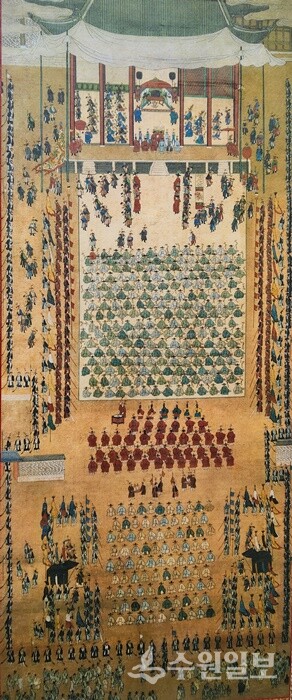
When the drum signaling completion of preparations sounded, King Jeongjo, dressed in military attire, emerged and sat at Naknamheon. The elderly officials from the capital, leaning on their staffs, ascended to the raised platform. Those of rank two and above were seated within the columns, while those of rank three and below sat on the steps. The remaining elderly, supported by their descendants, were seated below the steps.
King Jeongjo distributed yellow silk handkerchiefs to be tied to their staffs and gave each a bolt of silk. He then had food brought out and ordered musical entertainment. King Jeongjo displayed his poem and had the participants compose poems in response. He instructed that even those living in Hwaseong but not registered be invited. He ordered that wine and food be served to any elderly visitors. When Chae Jegong noted that half of the gathering appeared to be elderly, King Jeongjo replied that for auspicious occasions, more people are always better. When the officials distributed food to them as well, they shouted "Cheonse" (long live).
King Jeongjo took time to carefully tour Hwaseong.
As the scheduled events neared completion, King Jeongjo found time for leisure. He visited Banghwasuryu Pavilion, Hwaseong's most beautiful structure. This location, harmonizing with Jangan Gate, Hwahong Gate, Yucheon Stream, Yongryeon Pond, and Gwanggyo Mountain, presented a poetic vista in normal times, while strategically serving as a key defensive position in Hwaseong's northeast.
Moreover, the pavilion's floor plan is swastika-shaped (manjahs), and its roof, which turns three times while converging toward the center, creates a spire-like form, making it architecturally distinctive. Standing there, King Jeongjo, moved with deep emotion, said: "Had the Jangnyong Guard not worked with utmost sincerity, how could this have been achieved? It is because of this excellent commander that my heart is filled with joy."
The final event of the Hwaseong progress was archery, with King Jeongjo and attending officials scheduled to compete at Deukjung Pavilion. King Jeongjo excelled not only in scholarship but also in martial arts and archery. Archery was not merely a martial skill; it was also a method of spiritual cultivation requiring focused concentration.
On this day, King Jeongjo was the clear victor in archery. While officials may have deliberately yielded, King Jeongjo's archery prowess was genuine. However, he displayed humility, saying: "Though archery is counted among the Six Arts (yugyae) of the Zhou dynasty—namely rites, music, archery, horsemanship, calligraphy, and mathematics—it remains a skill (gi). As I have not practiced for four years, today's accuracy is mere chance."
When King Jeongjo saw the elderly statesman Hong Naksoon, he offered encouragement: "For you to strike three targets at your advanced age of eighty is truly rare." King Jeongjo then served dinner to his officials. After the meal, as the sun set, he ordered preparations for night archery. Small targets were set up with torches positioned on either side. King Jeongjo shot twice and struck five targets.
After the archery concluded, fireworks were set off at Deukjung Pavilion. With the archery at Deukjung Pavilion, all events in Hwaseong came to an end.
The four days of activities in Hwaseong were, as King Jeongjo himself said, a fulfillment of "cheonjae-ilui-jihoe" (千載一遇之會)—an encounter occurring but once in a thousand years.
We invite you to meet King Jeongjo and experience this "cheonjae-ilui-jihoe" (千載一遇之會) at the Hwaseong Culture Festival.