Kim Chung-young's Suwon Microscope (124) The Journey Home to Hanyang: Days 7-8 of the Hwaseong Royal Procession
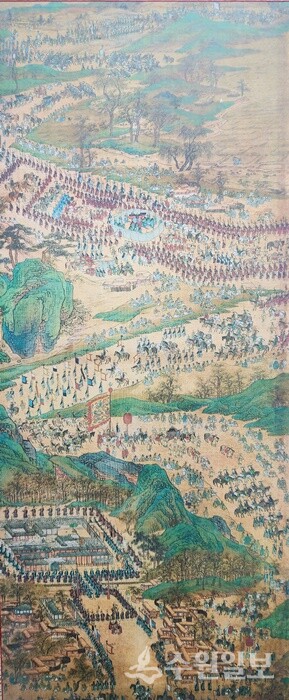
The seventh day of the Hwaseong royal procession had arrived.
The four-day events in Hwaseong concluded with archery at Deukjung Pavilion. Now remained the return journey to normalcy. The return route followed the same path as the outbound journey, but in reverse order.
As King Jeongjo departed Hwaseong Palace in the morning during the hour of Shenshi (辰時, 7-9 a.m.), he issued orders.
"In Gwangju, Siheung, and Gwacheon, reconnaissance and ambush troops have been waiting for many days, which concerns me. After the royal procession passes, have the Sueocheong and Jongyungcheong relay orders via messenger arrows to gradually withdraw the reconnaissance and ambush troops."
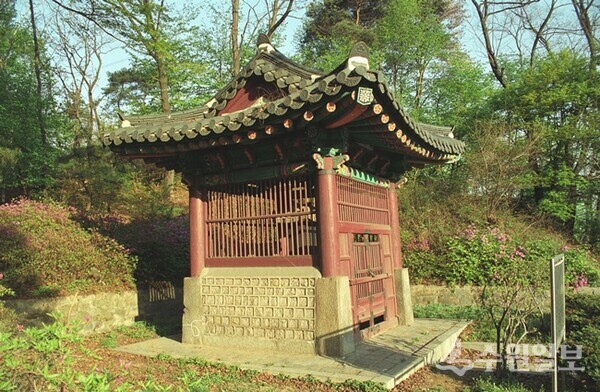
The procession then arrived at Mireuk Peak (Jijidae Pass). Upon arriving, Hyungsungwon was not visible. King Jeongjo ordered his attendants: "Whenever I reach this Mireuk Pass, I cannot bear to leave and I pause the procession, gazing southward for a long while. Unknowingly, I wander on horseback. This time, looking at the top of the pass, I saw a round stone formation. Name that place 'Jiji (遲遲),' meaning reluctance to depart. And henceforth, place a stone marker beneath Mireuk Peak with the three characters 'Jijidae' inscribed upon it." From this time forward, the pass became known as "Jijidae Pass."
Around midday, the procession arrived at Sageun Sineom Palace. King Jeongjo arrived before his mother and summoned Gwangju Governor Seo Mi-su, Siheung County Magistrate Hong Gyeong-hu, and Gwacheon County Magistrate Kim I-yu to inquire about the ills and hardships of the local regions.
When Hyegyeong Palace's palanquin arrived, she was escorted inside and lunch was served. After the meal, the procession resumed. Upon reaching Anyang Bridge, they rested briefly and the King offered rice gruel to his mother. The procession then arrived at Siheung Palace. King Jeongjo arrived first, inspected the facilities, then escorted his mother inside and served dinner. The types of food were identical to those when traveling to Hwaseong.
On the eighth day (lunar second month 16th), as the procession departed Siheung Palace in the morning during the hour of Mao (卯時, 5-7 a.m.), King Jeongjo made remarks.
"Local officials should gather the elders and common people from their jurisdictions and await us along the royal procession route." This was his desire to hear the opinions of the common people directly. At 6:45 a.m. (Mao Jeong Samgak, 卯正三刻), the procession departed Siheung Palace.
As the procession reached the road before Munseong-dong, Siheung County Magistrate Hong Gyeong-hu appeared with the common people to greet the royal palanquin. King Jeongjo paused and spoke.
"It is customary that wherever the royal procession passes, we bestow royal favors. Today, having traveled with my mother and spent the second night at Siheung Palace, all proceeded in perfect safety. Thus, I cannot help but be gratified. How could I be stingy toward the people? I shall certainly reduce the corvée labor, eliminate the chronic hardships, and widely extend maternal benevolence to fulfill the wishes of the people. If any of you have grievances to express, speak without hesitation."
In response to King Jeongjo's invitation, the common people began to speak.
"Fortunately, we live in a wise and enlightened age, and nothing—from what we wear to what we eat—is without Your Majesty's grace. There is nothing of particular concern requiring the royal ear."
Upon hearing this, King Jeongjo remained skeptical. He pressed them further.
"Such words are mere courtesy to one's superiors. All of you, as my subjects, constantly lament that imperial benevolence has not reached you sufficiently. Moreover, being deep within the nine-layered palace, I cannot fully understand the ailments and hardships of the common people. Thus, I have summoned you before my palanquin to give you the opportunity to speak your minds. Rather than being unable to hear what I wish to hear regarding the various grievances, I have come here to listen directly so as to fulfill the wishes of the many people who look upon this procession with hope. Now that you have the opportunity to speak, what cause for fear prevents you from doing so?"
Haengwu Seungji Yi Ik-un relayed King Jeongjo's words to all the people and reported their sentiments to the King.
"The common people report that they have no pressing chronic hardships. However, they mention that they have suffered grievances from being conscripted twice for corvée labor levies."
King Jeongjo instructed Bibyeonsa Council Member Yi Si-su to widely announce his will to the people.
"While it may be difficult to extend extraordinary benevolence at other times, how could there be no special consideration this year? Regarding the grain loan collection from last autumn that I have already ordered postponed, it shall now be completely remitted. For corvée labor, the Bibyeonsa shall work with provincial and local officials to devise methods to reduce grievances and labor. Furthermore, every year when the King travels in the first month, the common people have labored not insignificantly to clear the snow from the procession route and maintain the roads. From this year onward, I have designated the dates for royal processions to coincide with spring and autumn leisure seasons for farming. This too comes from my concern for the people. Henceforth, detailed reports on the people's conditions shall be collected with each procession passage. Be well aware that if there are matters requiring correction of grievances, you shall inform us."
Upon hearing King Jeongjo's words, all the people offered blessings and withdrew. At this moment, one person requested food. King Jeongjo instructed Yi Ik-un to inquire about his age, which was reported to be sixty-one. King Jeongjo remarked, "Though the man's behavior is presumptuous and his manners are wanting, having already inquired about his age, how could I simply send him away? Grant him his wish and give him several measures of rice."
After concluding their rest at Munseong-dong, the procession resumed its journey. Upon reaching Beondaebang Plain, King Jeongjo again rested and offered rice gruel to his mother. The procession then proceeded via Manan Pass and arrived at Noryang Palace. King Jeongjo escorted his mother to Yongyangbongjeo Pavilion and served lunch.
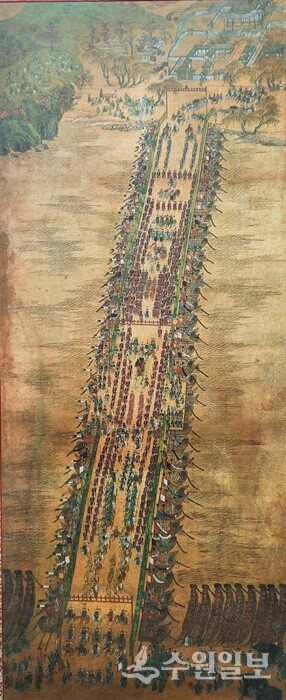
King Jeongjo summoned Yi Heung-un, who managed the pontoon bridge (Jusyo Docheong), granted him a gold silk cloth that Hyegyeong Palace had presented, and bestowed differentiated rewards upon the boatmen who had constructed the bridge. He also presented provisions to the officials at Noryang.
King Jeongjo addressed his officials: "The eight-day procession has been arduous. My mother's health and vigor remain steadily strong, and as we now return, I cannot contain my joy."
Chief Archivist Sim Yi-ji remarked, "The rain on the tenth day lasted only half the afternoon, and the rain on the fourteenth day came after the banquet… We can see that even Heaven rejoices."
King Jeongjo spoke: "The Crown Prince has been sending letters twice daily since the day I departed the palace, conveying his regards… " He then showed two letters from the Crown Prince. The first expressed congratulations on his grandmother's sixtieth birthday celebration and the banquet for the elderly, and the latter conveyed the Crown Prince's great joy at being able to see his father today. The officials read the letters and offered congratulations. The Crown Prince was six years old at that time; five years later, when King Jeongjo passed away, the Crown Prince ascended the throne as King Sunjo (純祖).
King Jeongjo summoned Seo Yong-bo, the chief director of the Han River pontoon bridge construction (Jusyo Dangshang), and ordered: "Tomorrow, dismantle the bridge and send the boats downstream so the boatmen are not delayed." The pontoon bridge was dismantled the following day as King Jeongjo commanded—on the lunar second month 17th—twenty-three days after its construction.
The eight-day magnificent Hwaseong royal procession had concluded.
Thus was recorded the history of a "rare meeting once in a thousand years (千載一遇之會)" that happens perhaps only once in an age.