Kim Chung-young's Suwon Microscope (125) The Story of Building Suwon Hwaseong Fortress
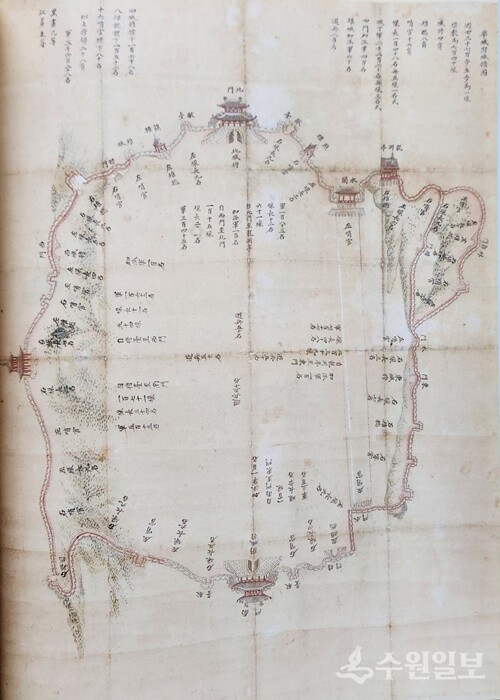
The idea of building fortress walls in Suwon began with a memorial from Vice Minister Kang Yu on June 10, 1790 (the 14th year of King Jeongjo's reign). He argued for the necessity of a walled town to make Suwon a strategic military location and to protect the tomb of Crown Prince Sado.
Eight days after Kang Yu's memorial, on June 18, King Sunjo was born. Then on January 22, 1791 (the 15th year of King Jeongjo's reign), Minister of Personnel Shin Ki-kyung argued that "a fortress wall must be built for the prosperity of Suwon and the defense of the capital."
In response to this series of events, King Jeongjo decided to construct fortress walls in the new township. Jeongjo instructed Jeong Yak-yong to establish a fortress construction plan. Accepting the basic plan developed by Dasan, it was announced as the 'Eoje Seonghwa Juyak (Royal Decree on Hwaseong Construction).'
This plan presented eight matters, including information about the scale and materials. The scale of the fortress was set at 3,600 bo with a height of 2 gi and 5 ja. Subsequently, on January 14, 1794, King Jeongjo visited Suwon to inspect the fortress site. Upon seeing the flag markers (giyo) placed to establish the site pass through residences in Bukli (North Village), he said, "This harms human harmony."
King Jeongjo instructed that the fortress site be moved further back and new flags be erected, creating a winding shape resembling a willow leaf. As a result, the fortress circumference expanded from 3,600 bo to 4,600 bo.
There were differing opinions on materials as well. Using bricks would face technical shortages and difficulty obtaining firewood. Using earth had the disadvantage of being weak, so ultimately stone was chosen as the material, resulting in a stone fortress.
This decision reflected the experience of Suwon Prefect Cho Sim-tae, who was in charge of constructing the Hyungnyung Tomb and the new township.
Stone veins were found in two locations at Sukjishan in Gongseok-myeon, two locations at Yeogisan, and in Gwondong. Additionally, while clearing the fortress site at Paldal Mountain, a stone vein was discovered on the left ridge.
When stone veins were discovered at Sukjishan and Yeogisan in Gongseok-myeon one month before construction began, Chae Je-gong reported to King Jeongjo with great emotion: "I believe the Divine has kept these stones hidden and waited for this day, all because Your Majesty's filial piety has moved Heaven."
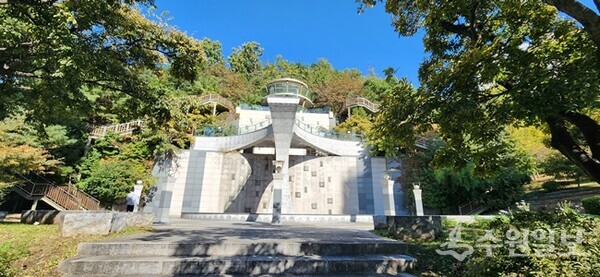
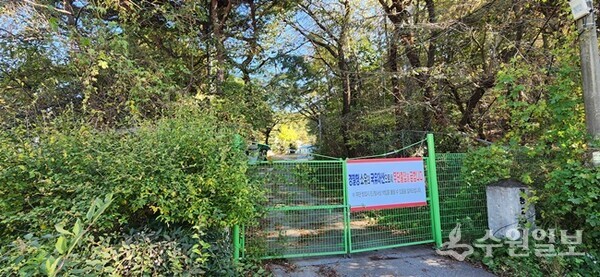
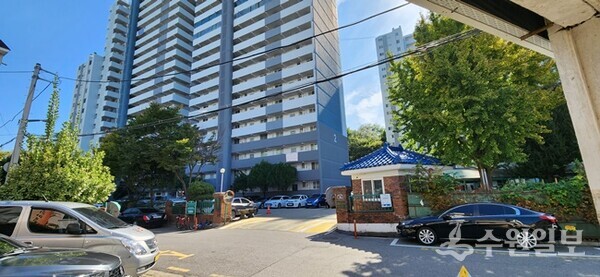
The total number of stones quarried for construction was approximately 187,600 blocks: 81,100 from Sukjishan, 62,400 from Yeogisan, 30,200 from Gwondong, and 13,900 from Paldal Mountain.
Once stone veins were discovered, skilled craftsmen had to be secured. At the time, craftsmen worked either for government agencies as official craftsmen (gwanjang) or as private craftsmen (sajang).
On December 6, 1793, the Bibyeongsa (State Council for Military Affairs) sent official letters to various Seoul government agencies including Jangnyongyeong, Hunryeondogam, Geumwiyeong, Eoyeongcheong, Sueocheong, Yongohyeong, Jongyungcheong, Naesusa, Seongonggam, Sanguiwon, Gongjo, Jungbu, Dongbu, Seobbu, Nambu, Bukbu, and Waseo (瓦署), instructing that since construction of Hwaseong Fortress was beginning, the allocated craftsmen could not be transferred elsewhere.
Hwaseong construction began in earnest on January 7, 1794, with the start of stone quarrying. The Hwaseong fortress construction project involved 372 people from the Hwaseong Construction Bureau and 1,821 artisans from 22 crafts, totaling 2,193 workers.
The most significant portion of Hwaseong construction was the work of building fortress walls.
Stone-related work included quarrying at the quarry sites (buseokso), dressing stones, transporting stones, and building walls. As a result, stonemasons (seoksu) numbered 642 out of the 1,821 total craftsmen, accounting for 35.2%.
Examining the origins of the 642 stonemasons, 209 participated from Seoul, of whom 153 were official craftsmen affiliated with government agencies and 56 were private craftsmen. 173 participated from Gyeonggi Province, 53 from Chungcheong Province, 17 from Gangwon Province, 74 from Hwanghae Province, 41 from Jeolla Province, 23 from Gyeongsang Province, and 52 from Pyeongan Province. A total of 381 craftsmen (59%) from Seoul and Gyeonggi Province participated.
The price of fortress stones was determined by size. Large fortress stones with a back length of 3 ja and 5 chi and one side of 2 ja cost 8 jeon, medium stones with a length of 3 ja and one side of 1 ja and 8 chi cost 5 jeon, and small fortress stones with a length of 2 ja and 8 chi and one side of 1 ja and 5 chi cost 3 jeon.
Besides fortress stones, specially-purpose fan-shaped stones (seondanseok) were made of large, rectangular stones. Large fan-shaped stones with a length of 5 ja and 2 chi, width of 4 ja and 1 chi, and height of 4 ja cost 15 nyang. High-value arch stones (hongyeseok) used for arches measured 5 ja and 1 chi in length, 2 ja in width, and 2 ja and 7 chi in height, costing 12 nyang.
The Hwaseong Construction Record also documents the characteristics of stones by quarry location. Sukjishan stones were strong with fine grain, Yeogisan stones were soft and rough, Gwondong stones were similar to Yeogisan but with finer grain, and Paldal Mountain stones were stronger than Sukjishan but coarser than Yeogisan.
Beginning with stone quarrying on January 7, Gapinnyeon (1794), Suwon Hwaseong construction commenced. The original estimate was that construction would take 10 years. However, performance-based compensation systems were introduced in various areas, and standards were established for stone quarrying and transportation, allowing unit prices to be determined, which shortened the construction period.
The Hwaseong construction took 34 months total, but with a 6-month break in between, the actual construction period was 28 months, completing on September 10, 1796.
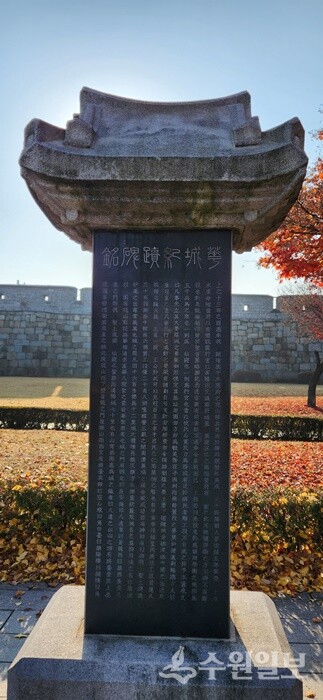
Kim Jong-soo, who composed the 'Hwaseong Achievement Monument Inscription (華城紀蹟碑文, a record of the circumstances of Hwaseong's construction),' inscribed: "While there was divine assistance, King Jeongjo's brilliant planning and management methods were ten thousand times superior to ordinary practice."