Chim Young's Suwon Microscope (127) Suwon Developed Through the Meeting of 'Auspicious Land' and 'Talent'
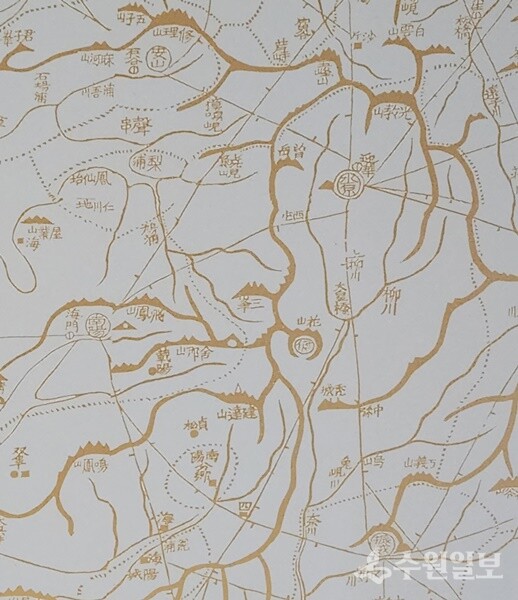
Suwon is geographically situated in a favorable location. Moreover, it developed by meeting with outstanding talent.
First, Gwangyosan, the main peak of the Hannam Jeongmaek originating from the Baekdudaegan, created Mount Hwasan on the land vein. Suwon's old township of Mount Hwasan was called the finest auspicious land in Joseon, surrounded by 800 mountain peaks.
The mountain range of Suwon originating from Gwangyosan encloses from east to west, forming a basin. Due to this, Suwon formed a single watershed system, a topography where water from other regions does not flow in. In other words, by only handling water from its own land, it is not affected by surrounding areas and became a city safe from water.
Second, Suwon is geographically located at the gateway to the capital Seoul. In 1794 (the 18th year of King Jeongjo), Hong Yang-ho, Minister of Rites and Chancellor of the Gyeongmun, expressed in the upper beam inscription at Jangansang Gate: "Hwaseong is a great capital city that must be protected. The land has its back to the sea and faces the Han River, situated at the boundary thirty li south of Seoul, pulling in Yeongnam and pressing down Honam, with great roads connecting in all directions." This clarified that Suwon was geographically a strategic location.
In feng shui, the burial site of the deceased is called yin residence, and the homestead of the living is called yang residence.
Ki Ja-heon, Left State Councillor during the reign of King Seonjo, was the person who recognized Suwon as an auspicious land. Ki Ja-heon said that King Seonjo's tomb should be placed at Mount Hwasan in Suwon. During King Hyojong's reign, Yun Seon-do likewise said that Mount Hwasan in Suwon was the best location for King Hyojong's tomb. Banggye Yu Hyungwon said that for Suwon to develop, if the township were moved to the foot of Paldal Mountain in Bukpyeong, it could eventually develop into a major metropolis with ten thousand households.
It was the great king Jeongjo who recognized Suwon's outstanding geographical advantage. The person representing King Jeongjo's sentiments was Geumseong-wi Park Myeong-won. At a royal conference on July 11, 1789 (the 13th year of King Jeongjo), he submitted a memorial stating that Your Highness's lack of royal sons was because Yeonguwon, the tomb of Crown Prince Sado, was an inauspicious location, and thus it must be relocated to an auspicious land.
King Jeongjo accepted their arguments and captured all of Suwon's geographical advantages. He placed his father Crown Prince Sado's tomb at an auspicious yin residence, built a new township at an auspicious yang residence, and constructed a fortress. To carry this out, he employed the finest talents of the time.
He entrusted Jeong Yak-yong with the design of Hwaseong and had him establish the basic plan for the fortress construction. He appointed Chae Je-gong as Prime Minister overseeing Hwaseong's construction and the first governor of Hwaseong, entrusting him with overall responsibility for the construction of Yeonguwon, the new township, and the fortress. Jo Sim-tae was appointed as the governor of Suwon Prefecture and took charge of the practical work for the construction of Yeonguwon, the new township, and Hwaseong. Through employing these talents, King Jeongjo achieved the construction of Yeonguwon and Hwaseong that would be remembered throughout history.
King Jeongjo ordered: "The history we have accomplished is not a private matter, so record it in detail for it to serve as a lesson to posterity." At that time, records of the construction of Yeonguwon, records of the making of Hwaseong, records of the sixtieth birthday celebration of Empress Hyegyeong were left, along with many records such as the 'Hongjaejeon-seo' and the 'Seungjeongwon Ilgi'.
Those who participated in the construction of Yeonguwon, the new township, and Hwaseong also left many records. Jeong Yak-yong's 'Yeoyudang Jeonseo', Chae Je-gong's 'Beonam-jip', and Jo Sim-tae's 'Suwon-bu Haji Choro' are examples. Apart from these, many who served as governors of Suwon left collections of writings and artifacts.
Hwaseong, constructed through favorable geographical conditions and the efforts of outstanding talents, fell into ruins through the Japanese colonial period and the Korean War. Congressman Lee Byeong-hui found this regrettable. He included the Hwaseong restoration project in the national historic site restoration project promoted as a key undertaking by the Park Chung-hee government.
He judged that the Gyeonggi Provincial Government would become a driving force for Suwon's development and achieved the relocation of Gyeonggi Provincial Government to Suwon in 1963. In 1969, he attracted Samsung Electronics and subsequently brought Sungkyunkwan University to Suwon. This became the cornerstone of Suwon's development.
Subsequently, Shim Jae-deok, director of the Suwon Cultural Center, took interest in Hwaseong and engaged in activities. When Gyeonggi Provincial Hospital (Suwon Medical Center), located at the site of Hwaseong Haenggung Palace, decided to build a modern building there, he established a committee for the restoration of Hwaseong Haenggung Palace.
He persuaded Lim Sa-bin, the provincial governor, to relocate the Gyeonggi Provincial Hospital next to the tobacco factory. As the first popularly elected mayor, he devoted himself to the restoration of Hwaseong Haenggung Palace. He subsequently focused on registering Hwaseong as a UNESCO World Heritage Site.
With utmost dedication, he brought the 2002 World Cup matches to Suwon. In doing so, he said he could not show foreign tourists embarrassing restrooms, and thus devoted himself to a restroom culture movement. This was a remarkable achievement that transformed restroom culture in the Republic of Korea at once. This activity became the catalyst for pursuing a global restroom culture improvement movement beyond Korea.
Suwon is a region with outstanding geographical advantages. In Suwon, outstanding leaders like King Jeongjo of the Joseon dynasty and talented individuals such as Prime Minister Chae Je-gong of Beonam, Hwaseong Governor Jo Sim-tae, Congressman Lee Byeong-hui, and Mayor of Suwon Shim Jae-deok exercised outstanding wisdom at critical turning points.
Suwon has grown into a major city that surpasses the population of Ulsan, a metropolitan city nationwide.
However, today's Suwon has narrower administrative boundaries compared to adjacent cities. It is now a time when role-sharing is needed with adjacent cities like Yongin, Hwaseong, Osan, and Pyeongtaek, which are growing into major cities. Strategic approaches in administration, education, cultural tourism, and research and development are necessary. It is time to take the outstanding wisdom of our ancestors as a lesson.