Kim Choong-young Suwon Microscope (127) Suwon Developed Through the Convergence of "Propitious Land" and "Talented People"
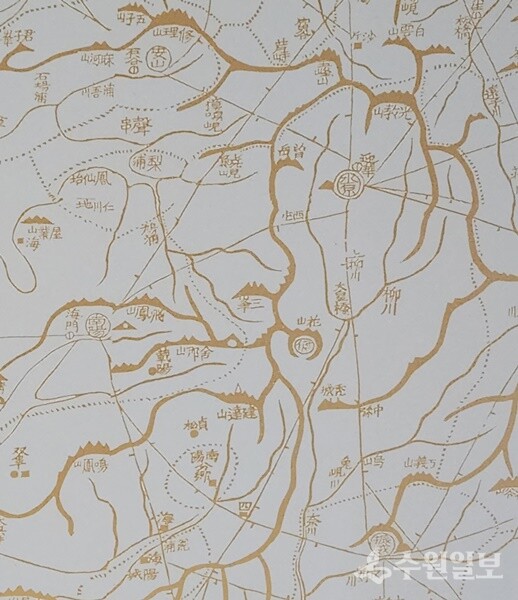
Suwon is located in a geographically favorable place. Moreover, it developed by meeting outstanding talented people.
First, Gwanggyo Mountain, the main peak of the Hannam Jeongmaek originating from the Baekdudaegan, created Hwasan Mountain on the earth vein. Suwon's old town of Hwasan was called the finest propitious land in Joseon, surrounded by 800 mountain peaks.
The mountain range of Suwon originating from Gwanggyo Mountain encloses it from east and west, forming a basin. As a result, Suwon forms a single watershed system, meaning water from other regions does not flow in. In other words, Suwon only deals with water from its own land, so it is not affected by surrounding areas and has become a city safe from water disasters.
Second, Suwon is geographically located at the gateway to the capital, Seoul. In 1794 (King Jeongjo's 18th year), Hong Yang-ho, Minister of Rites and Senior Compiler of the Yemungwan, expressed in the inscribed tablet of Jangan Gate: "Hwaseong is a great capital that must be protected. The land faces the sea and overlooks the Han River, situated at the boundary of 100 li from Seoul, pulling in Yeongnam and suppressing Honam, with great roads extending in all directions." This revealed that Suwon was geographically a strategic location.
In geomancy, the burial site of a deceased person is called eum-taek (negative site), and the home site of a living person is called yang-taek (positive site).
The person who recognized Suwon as a propitious land was Ki Ja-heon, Left Prime Minister during the Seonjo era. Ki Ja-heon said that the burial site of King Seonjo should be at Hwasan Mountain in Suwon. During the Hyojong era, Yun Sun-do also said that Suwon's Hwasan was the finest burial site for King Hyojong. Ban-gye Yu Hyung-won said that for Suwon to develop, if the administrative seat were moved to the foot of Paldalsan Mountain in Bukpyeong, it could eventually develop into a major city with 10,000 households.
The person who recognized Suwon's excellent geomancy was the great ruler King Jeongjo. The person who represented King Jeongjo's intentions was Geum Seong-wi Park Myeong-won. At a royal conference on July 11, 1789 (King Jeongjo's 13th year), he submitted a memorial stating that Your Majesty's lack of a prince was because Crown Prince Sado's tomb at Yeongwon was an inauspicious site, and relocation to a propitious land was necessary.
King Jeongjo accepted their arguments and took all of Suwon's geographic advantages. He used the propitious negative site for his father Crown Prince Sado's tomb and constructed a new town and fortress wall at the propitious positive site. To carry out this work, he employed the greatest talents of the time.
He assigned fortress design to Jung Yak-yong to establish the basic plan for Hwaseong construction. He entrusted Chae Je-gong with the role of Prime Minister overseeing Hwaseong construction and inaugural Hwaseong Magistrate, giving him overall responsibility for creating Hyungnyung Mausoleum, the new town, and Hwaseong construction. Cho Shim-tae was appointed Suwon Magistrate and took charge of the practical work of Hyungnyung Mausoleum, the new town, and Hwaseong construction. Through their service, King Jeongjo achieved the construction of Hyungnyung Mausoleum and Hwaseong, works that remain in history.
King Jeongjo instructed: "Since the historical projects we have accomplished are not private matters, leave detailed records so they may serve as lessons for posterity." Extensive records were left at that time, including records of the creation of Hyungnyung Mausoleum, the construction of Hwaseong, records of the 60th birthday celebration of Lady Hyekyung Hong, and many records such as "Hongjae Jeonseo" and "Seungjeongwon Ilgi."
Those who participated in the construction of Hyungnyung Mausoleum, the new town, and Hwaseong also left many records. These include Jung Yak-yong's "Yeoyudang Jeonseo," Chae Je-gong's "Beonam Collection," and Cho Shim-tae's "Suwon Magistrate Records," among others. Additionally, many Suwon magistrates left numerous collections and artifacts.
Hwaseong, built through favorable geographic conditions and the efforts of outstanding talents, was reduced to ruins through Japanese colonial period and the Korean War. The person who found this regrettable was National Assemblyman Lee Byeong-hui. He included the Hwaseong restoration project in the national defense heritage restoration project that the Park Chung-hee government pursued as a priority initiative.
He judged that Gyeonggi Provincial Government would become the driving force for Suwon's development and succeeded in attracting it to Suwon in 1963. In 1969, he attracted Samsung Electronics, and subsequently brought Sungkyunkwan University to Suwon. This became the foundation for Suwon's development.
Subsequently, Shim Jae-deok, director of the Suwon Cultural Center, took interest in Hwaseong and became active. When Gyeonggi Provincial Hospital (Suwon Medical Center), located at the site of Hwaseong Haengung (Royal Residence), announced it would rebuild a modern building on that site, he formed the Hwaseong Haengung Restoration Promotion Committee.
He persuaded Governor Im Sa-bin to relocate Gyeonggi Provincial Hospital next to the tobacco factory. As the first elected mayor, he devoted himself to restoring Hwaseong Haengung. He subsequently focused on listing Hwaseong on the UNESCO World Cultural Heritage list.
He dedicated all his efforts to bringing the 2002 World Cup matches to Suwon. In doing so, saying he could not show foreign tourists embarrassing restrooms, he threw himself into the restroom culture movement. This was a great achievement that changed Korea's restroom culture in one fell swoop. This activity became the catalyst for pursuing world restroom culture improvement movements beyond South Korea.
Suwon is a region with outstanding geographic advantages. In Suwon, outstanding talents such as Jeongjo, the excellent ruler of the Joseon era, Prime Minister Ban-am Chae Je-gong, Hwaseong Magistrate Cho Shim-tae, National Assemblyman Lee Byeong-hui, and Mayor Shim Jae-deok exercised outstanding wisdom at important turning points.
Suwon has grown into a major city that surpasses Ulsan, a metropolitan city nationwide.
However, today's Suwon has a narrower administrative area compared to adjacent cities. It is a time when role-sharing with adjacent growing cities such as Yongin, Hwaseong, Osan, and Pyeongtaek is necessary. Strategies in administration, education, culture and tourism, research and development are needed. It is time to take the outstanding wisdom of our ancestors as a lesson.