Kim Chung-young's Suwon Microscope (128) The Story of the Eulmin Seobi and Geumseong Commander Park Myeong-won at the Suwon Hwaseong Museum Entrance
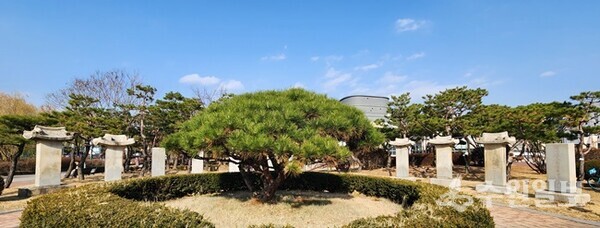
During the Joseon Dynasty, seobi monuments (also called songdeok-bi, gongdeok-bi, or bulmang-bi) were erected at the entrances of districts to commemorate the meritorious deeds of local magistrates who had displayed good governance during their tenure. In Suwon, these were mainly erected outside Paldalmun and Jangan gates, but when damaged during the Korean War in 1950, they were relocated to the old pine tree area.
Later, when the Suwon Museum and Suwon Hwaseong Museum were constructed, the merit monuments related to Suwon-bu from the old town period were moved to the Suwon Museum, while 10 seobi monuments related to Suwon Yousu-bu were relocated in front of the Suwon Hwaseong Museum.
In 1271 (Goryeo's 12th year of Weonjong), Suju-mok was renamed Suwon Doho-bu. Before constructing Hwaseong, King Jeongjo elevated Suwon's status by renaming it Hwaseong and promoting it to Yousu-bu status on January 12, 1793. However, even though the district's name changed, there was a tendency to use the long-established name Suwon in parallel.
In May 1895 during the Gabo Reforms, the local administrative system was reorganized and Suwon reverted to Suwon County.
Hwaseong Yousu-bu was maintained for 102 years, during which 84 Suwon governors were appointed, with an average tenure of approximately 15 months.
Although Suwon governors were local officials, they held central government positions (gyeong-gwan-jik) rather than local positions (oe-gwan-jik), belonging to the high rank of Jeong 2-pum, equivalent to the rank of Hanseongbu Pangryun (Chief of the Hanseongbu).
Suwon governors served as the head of administration, the commander of the Jangnyong-yeong exterior camp (Jangnyong-oesa), and the administrator of the Hwaseong Haenggung (Hwaseong Oesa).
While overseeing all operations of Yousu-bu, they held duties related to Hwaseong construction and the sacrificial rites at Hyungneung, Geonneu, and Hwaryeong temples, as well as receiving royal visits to royal mausoleums, and as Jangnyong-oesa, they held military training and command duties.
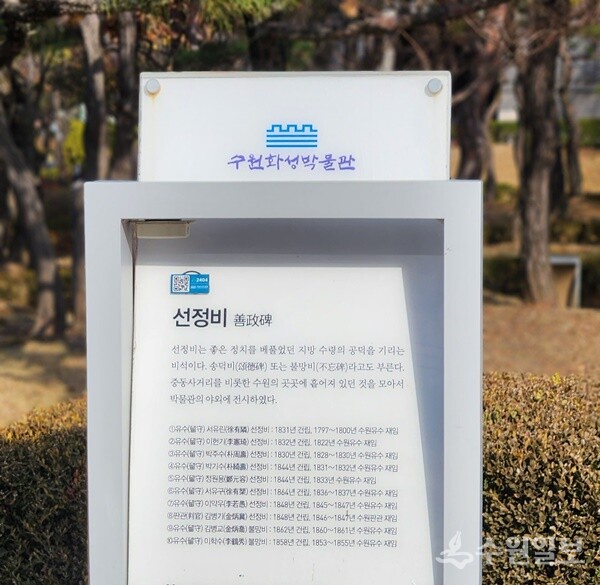
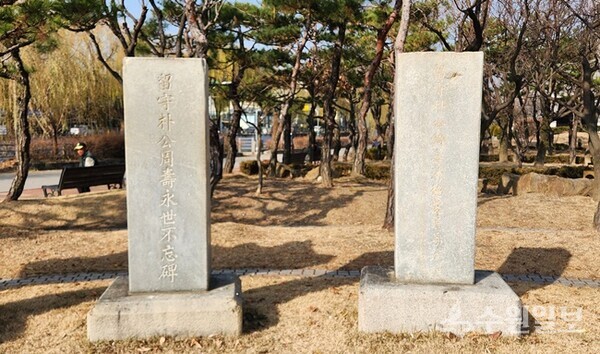
Currently, in front of the Suwon Hwaseong Museum stand 7 seobi monuments of Suwon governors out of 84, 2 bulmang monuments, and 1 bulmang monument of a judge.
What is notable is that the bulmang monument of Park Ju-su and the seobi monument of Park Ki-su stand side by side. We wish to examine for what reasons these monuments were erected.
The governors Park Ju-su and Park Ki-su were family members of Geumseong Commander Park Myeong-won. King Sunjo and Park Ju-su were cousins through their mothers.
Geumseong Commander Park Myeong-won married Princess Hwapyeong, the third daughter of King Yeongjo, at age 14. King Yeongjo loved him dearly and had him reside at Ihyeongung Palace in Inui-dong, Jongno-gu. He reportedly frequently advised on matters concerning Crown Prince Sado. When Princess Hwapyeong died of complications during childbirth at age 22 in 1748 while giving birth to her first daughter, King Yeongjo visited the mourning house five times and visited seven times after the funeral. King Yeongjo personally wrote 'Hyoeuhaengrok' (Record of Filial Piety and Affection), a collection of anecdotes about the princess, and the princess's epitaph. While Joseon Dynasty son-in-laws were prohibited from remarrying, they could take concubines. Subsequently, Park Myeong-won had three sons and three daughters with a concubine, but brought in an adopted son to continue the family line.
On July 11, 1789, at a court conference, Park Myeong-won submitted a memorial to King Jeongjo stating that the reason the king had no prince by age 38 was because Yeongwon (the tomb of Crown Prince Sado) at Baebong Mountain in Yangju was a geomantically inauspicious site.
This is an excerpt from the Jeongjo Sillok (Royal Annals of King Jeongjo) dated July 11, 1789, regarding the relocation of Crown Prince Sado's tomb.
'The decision was made to relocate Yeongwon (遷葬). The King, believing the geomantic formation of the original tomb was shallow and narrow, had intended to relocate it since early in his reign, but excessive caution had caused years to pass. At this time, Geumseong Commander Park Myeong-won submitted a memorial stating,'
"What is the significance and concern of the burial site? As a servant of the state, when thinking of the great affairs of ten thousand years, I cannot cease to apply my full mind, and by principles of righteousness, I cannot dare hide it myself. Therefore, I dare to risk my life and humbly present this.
I am by nature ignorant of geomancy, no different from a deaf person or a blind person, so I shall speak only of matters that everyone can easily know and easily see.
First is the withering of the terrain's veins, second is the breach of the Blue Dragon configuration, third is severe waves striking the back support, and fourth is the stone construction supporting the back cliff is not in its natural state.
From this, we can infer that the feng shui is not harmonious, the earth's nature is not complete, and the terrain is unfavorable. (Omitted) ... Alas, how can I bear to speak of the calamities in the fifth and ninth months of the byungoh year (deaths of Uibin Sung and Crown Prince Mun-hyo)? Our Majesty sits alone at the summit while the sun gradually descends to the western mountains, yet an heir to continue the line remains distant."(Remainder omitted)
Following Geumseong Commander Park Myeong-won's memorial, the relocation of the old town began on July 15, 1789, and on October 7, 1789, Crown Prince Sado's tomb was relocated to Hwasan in the old town, establishing Hyungneung. Meanwhile, a new town was constructed at the foot of Paldal Mountain. Subsequently, on June 8, 1790, King Sunjo was born.
During his lifetime, King Jeongjo left three royal epitaphs (sin-do-bi-mun). He issued epitaphs for General Yi Sun-sin, Ugam Song Si-yeol, and Geumseong Commander Park Myeong-won.
While the epitaphs for General Yi and Ugam were to honor deceased officials, the epitaph for Geumseong Commander Park Myeong-won honored the official King Jeongjo most trusted during his lifetime.
In the epitaph of Geumseong Commander, King Jeongjo stated,
"In 1789, establishing an eternal foundation in such a rare place (Suwon Hwaseong) - who could have accomplished this deed if not for your loyalty and merit? This is why from last autumn I have regarded you as a benefactor and a meritorious subject who saved the nation."
The Bannam Park family had deep connections with the royal family and Suwon. Six generations before Park Myeong-won, they produced Queen Uiin Park (Bannam Park family) for King Seonjo. Park Mi (朴瀰), the Geumyang Commander, a generation closer to Park Myeong-won, became the son-in-law of Princess Jeong-an (fifth daughter of King Seonjo).
Park Jwa-won, a Neungju magistrate who was Park Myeong-won's eighth cousin, had a son named Park Jong-shin, a Vice-Minister of Personnel. Park Jong-shin had a son Park Ki-su, who served as both Suwon governor and Minister of Personnel.
Yeoan Park Ji-won, Park Myeong-won's eighth cousin and younger brother, went to Qing China three times as an envoy. In 1780, when Park Myeong-won sent an envoy delegation to Beijing to celebrate the Qianlong Emperor's seventieth birthday, he included his eighth cousin Yeoan Park Ji-won as an official escort. During this journey, Park Ji-won wrote the immortal masterpiece 'Yeolha Ilgi' (Jehol Diary). Park Ji-won had a son Park Jong-chae, the magistrate of Gyeongsan County. Park Jong-chae had a son Park Gyu-su, who served as both Suwon governor and Minister of Personnel.
Furthermore, Park Jun-won, a sixteenth cousin of Park Myeong-won and Minister of Justice, had sons including Park Jong-bo, Minister of Finance, and a concubine Park Ssi of Gasun Palace. Park Jong-bo had Park Ju-su, who served as both Suwon governor and Minister of Rites. The concubine Park Ssi of Gasun Palace gave birth to King Sunjo with King Jeongjo.
Geumseong Commander Park Myeong-won's memorial led to the establishment of Hyungneung and Geonneu, and the construction of present-day Suwon new town. The family produced three Suwon governors.
First, Park Ju-su (March 1828–March 1830), grandson of Park Jun-won, Park Myeong-won's sixteenth cousin, served as Suwon governor and subsequently served as Chief of Hanseongbu and Minister of Military Affairs.
Second, Park Ki-su (February 1831–January 1832), grandson of Park Jwa-won, Park Myeong-won's eighth cousin, served as Suwon governor and subsequently served as Counselor of Personnel, Vice-Chancellor of the National University, and Provincial Governor of Gyeongsang Province.
Third, Park Gyu-su (August 1876–December 1876), grandson of Yeoan Park Ji-won, Park Myeong-won's eighth cousin, served as Chancellor and Minister of the Right before concluding his career as Suwon governor and passing away.
Recently, I unexpectedly met Kim Hye-gyeong, former director of Jangan Health Center, and her son Park Ho-woo at a café in front of the Hwaseong Museum in Maekhyang-dong, Paldal-gu, Suwon. At that meeting, I learned that they are descendants of Park Ki-su who served as Suwon governor, and heard about the contents of his life records compiled in a literary collection titled 'Itanjae-jip'.
When Park Ki-su took office as Suwon governor in 1831, he disciplined local strongmen (tohao) who used violence against the people and embezzled others' property, bringing relief to the residents, established the Hangmi Pavilion on Suwon's West Lake, renovated Doksan Fortress, and compiled 'Hwaseong-ji (Hwaseong Records) Gunyupji' documenting Suwon's condition after the construction of Suwon Hwaseong.
In May 1828, Park Ju-su submitted a report to the Bibyeongsa (the Border Defense Council) noting that environmental grain reserves for three districts including Ansan were insufficient for distribution. He obtained approval from Crown Prince Hyomyeong to use military grain stores from Namhan Fortress. Whenever disasters occurred, he repeatedly reduced taxes and distributed relief grain, earning praise from the people for his attention to their difficulties.
Park Ju-su left no personal literary collection, so detailed records have not been transmitted.
Park Gyu-su left a personal literary collection titled 'Hwanjae-jip', but since he spent most of his career in the central government and served as Suwon governor for only about six months, there are not many records concerning Suwon, though there are records of his recommendations to the central government to provide relief grain when disasters occurred.
Most historical records related to Suwon Hwaseong were created during King Jeongjo's era. The emergence of 'Itanjae-jip', the literary collection of Park Ki-su who served as Suwon governor, will be a valuable historical source for illuminating Suwon's history after King Jeongjo's time.