Kim Chung-young's Suwon Microscope (130) Lim Soo-bok, Former Acting Gyeonggi Province Governor - Hidden Hero of Suwon Hwaseong Restoration
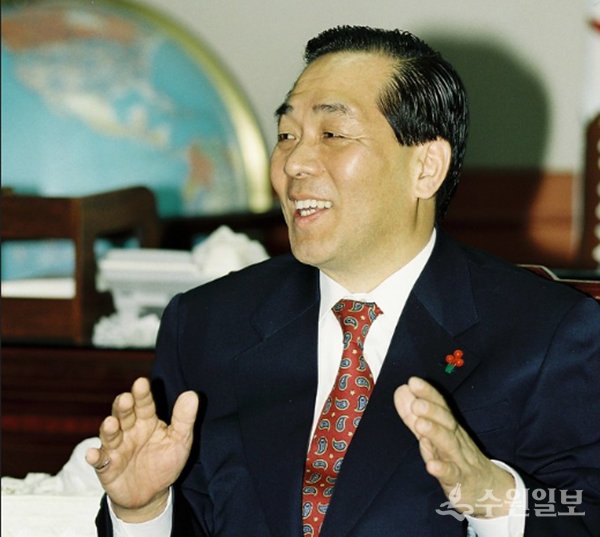
The greatest contributor to the restoration of Suwon Hwaseong is former Prime Minister without Portfolio Lee Byeong-hee, and the person who had it registered as a UNESCO World Heritage Site is former Suwon Mayor Shim Jae-duk.
However, there is an unsung hero of Hwaseong restoration that is not well known to the public. That person is Lim Soo-bok, former Acting Gyeonggi Province Governor.
The Park Chung-hee administration, having experienced Japanese colonial rule and the Korean War, focused on restoration projects of national defense relics that had been destroyed. At that time, the focus of cultural heritage projects was on restoring 'patriotic cultural relics.'
Projects promoted at this time included the restoration of General Yi Sun-sin's historical sites and Jinju Fortress, Nakseong Pavilion, Jeseungdang, Chilbaekuichong, Chungjangsah, Independence activist Yun Bong-gil's historical sites, Haengjusan Fortress, Ganghwa War Historical Site, Namhansanseong Fortress, Hanyang City Wall, Gochang Eupseong Fortress, Hongju Mountain Fortress, Haemi Eupseong Fortress, and Mungyeong Gate.
Lee Byeong-hee, a congressman from Suwon and Prime Minister without Portfolio, devoted considerable effort to having the Suwon Fortress Restoration Project included in the cultural heritage restoration projects that the government was actively promoting.
He then gave instructions to Lim Soo-bok, an administrator at the Prime Minister's office (former Acting Gyeonggi Province Governor).
"Administrator Lim, thoroughly study the history of Suwon Hwaseong and prepare so that the Suwon Hwaseong Restoration Project is included in the national defense relic restoration project."
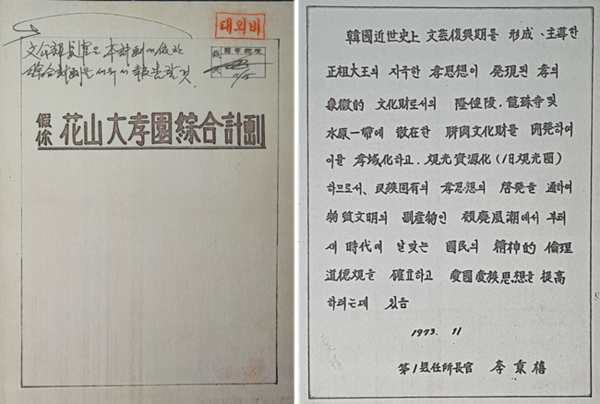
In response, Lim Soo-bok, with advice from Professor Kim Byeong-mo, a historian (current director of Goguryeo Cultural Heritage Research Institute), Dr. Choe Young-hee (former chairman of the National Institute of Korean History), and An Ik-seung, a local historian of Suwon, conducted field surveys and data collection over approximately two months to establish an ambitious plan called the 'Hwasan Daehyo Won Comprehensive Plan (花山大孝園綜合計劃)'.
The purpose statement of this plan read: "Through the 'sacred filial domain-ification' of King Jeongjo's mausoleum complex and Yongjusa Temple during the cultural renaissance, which embodies the ideal of filial piety, and scattered cultural heritage throughout the Suwon area, the plan aims to develop these into tourism resources, thereby promoting our nation's unique filial values, establishing ethical and moral standards befitting the new era to combat the decadent trends resulting from material civilization, and enhancing patriotic sentiment."
In November 1973, Prime Minister Kim Jong-pil, after reviewing the 'Hwasan Daehyo Won Comprehensive Plan,' instructed the Minister of Culture and Information to "establish and report a comprehensive plan." The Minister of Culture and Information subsequently formulated a detailed plan for the 'Suwon Fortress Restoration and Beautification Project' and submitted a comprehensive report to President Park Chung-hee.
In December of that year, the 'Suwon Fortress Restoration and Beautification Project' finally received approval from President Park Chung-hee and began preparation for implementation. The promotion of the Suwon Fortress Restoration and Beautification Project was carried out under the supervision of the Cultural Heritage Administration with close cooperation from the Prime Minister's office, Gyeonggi Province, and Suwon City.
On June 7, 1975, a groundbreaking ceremony was held at Jangannmun Gate attended by Prime Minister Kim Jong-pil, Gyeonggi Province Governor Cho Byeong-gyu, Congressman Lee Byeong-hee, Suwon Mayor Yi Jae-deok, and many citizens. The project was completed in September 1979, four years and three months after its start.
On December 6, 1997, Suwon Hwaseong was registered as a World Cultural Heritage Site. This achievement was made possible by the establishment of the 'Hwasan Daehyo Won Comprehensive Plan' in 1973.
Among those who worked tirelessly behind the scenes without seeking recognition to establish this vast comprehensive plan, a representative figure was none other than Lim Soo-bok.
Regarding this, Lim Soo-bok expressed: "The restoration of King Jeongjo's mausoleum complex and Suwon Hwaseong, accomplished through filial devotion, not only revives the identity of the region but also requires their inclusion in the 'national defense relic restoration project' to develop these valuable historical and tourism resources of Suwon and Hwaseong County into an industry for livelihood. I was driven by this heavy responsibility in pursuing this project."
Meanwhile, Acting Gyeonggi Province Governor Lim Soo-bok devoted considerable attention and effort to resolving pending issues in the Suwon region during his tenure.
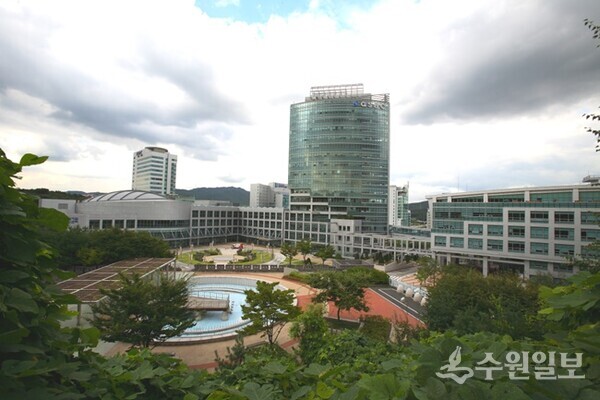
▷When South Korea received IMF bailout in December 1997, small and medium enterprises faced even greater difficulties. To address this, as the need for systematic support was raised, Gyeonggi Province decided to establish the Gyeonggi Small and Medium Business Support Center on a site of 30,246 pyeong in the vicinity of Plot 111-8, Ui-dong, Suwon, with a total floor area of 25,402 pyeong. With the establishment of the Gyeonggi Small and Medium Business Support Center in Suwon, it made significant contributions to the revitalization of small and medium enterprises.
▷He also made considerable efforts to resolve chronic traffic congestion in Gyeonggi Province. In particular, to alleviate the traffic congestion bottleneck in the Gwacheon-Umyeon Mountain section of the Uiwang-Gwacheon Road, which opened in 1992, to resolve traffic problems in Suwon and the northern region, 55.8 billion won was invested, making a significant contribution to resolving traffic congestion in the northern areas including Suwon.
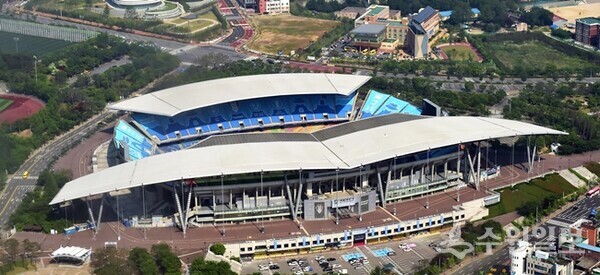
▷On December 29, 1997, Suwon's hosting of the 2002 Korea-Japan World Cup soccer match was finally confirmed.
The construction of the World Cup soccer stadium required a total of 310.7 billion won. The project was pursued under the condition that Suwon City would cover land compensation costs while Samsung would bear the full construction costs. However, when South Korea received IMF bailout in December 1997, Samsung notified of suspension of investment after investing 28 billion won in civil engineering work, citing difficulties in bearing construction costs. Gyeonggi Province and Suwon City reached consensus on sharing the project costs at a 60:40 ratio for the successful hosting of the World Cup match. Excluding 44 billion won in national treasury funds and 28 billion won covered by Samsung, Gyeonggi Province bore 60% of the remaining construction costs (143 billion won) and Suwon City bore 40% (95.7 billion won), completing the soccer stadium and successfully concluding the World Cup soccer match.
▷On March 5, 1998, the completion ceremony of Bongsudang at Hwaseong Palace was held. In his congratulatory speech at the Bongsudang completion ceremony, Acting Gyeonggi Province Governor Lim Soo-bok stated, "The demolition of Hwaseong Palace was a vicious policy by Japan to eliminate our nation's culture," and said, "I am confident that by setting back the new Suwon Medical Center project and restoring the Bongsudang of Hwaseong Palace in just over four years, it will serve as a practical education venue for the 'filial devotion' that raises national pride." Reflecting on his memories from 25 years earlier in 1973 when he worked tirelessly to include the 'Hwasan Daehyo Won Comprehensive Plan' in the 'national defense relic restoration project,' Lim Soo-bok commended the efforts of related officials including Suwon Mayor Shim Jae-duk and Kim Dong-hwi, chairman of the Hwaseong Palace Restoration Committee, who worked toward the restoration of Bongsudang.
In addition, Acting Gyeonggi Province Governor Lim devoted himself to the establishment of the Gyeonggi Cultural Foundation and the Gyeonggi Regional Development Authority, the founding of the Gyeonggi Pops Orchestra, the construction of a provincial National Music Hall, the promotion of Suwon private railway station, and the attraction of Gyeonggi Broadcasting, thereby laying the foundation for Gyeonggi Province to grow into the nation's premier metropolitan local government in both substance and form during his tenure in other cultural sectors.
Who is Former Acting Gyeonggi Province Governor Lim Soo-bok?
He was born in 1943 in Onsugol, a Lim clan village in Gokbanjeong-dong, Suwon City. After graduating from Seryucho Elementary School and Suwon North Middle School, he went to Seoul, where he graduated from Jungdong High School and Yonsei University's Department of Education, and was commissioned as a ROTC officer, retiring with the rank of first lieutenant. In 1968, he was appointed as an administrator at the Prime Minister's office, where he assisted Congressman Lee Byeong-hee, Prime Minister without Portfolio.
Starting with service at the Prime Minister's office, he served as an administrative official at the Presidential Secretariat, Mayor of Hanam City and Gunpo City, Mayor of Gwangmyeong City, Inspector of the Ministry of Interior, Counselor of the Fourth Administrative Coordination Division at the Office of the Prime Minister, Director of Planning and Management at Gyeonggi Province, and Vice Governor of Gyeonggi Province.
On September 18, 1997, Governor Yi In-je resigned to run in the presidential election, and since his remaining term was less than a year, Vice Governor Lim Soo-bok served as Acting Gyeonggi Province Governor for 10 months until June 30, 1998.
After retiring from public service, he served as an adjunct professor at Yonsei University and chairman of the Korea Local Government Internationalization Foundation. Currently, he serves as the central president of the Korea Silver Police Volunteer Corps (established in 2014), where he continues to engage in volunteer activities.
The Korea Silver Police Volunteer Corps is a non-profit private organization consisting of retired workers aged 60 and above, with approximately 3,000 members centered in Incheon and Gyeonggi Province, taking the lead in protecting the living safety of the Republic of Korea.