Kim Chung-young's Suwon Microscope (132) Construction of Suwon Yeonhwajang: Reborn as a 'Sanctuary of the Soul' Through Difficult and Arduous Journey
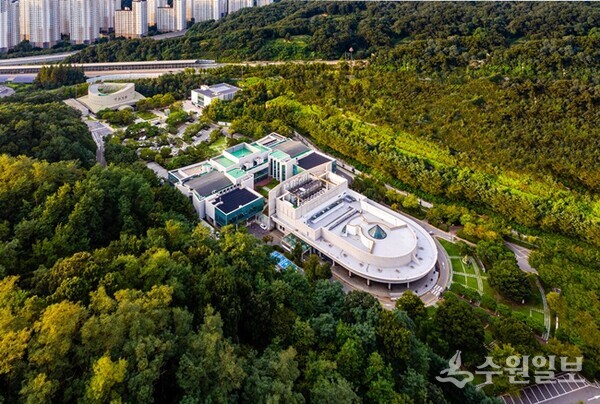
The construction of a crematorium in Hadong, Suwon was a difficult and treacherous path from site selection onward. Residents of Uiui-dong and Hadong formed a countermeasures committee to oppose the relocation of the crematorium and launched organized resistance.
When the relocation site was announced on February 10, 1995, five days later on the 15th, approximately 400 residents held a protest rally at Olympic Park in front of City Hall. Residents argued that it was unfair for the crematorium relocation site to be confirmed before the urban planning facility (crematorium) was decided according to urban planning law procedures.
On the 14th, a day earlier, 37 leaders of tong and ban (neighborhood units) in Uiui-dong submitted their resignations in opposition to the decision on the crematorium relocation site. They argued that since the area had been designated as Woncheon Recreation Area since 1972, residents had suffered disadvantages, and after the construction of a garbage transfer station, the addition of a crematorium was an act of disregarding residents, making it impossible to accept the city's unilateral decision.
On February 17, approximately 200 residents staged a protest in front of the Uiui-dong Sanitation Garage, demanding the withdrawal of the crematorium relocation. Two protesters were injured in the heated demonstration and were transported for treatment.
On March 2, a third protest was held at Olympic Park in front of City Hall. About 200 participants demanded opposition to the crematorium relocation to Uiui-dong, while also requesting the development of the Uiui-dong area collective village as a 'natural settlement district' and the early establishment of a 'Woncheon Recreation Area development plan.'
At the March 15 protest, residents from adjacent Sanghyeon-ri in Yongin County also participated. Approximately 130 people staged a demonstration expressing absolute opposition to the crematorium construction in Uiui-dong. By this point, approximately 940 people had participated in four rounds of collective protests to actively oppose the crematorium relocation.
While staging protest demonstrations, 632 residents submitted petitions and appeals opposing the crematorium relocation to Suwon City, Gyeonggi Province, and the Board of Audit and Inspection on February 23, 1995. On March 2, 1,320 residents including representatives from Sanghyeon-ri submitted a petition opposing the crematorium relocation. Suwon City held several genuine conversations with resident representatives and achieved some convergence of opinions.
On May 20, eight resident representatives submitted a 'petition for withdrawal of the crematorium relocation installation plan,' requesting detailed information including the regularization of existing houses and permission for new construction within the Woncheon Recreation Area, establishment of comprehensive development plan for Uiui-dong, and whether pollution would occur from the crematorium relocation.
Suwon City compiled residents' requests and announced a comprehensive development plan for Uiui-dong. ▷Designated 11 natural hamlets in Uiui-dong as 'natural settlement areas' to be developed ▷Secured 100 million won for the Woncheon Recreation Area development plan establishment project ▷Promoted water and sewage system construction in natural hamlets ▷Planned to open six village access roads totaling 6,400 meters.
Additionally, regarding residents' request that the funeral hall operations within the crematorium be managed by the village, Suwon City announced that if requested through 'joint names of the local resident representatives council' and through legal procedures, it would entrust management to the village after approval by the Suwon City Council.
On March 27, 1995, Suwon City held a 'design competition for new crematorium facility construction' to promote the crematorium relocation project. For the funeral hall, crematorium, and memorial hall, the city presented design guidelines stating they 'should not detract from urban aesthetics, should not evoke feelings of disgust, should symbolize filial piety, possess grand and solemn sculptural beauty, and should be convenient, free of resistance, and serve as an exemplary cutting-edge building with long-term perspective.'
The application period was from March 28 to April 6, 1995, and the 'winning design' would be adopted as the basic plan with a design service contract to be executed. By the April 6 application deadline, 17 architectural offices had submitted designs, showing keen interest.
To facilitate smooth administrative procedures, 16 design review committee members were appointed on May 19, 1995. The committee included four members from Suwon City including the Mayor, the City Council Chair and the Social and Economic Affairs Committee Chair from the Suwon City Council, professors, and resident representatives from Uiui-dong.
As the first-term mayoral election was held during the design competition review process for Suwon Crematorium, the design selection procedure was postponed. When Shim Jae-deok was elected mayor of the first-term Suwon City starting July 1, 1995, the suspended crematorium project was reactivated as a full-fledged undertaking.
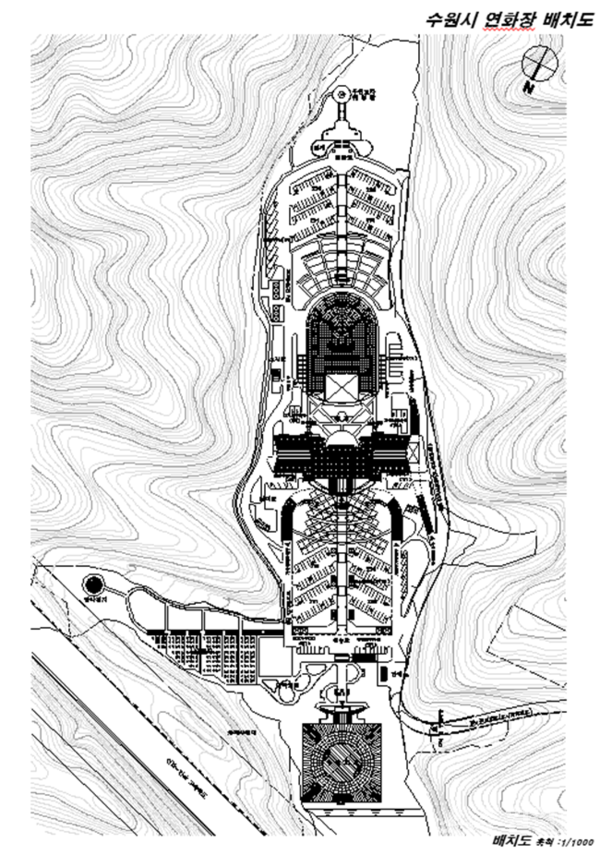
The design competition review for Suwon Crematorium was conducted confidentially on September 26, 1995, with the design by Kim Dong-hun, architect at Jinu Comprehensive Architecture Office, selected as the 'winning design.'
Representative Kim Dong-hun stated, "The spirit of Suwon Yeonhwajang was people. We endeavored to create architecture that honors both the deceased and the living. Suwon Yeonhwajang was designed in the form of 'the human figure.'"
This design was praised for promoting familiarity and openness with surrounding areas and was evaluated as an environmentally friendly comprehensive funeral facility serving as a central urban facility.
Full-scale design began in January 1996. After the basic and detailed designs for the funeral hall, crematorium, and memorial hall were completed, the project had to undergo design review by the Gyeonggi Province Regional Design Review Committee. Subsequently, in February 1996, Daewoo Engineering and Construction was selected as the construction contractor.
Design work for construction was undertaken, completing the detailed design and traffic impact assessment for Suwon Yeonhwajang, and construction finally began on December 31, 1997. The construction access road was completed in April 1998, and on August 8, 2000, after three years of construction with a budget of 35.5 billion won, Suwon Yeonhwajang was completed.
Suwon Yeonhwajang is an ultra-modern cremation facility adopting a smokeless, odorless, real-time pollution gas advanced monitoring system, establishing a new paradigm for comprehensive funeral facilities nationwide and making Suwon City a leader in funeral culture.
Suwon Yeonhwajang includes ▷Memorial House (memorial hall) ▷Seunghwawon (crematorium) ▷Funeral hall ▷Scattering garden ▷Memorial tower. It is equipped with nine cremation furnaces, family waiting rooms, bone collection room, storage room, and incense offering room.
Suwon Yeonhwajang was the first to receive the designation 'comprehensive funeral facility.'
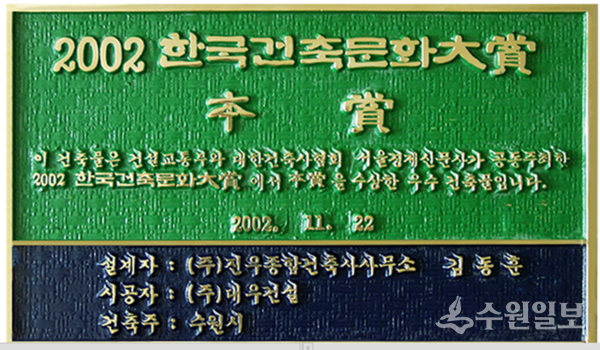
On December 13, 2000, it received the 'Republic of Korea Environmental Culture Award,' and on November 22, 2002, received the '2002 Korean Architecture and Culture Award.'
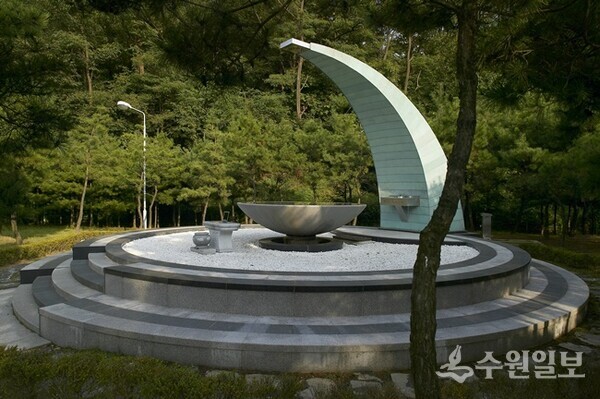
On May 29, 2009, the state funeral for former President Roh Moo-hyun was held there, and on May 27, 2012, on the third anniversary of former President Roh Moo-hyun's passing, a memorial monument was erected within Suwon Yeonhwajang.
On April 24, 2010, the cremation ceremony for six Cheonan naval vessel casualties was held at Suwon Yeonhwajang.
Following the Sewol ferry sinking on April 16, 2014, cremation ceremonies were held for 208 victims from the Ansan area. Mayor Shim Jae-deok, who built this facility, also underwent cremation and funeral here after his death.
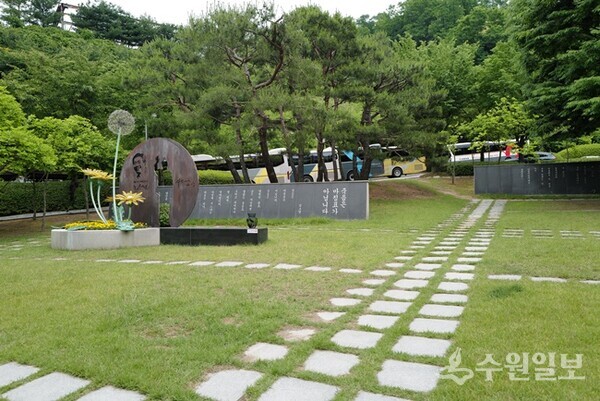
Suwon Yeonhwajang was built through the wisdom of Mayor Lee Sang-ryong of the 20th administration and the resolute will of Mayor Shim Jae-deok of the first democratic term.
In particular, it is evaluated as a representative case of exemplarily resolving the 'NIMBY' sentiment.