Suwon Under the Microscope (133) Professor Kim Dong-wook: "Suwon Hwaseong is my beginning and my end"
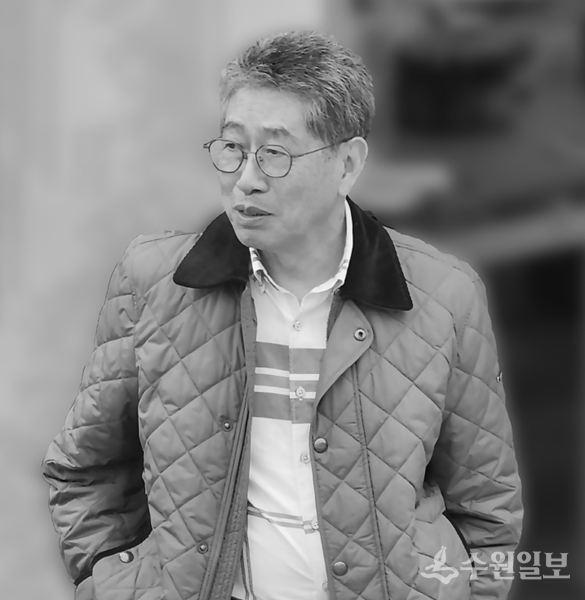
Behind Suwon Hwaseong's inscription as a UNESCO World Heritage Site lay the participation and efforts of many people, with Mayor Shim Jae-deok of the first elected term of Suwon City leading the charge.
Prior to this, it was Professor Kim Dong-wook of the Department of Architecture at Kyonggi University who theoretically presented the world cultural heritage value of Suwon Hwaseong to Mayor Shim.
Professor Kim graduated from Korea University's Department of Architectural Engineering in 1974 and joined Hyundai Engineering and Construction, but later resigned to pursue the study of Korean architecture. After entering Korea University's graduate school, he became interested in Suwon Hwaseong before restoration work had even begun, and while conducting field surveys of Suwon Hwaseong in his spare time, he obtained and began reading a facsimile edition of the 'Hwaseong Seongyeok Uigwe' (Hwaseong Construction Record).
After obtaining his master's degree, he became a research student at Waseda University through a graduate student exchange program between Korea University and Waseda University in Japan. In 1978, he entered the doctoral program at Waseda University, and around this time, Professor Kang Man-gil of the Department of History at Korea University came to Waseda University as an exchange professor. Under Professor Kang's guidance in reading the 'Hwaseong Seongyeok Uigwe', he became even more absorbed in Suwon Hwaseong.
In 1980, he presented four academic papers on the theme of "Suwon Hwaseong Research" at the spring and fall conferences of the Japanese Architectural Institute.
After returning to Korea in 1982, he took up a position as a professor in the Department of Architectural Engineering at Kyonggi University. His connection with Suwon Hwaseong deepened further.
Beginning with the publication of a paper titled "Preliminary Study on the Hwaseong Seongyeok Uigwe" in 1982, he published papers in 1983 including "On the Use of Bricks in Suwon Fortress Walls" and "Foundational Research for the Restoration of Suwon Hwaseong Haenggung."
In 1989, his book "Suwon Hwaseong" was published in the "Colorful Books" series, contributing greatly to making Suwon Hwaseong known to the public.
In 1989, a new construction plan for the "Gyeonggi Provincial Suwon Medical Center" located at the site of Hwaseong Haenggung was announced. The plan was to demolish the dilapidated hospital and build a modernized facility in its place. Shim Jae-deok, then Director of the Suwon Cultural Center who was promoting the restoration of Hwaseong Haenggung, requested that local historian Lee Seung-eon search for materials related to Hwaseong Haenggung.
In late May 1989, Lee Seung-eon informed Director Shim Jae-deok that a "Hwaseong Haenggung Map" existed at the Gyujanggak Archives of Seoul National University, leading to the formation of the "Hwaseong Haenggung Restoration Promotion Committee."
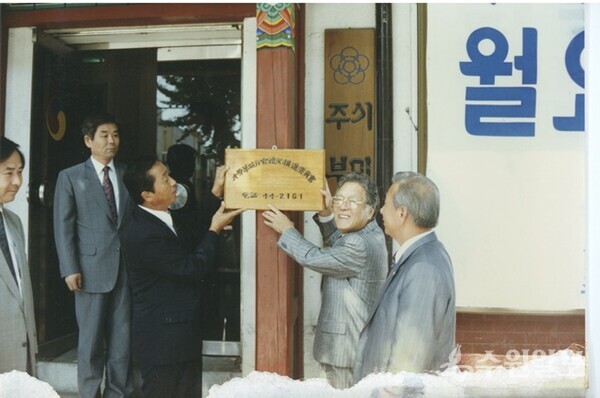
At that time, 81 representatives from various sectors of Suwon's cultural and social circles were selected for the Haenggung restoration promotion committee, and Professor Kim Dong-wook was the only academic expert to participate.
Through his involvement with the Hwaseong Haenggung Restoration Promotion Committee, Professor Kim became increasingly engaged in research and various activities related to Suwon Hwaseong.
In 1994, he presented research on the material transport equipment used in the construction of Suwon Hwaseong and the significance of Suwon Hwaseong's construction and urban development at the general meeting of the "200th Anniversary Commemorative Project Committee for Suwon Hwaseong's Construction."
Furthermore, he contributed to the commemorative projects by publishing a booklet titled "18th Century Architectural Thought and Practice—Suwon Fortress" for the 200th anniversary celebration of Hwaseong's construction.
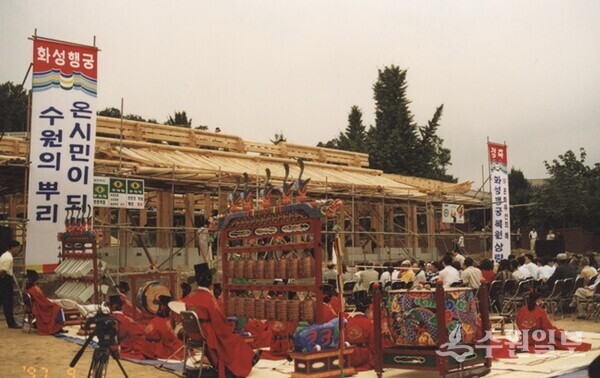
Starting in 1995, he participated as a cultural heritage specialist consultant for the Cultural Heritage Administration in the Hwaseong Haenggung restoration project, providing consultation on authentication and construction progress. Through his efforts, the first phase of the Hwaseong Haenggung restoration project was successfully completed in 2003.
Professor Kim also made significant contributions to the process of Hwaseong's inscription as a UNESCO World Heritage Site.
In March 1996, the Cultural Heritage Administration decided to nominate Korea's representative fortress walls and palaces for UNESCO World Heritage status. There were suggestions to nominate Changdeokgung Palace as the palace and Namhansanseong in Gwangju and Samnyeonsan Fortress in Boeun, North Chungcheong Province as the fortress walls.
However, Professor Kim, who had long studied Suwon Hwaseong, argued that Suwon Hwaseong should be nominated for UNESCO World Heritage status. By explaining the cultural value and excellence of Suwon Hwaseong, particularly the value of the 'Hwaseong Seongyeok Uigwe,' the pinnacle of documentary culture, Professor Kim played a decisive role in Suwon Hwaseong being selected as a UNESCO World Heritage candidate in 1997.
Professor Kim also provided consultation during the process of drafting Suwon Hwaseong's World Heritage inscription application and played a major role in the process. In March 1997, the World Heritage Committee conducted an on-site inspection, with Professor Nimal De Silva from Sri Lanka, affiliated with the International Council on Monuments and Sites (ICOMOS), as the inspector. When he visited Suwon to inspect Suwon Hwaseong, it was Professor Kim Dong-wook who explained the excellence and value of Suwon Hwaseong.
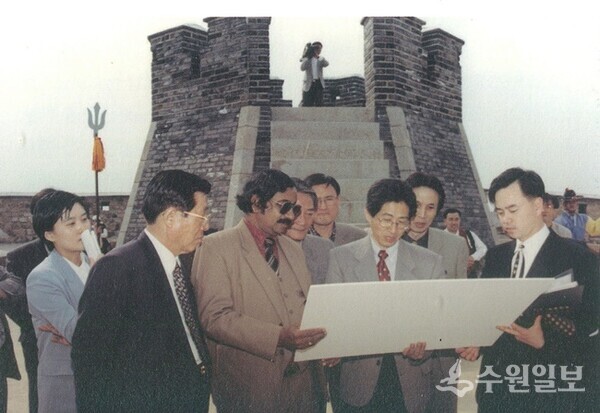
When Inspector Silva raised concerns about the restored portions of Suwon Hwaseong, Professor Kim explained that the 'Hwaseong Seongyeok Uigwe' existed and that restoration had been based on the design drawings.
However, when members of the World Heritage Committee raised the issue that Suwon Hwaseong was not in its original form, Mayor Shim Jae-deok personally traveled to Paris to explain with the 'Hwaseong Seongyeok Uigwe' in hand. With Mayor Shim Jae-deok's passion, the value of Suwon Hwaseong was highly evaluated, and it was ultimately inscribed as a UNESCO World Heritage Site.
Professor Kim Dong-wook, captivated by Suwon Hwaseong, spent his entire life with it. While serving as a member of the Korean Architectural History Association and as a cultural heritage specialist, Professor Kim conducted research and provided consultation on architectural cultural properties throughout the country. Regarding Suwon Hwaseong, he has published some 40 research papers and authored books including "Suwon Hwaseong (Colorful Books)," "Research on Korean Architectural Construction History," "18th Century Architectural Thought and Practice—Suwon Fortress," and "The Spirit of Practical Learning in the New City of Joseon, Suwon Hwaseong," as well as co-authored works such as "18th Century New City and 20th Century New City," "Research on the Ritual Ceremony and Architectural Characteristics of Hwaryeong Hall," "Hwaseong Seongyeok Uigwe Terminology Dictionary," and "Rational Ritual Space: Suwon's Hwaryeong Hall."
He is currently writing a book titled "The Influence of 18th Century Suwon Hwaseong Construction Technology on the Architectural Environment of Late Joseon."
Professor Kim Dong-wook reflected, "My connection with Suwon Hwaseong is a dharma companion that allows me to walk the path of a scholar blessed with happiness, and an unfailing spring," and "Suwon Hwaseong is my beginning and my end."