Kim Chung-young's Suwon Microscope (134) Kim Yi-hwan, Founding Director of Hwaseong Research Society (Director of Lee Young Art Museum) and His Connection to Suwon
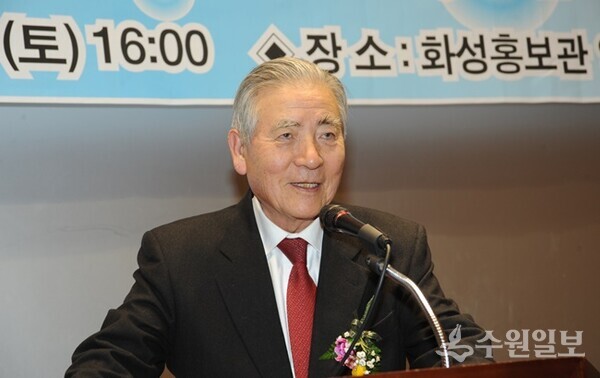
In the early 2000s, Suwon was a city without a single proper art museum or museum. Then in 2001, a private art museum called "Lee Young Art Museum (Director Kim Yi-hwan)" opened in Yeongdeok-dong, Giheung-gu, Yongin City, at the boundary of Suwon, after converting a pig farm. This was like welcome news for the Suwon-Yongin region, which had no art-related facilities.
The Lee Young Art Museum houses works by many painters, but it is particularly noted for its concentrated collection of paintings by Park Saeng-gwang and Jeon Hyeok-rim, two titans of Korean art.
Director Kim Yi-hwan of the Lee Young Art Museum grew up exposed to calligraphy from an early age, as his father served as a sseodang (traditional study) instructor in Goseong, South Gyeongsang Province. After graduating from university and working in the public sector in Busan, he could not pass by a frame shop near his home. This encounter became his connection to artworks.
One day, the owner suggested he purchase a fine plum blossom painting. It was a work by Hwang Mae-san, a painter fairly well-known for plum blossoms in the Yeongnam region. At the time, he recalled that spending a large sum with his modest monthly salary was "the moment I took a wrong turn." From this point onward, heeding his wife's counsel, he began purchasing small antiques and paintings by setting aside portions of his salary.
Later, when he was transferred to work in Seoul, a friend happened to open a shop in Insa-dong. Through the friend, he heard that Park Saeng-gwang's "Black Peony" was excellent. He was told the painter was from Jinju.
Park Saeng-gwang lived in Suyu-ri, Seoul. In the late spring of 1977, upon hearing of Park Saeng-gwang's exhibition, he went to the gallery wanting to see the Black Peony, only to learn it had already been sold. His interest in the Black Peony became the catalyst for his trips to Suyu-ri.
He began visiting Suyu-ri frequently, and observing Park's difficult circumstances, he was moved to compassion and began providing modest help. One day, Park said, "Now at the end of my life, I want to focus on my work with peace of mind..." and his words trailed off.
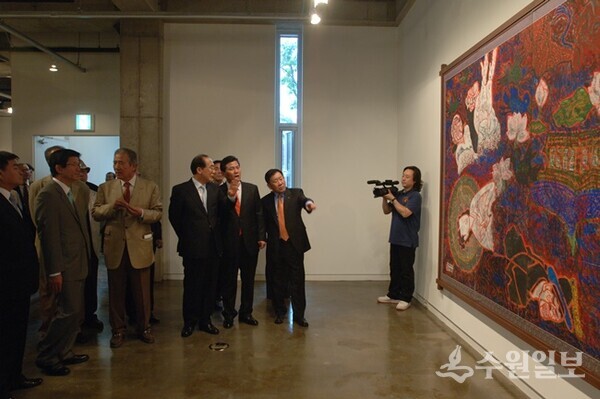
From this point, he decided to become Park's patron. As he supplied rare art materials and pigments that were difficult to obtain at the time, Park Saeng-gwang produced the masterworks of his lifetime. The Lee Young Art Museum came to house 100 immortal masterpieces from this period, including "Empress Myeongseong," painted during this time.
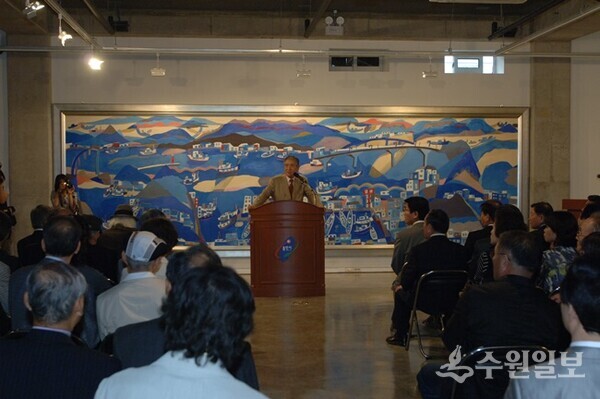
The Lee Young Art Museum's other major collection comprises works by painter Jeon Hyeok-rim, who is from Tongyeong. Beginning in 1987, when his wife Sin Young-sook purchased a Jeon Hyeok-rim painting, he became captivated by the intense colors of the sea before Tongyeong and began collecting Jeon's works. From 2003 to 2008, he and his wife made the round trip of 760 kilometers from Seoul to Tongyeong every Saturday without fail for five years.
Each time they went to Tongyeong, the couple gave the painter spending money and asked him to "create paintings until we visit again next week." Painter Jeon faithfully completed the "homework" they assigned, achieving the remarkable feat of completing over 1,050 paintings expressing cosmic truths—his "New Mandala" series—over five years. The Lee Young Art Museum houses approximately 200 of these works.
Subsequently, Director Kim became interested in establishing an art museum.
As his approximately 20 years of public service drew to a close, the Hyosung Group was promoting golf course construction in Singal, and he was selected as the right person for the job, taking the position of CEO of Singal Golf Club.
Kim Yi-hwan first purchased land and promoted golf course construction. In doing so, thinking of his later years, he secured land in two locations: one for constructing a pig farm and another for building an art museum.
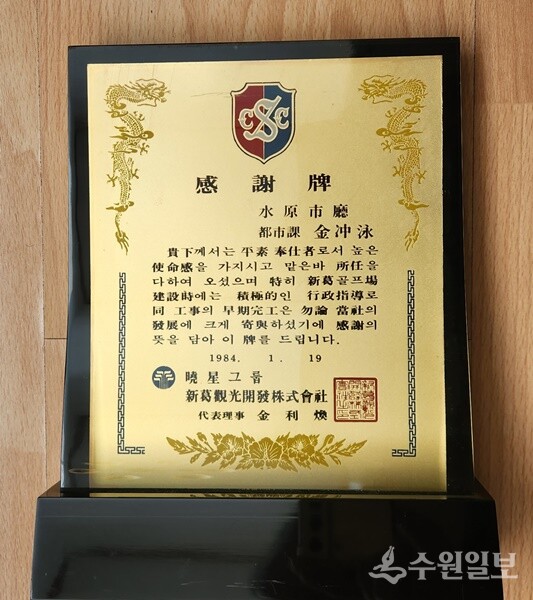
Once the golf course construction site was secured, administrative procedures had to be pursued. However, Singal Golf Club (currently Taegwang Golf Club) was administratively part of Yongin County, but half of it was included in the Suwon urban planning zone, requiring permits from both Suwon and Yongin. At that time, the author, as a practical administrator in the urban planning division of Suwon City's Urban Development Department, first met Kim Yi-hwan, CEO of Singal Golf Club. Upon completion of the golf course, he presented plaques of appreciation to those who had helped him over the years, and the author also received one.
Later, as Hyosung sold the golf course to the Hanbo Group, CEO Kim had to move. Awaiting him was the construction site for a golf course in Gwangju, Gyeonggi Province, being developed by the LG Group. After completing and operating LG Heesung Country Club, he decided to establish an art museum.
To build an art museum on the land at the entrance of Singal Golf Club that he had already secured, he sought permits from Yongin City. Yongin City stated that since the location was designated as part of a land utilization planning zone with no urban plan established, they could not issue permits.
Uncertain how to resolve this difficult situation, Kim Yi-hwan recalled the author, who had long been involved in urban planning in Suwon City. This was in 1998, when the author was the head of Suwon City's Urban Planning Division. The relationship between CEO Kim Yi-hwan and the author reconnected.
At that time, the author suggested that urban planning procedures for the land in front of the golf course would be delayed, making permits difficult, and advised considering alternative proposals. At that time, the pig farm's operations had become difficult and it had closed. Upon visiting, the access road was inconvenient and pig houses were scattered across multiple buildings, making it unsuitable for use as an art museum. Nevertheless, the author considered the possibility of utilizing the hill to the east.
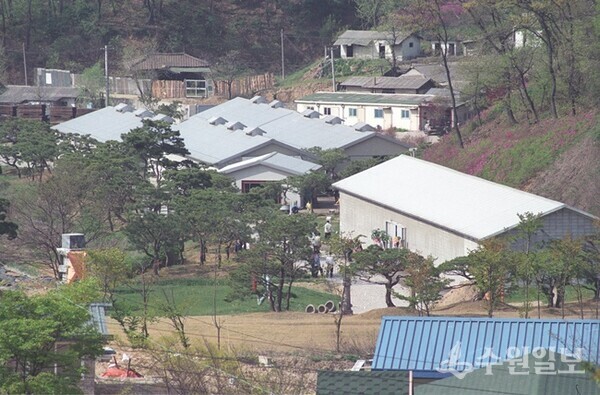
Despite the constraints of the pig farm, Director Kim Yi-hwan pursued a reversal of its image and transformed and elevated it through art. Moreover, by actively utilizing the hill to the east, he converted it into a unique art museum unlike any other in the world.
After approximately two years of preparation, the Lee Young Art Museum formally opened in June 2001 in Yeongdeok-dong, Giheung-gu, Yongin City.
Prior to this, on December 6, 1997, Suwon Hwaseong was inscribed as a UNESCO World Heritage Site, and the author and others took the lead in forming the "Society for the Love of Suwon Hwaseong," which was active at that time. As membership grew to over 30 people, the idea of establishing a non-profit organization emerged. At that time, members were already secured, and the need was to find an impartial leader with cultural mindedness.
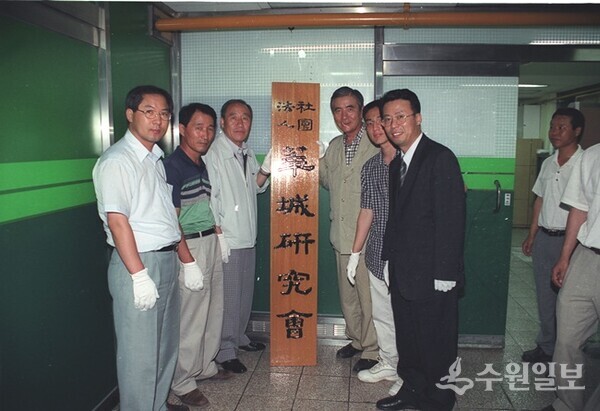
This was a time when the pig farm improvement project was in full progress, and Director Kim Yi-hwan possessed considerable interest and knowledge regarding Suwon Hwaseong. The author and Kim Woo-young, editor-in-chief of Suwon City's PR magazine "Evergreen Suwon" at the time, proposed that Director Kim serve as the head. Many members agreed.
Following our earnest proposal, Lee Young Art Museum Director Kim Yi-hwan accepted, and the "Society for the Love of Hwaseong" underwent approximately two years of preparation before finally launching as "the Hwaseong Research Society," a non-profit organization, on May 21, 2001.
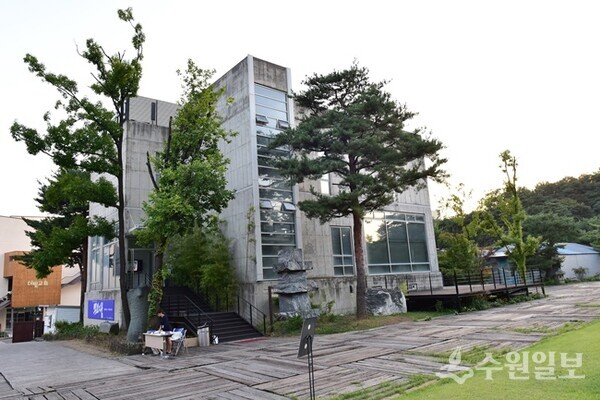
When the Lee Young Art Museum reached its 4th or 5th year of operation, a crisis emerged. As the Korea Land Corporation designated the Yeongdeok-ri area as a residential development zone, a plan was promoted to run an expressway between Yongin and Seoul through the art museum. The museum faced an existential crisis.
At this time, Director Kim Yi-hwan proposed, "If we must relocate anyway, let us establish the Lee Young Art Museum in an area adjacent to 'the UNESCO World Heritage Site Suwon Hwaseong,'" but Suwon City did not accept this proposal, and it came to nothing.
Coincidentally, as urban planning procedures for the area at the entrance of Taegwang Golf Club were completed, on June 2, 2008, a new art museum was constructed at 55-1 Yeongdeok-dong, Giheung-gu, Yongin City, and opened its doors.
Director Kim Yi-hwan served for approximately two years as the "Society for the Love of Hwaseong" and two consecutive four-year terms as "Director of the Hwaseong Research Society," taking charge of the society's formative ten years and playing a major role in its development into a model organization among national cultural heritage preservation groups.
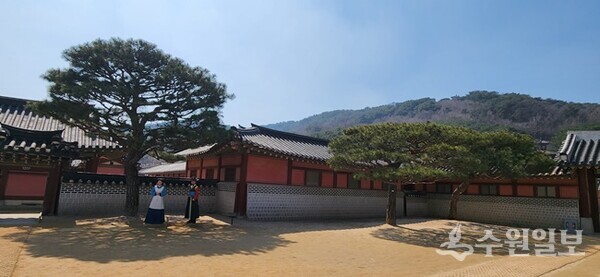
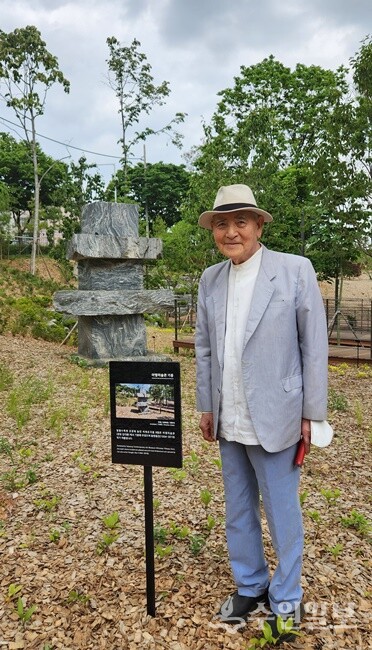
Founding Director Kim Yi-hwan of the Hwaseong Research Society (director of the Lee Young Art Museum) made significant contributions and participated in efforts to enhance Suwon and the UNESCO World Heritage Site Suwon Hwaseong. He donated 15 pine trees to Hwaseong Palace and the Palace Plaza, donated 8 stone sculptures to the Ilwol Arboretum, and served as an advisor in the art field as a cultural arts consultant for Suwon and as a director of the Suwon Cultural Foundation.
Founding Director Kim Yi-hwan of the Hwaseong Research Society (director of the Lee Young Art Museum) led efforts to enhance the UNESCO World Heritage Site Suwon Hwaseong, actively supported painters Park Saeng-gwang and Jeon Hyeok-rim, enabling them to leave immortal masterpieces, walked the path of a pioneer in quenching the thirst of artists in the Suwon-Yongin region, and passed away peacefully at the age of 89 on March 11 of this year.
We pray for his eternal rest.