Kim Jusong's Japan Observation Record A Journey Following the Path of the Joseon Tongsinsa (1)
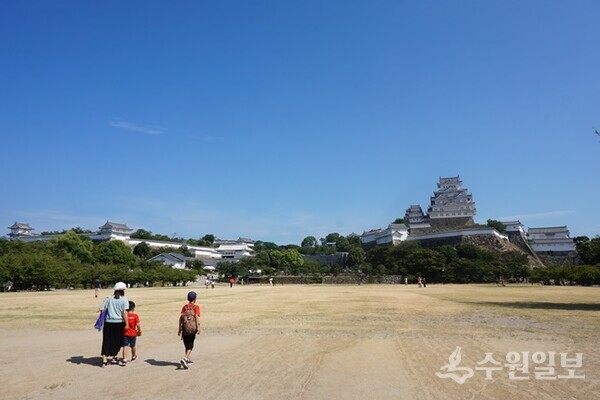
This Japan field study by the Hwaseong Research Association was conducted over four days from August 8 to 11.
I participated in this field study together with my father (Kim Chung-young, Editorial Board Member of News S), a member of the Hwaseong Research Association.
The theme of this field study was to follow the route taken by the Joseon Tongsinsa, who were dispatched on twelve occasions, to reach Edo, the center of activity at that time.
The route of these envoys heading to Edo, or present-day Tokyo, consisted of two paths: a maritime route from Busan to Osaka and an overland route from Kyoto to Edo.
Among these, this field study team traveled in reverse along the maritime route from Shimonoseki to Osaka.
This journey included important castles in Japan within the route of the Joseon Tongsinsa, as well as some other important sites related to Korean history in Japan.
Such places included Himeji Castle, the ruins of Nagoya Castle, an advance base of Toyotomi Hideyoshi located in Saga Prefecture, and Kushida Shrine in Fukuoka, where it is said that the Yuan-Mongol allied forces' fleet was anchored.
First, I briefly explained the Joseon Tongsinsa, which became the main subject of observation, and then wrote an account of the places we visited.
Unlike the Yeonhaengsa (envoys to Qing China), whose chief envoy, the chief ambassador, was selected from officials of rank 3 or above from the Jongban (宗班) or administrative positions, the Joseon Tongsinsa appointed a person holding the position of Chamui (參議), an official rank of 3.
The envoy delegation boarded three sailing vessels called the chief ambassador's ship, vice ambassador's ship, and associate envoy's ship, heading to Japan.
When they were dispatched, gifts sent by the Joseon king to the Tokugawa shogun or crown prince, as well as gifts sent to the roju (老中: the highest senior retainers of the shogunate), port officials, daimyo (大名: feudal lords who owned fiefs such as domains in Japan), and temples in places of call and lodging were loaded on three cargo ships and accompanied them. After receiving an audience with the king and heading to Japan via Busan, these envoys passed through islands such as Tsushima, Iki Island, and Aino Island (相島 or 藍島), entered the Seto Inland Sea through Shimonoseki, and headed to Osaka.
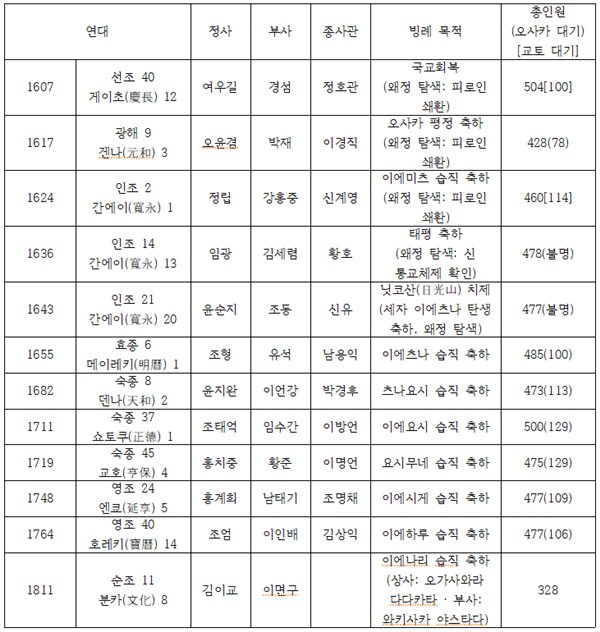
The table above is a chronology related to the diplomatic missions of the Joseon Tongsinsa, with portions taken from the chronology included in Nakao Hiroshi's 'Stories of the Joseon Tongsinsa.' What can be confirmed through this is that twelve Tongsinsa missions were dispatched to Japan from 1607 to 1811.
Looking at the purposes for which they were dispatched to Japan, from 1607 to 1643, envoys were sent for purposes such as gathering information about Japan's political situation and making preparations for the repatriation of captives (被擄人). In contrast, from 1655 onwards, the Joseon Tongsinsa had the purpose of congratulating the succession of the Edo shogunate's shogun. With these purposes, except for two occasions when the Tongsinsa held diplomatic ceremonies at Fushimi, Kyoto in 1617 and in Tsushima in 1811, all others proceeded to Edo following the routes that we visited during this field study.
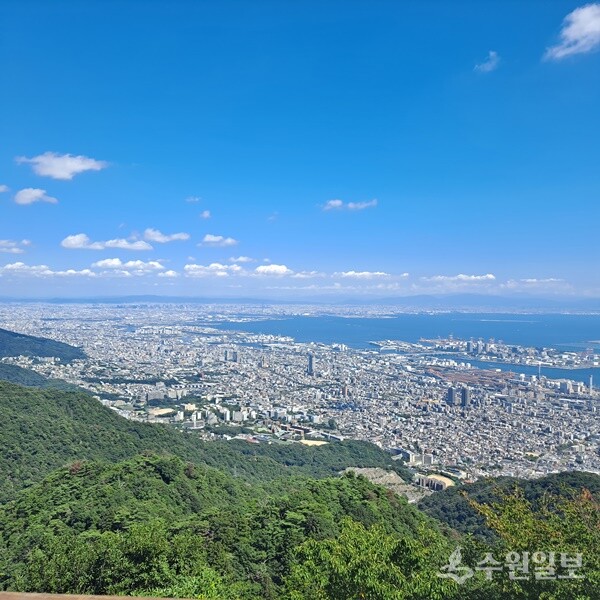
The first destination of this journey was Mount Maya in Kobe. Here, I learned that cable cars in Japan are different from those in Korea. In Korea, cable cars are transportation that hang from cables and float through the air as they climb mountains. In contrast, in Japan, cable cars are railways pulled up by cables, while what Koreans call cable cars are called ropeway in Japan.
The weather on that day was exceptionally clear, and from Kakuseitai, we could see a broad view extending to the coastline of the Osaka area in the distance. From Kakuseitai, the summit of Mount Maya, one can glimpse the coastlines of Kobe and Osaka, located at the easternmost part of the Seto Inland Sea. In the photograph, the vast urban area spreading to the west corresponds to Kobe, and the area to the upper right across the sea is Osaka.
Both of these places were also included in the route traveled by the Joseon Tongsinsa. The final anchorage point for the Joseon Tongsinsa envoy delegation sailing through the Seto Inland Sea was called Hyogo-tsu (兵庫津). In other words, anchored in the vast sea spreading to the right, the Joseon envoy delegation would have prepared to go ashore. At that time, cargo ships carrying gifts related to the envoy delegation's route from Joseon, along with six ships including the chief ambassador's ship, vice ambassador's ship, and associate envoy's ship, and numerous escort ships from various regions lined up here—what a spectacular sight it must have been. After preparing at Hyogo-tsu, the envoy delegation reportedly transferred to Japanese vessels at Kawaguchi in Osaka and headed to Kyoto.
Following this, our journey proceeded to Himeji.
Here, we were able to encounter a very special connection.
It was with members of an organization called the 'Harima Korean Alphabet Research Association.' Meeting these people, I was able to feel their passion for Korea and the Korean language. Some studied Korean at the research association out of enthusiasm to understand what their favorite idols say, while others had visited Korea multiple times and had friends there, so they came to the Harima Korean Alphabet Research Association wanting to speak Korean with these friends. I could see their goodwill and enthusiasm toward Korean language and Korea.
I also learned at the meeting that this organization had been exchanging with the Hwaseong Research Association for a long time since the 1990s.
After meeting with them, for dinner on the first evening, we tasted chanko-nabe, a dish prepared by sumo wrestlers.
The restaurant had sumo-related items displayed, and the restaurant was marked with '力士料理,' so I assumed the restaurant had a sumo concept in some way.
However, while eating, I heard that the restaurant owner had been a sumo wrestler.
In the chanko-nabe here, sesame was ground in a mortar-like bowl, and each table had a mortar pestle, which was used to grind the sesame and mix it with broth to use as sauce.
While we were enjoying our meal, the sumo wrestler restaurant owner brought sumo wrestler costumes for us to experience.
Several teachers who participated in the field study together tried on these costumes, and the experience proceeded with them assuming sumo postures and trying pushing movements with the restaurant owner who had been a sumo wrestler.
Members of the Korean Alphabet Research Association also joined us at this meal, and through conversation with them, I was able to feel their passion even more deeply.
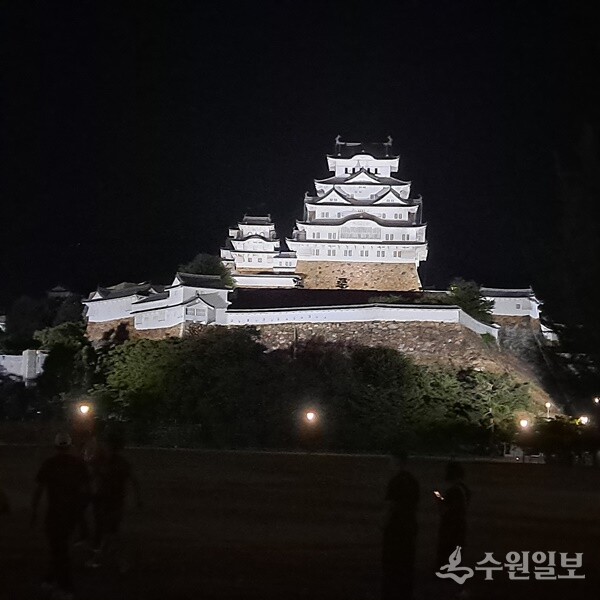
After this abundant and harmonious evening dinner concluded, we went to see Himeji Castle, which illuminates every night, and the scenery is said to be beautiful. The main tower of Himeji Castle is whitewashed, and with white lights shining on it at night, the castle shone with a silvery glow.
Himeji Castle was the location of the domain administrative office of the Himeji domain during the Edo shogunate period. It is said that this Himeji domain, having a Joseon Tongsinsa anchorage point called Murotsu (室津) nearby, played the role of receiving and entertaining the envoy delegation when they anchored at Murotsu.
The next morning, we toured the interior of Himeji Castle, which had shone with a silvery glow under the night lights. Exploring the interior of Himeji Castle, I could observe the defensive strategies of the Japanese, which differ from Korean fortifications.
In this case, the castle had a broad outer fortress, and in the case of the inner fortress as well, multiple layers of castle walls were constructed reaching the main tower, showing a defensive strategy centered on the daimyo.
Additionally, near the main tower, gun ports (銃眼) had openable and closable windows allowing for concealed attacks, and there were spaces within the castle to hide samurai and passages that could come from the small tower beside it, showing their efforts to protect the daimyo.
It is said that millstones of residents and stone coffins from nearby burial mounds were also used to build the castle, which suggests what a massive undertaking it must have been.
Himeji Castle also has a garden called Kokoen (好古園), and I was told that this place was turned into a garden from what was a samurai residence during the shogunate period. Hearing this, I thought that a person who could have a large mansion near the main tower where the daimyo worked or lived must have been a samurai of very high status.
Upon entering Kokoen, there is a lake, and within it there is also a space made like a stream with water flowing gently, so despite being an artificial park, one could feel natural beauty. Since we visited in summer, we could only see the lake, the flowing water, and the lush forest, which was unfortunate.
However, there were spaces like seedling gardens and flower gardens that would be nice to visit in spring, and it is said that the autumn maple leaves are beautiful, so it was a garden I wanted to revisit in autumn or spring.