Kim Ju-song's Japan Field Study Following the Path of the Joseon Envoy Mission (1)
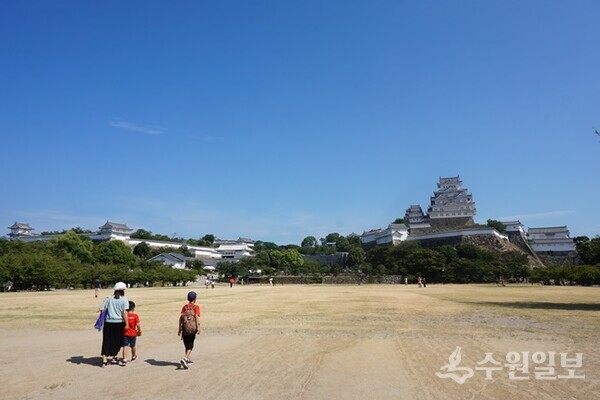
This Hwaseong Research Institute field study in Japan was conducted over four days from August 8 to 11.
I participated in this field study together with my father (Kim Chung-young, Editorial Committee Member of News S), who is a member of the Hwaseong Research Institute.
The theme of this field study was to retrace the route taken by those dispatched as the Joseon Envoy Mission twelve times to reach Edo, the center of Japan at that time.
The route to Edo, or present-day Tokyo, consisted of two paths: a maritime route from Busan to Osaka and an overland route from Kyoto to Edo.
Among these, our field study team traced in reverse the maritime route from Shimonoseki to Osaka.
This journey included important castles in Japan within the route of the Joseon Envoy Mission, as well as some other significant sites in Japan related to Korean history.
Such places included Himeji Castle, Nagoya Castle ruins, the advance base of Toyotomi Hideyoshi located in Saga Prefecture, and Kushida Shrine in Fukuoka, which is said to have stones from the Mongol-Goryeo allied forces.
First, I will provide a brief explanation of the Joseon Envoy Mission, the main subject of this study, and then write a field study report on the places we visited.
Unlike the Yeanhang envoys, where the chief of the delegation (Jeongsa) was selected from officials of rank three or higher from the Jongban, the Joseon Envoy Mission appointed a person holding the rank of rank-three official, Chamui (參議).
The delegation boarded three ships called the Jeongsa-seon, Bussa-seon, and Jongsagwan-seon and sailed to Japan.
When they were dispatched, gifts sent by the King of Joseon to the Tokugawa shogun and the crown prince, as well as gifts sent to the roju (老中: senior retainers of the shogunate), port officials, feudal lords (daimyo) of the stationed areas and temples, were loaded onto three cargo ships and accompanied them. After meeting with the king and heading to Japan through Busan, they passed through islands such as Tsushima, Iki Island, and Aino Island (相島 or 藍島), entered the Seto Inland Sea through Shimonoseki, and headed to Osaka.
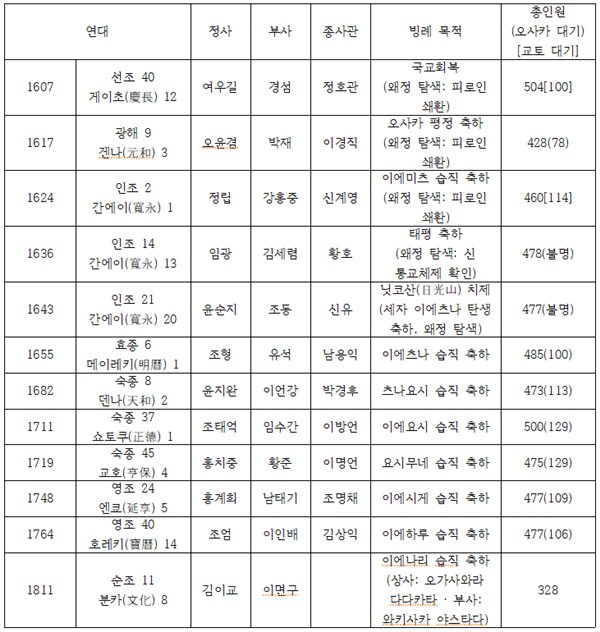
The above table is a chronological table related to the ceremonial protocols of the Joseon Envoy Mission, from which part of the chronological table contained in Nakao Hiroshi's 'The Story of the Joseon Envoy Mission' has been extracted. Through this, it can be confirmed that twelve envoy missions were dispatched to Japan from 1607 to 1811.
Looking at the purposes for which these missions were dispatched to Japan, from 1607 to 1643, envoys were sent for purposes such as understanding Japan's political situation and preparing for the repatriation of captives. Meanwhile, the Joseon Envoy Missions from 1655 onward can be seen to have the purpose of congratulating the Edo shogunate on the succession of the shogun's position. The envoy missions dispatched to Japan for these purposes followed the route that we visited during this field study to head to Edo, except for two occasions: when ceremonies were held in Fushimi, Kyoto in 1617, and on Tsushima in 1811.
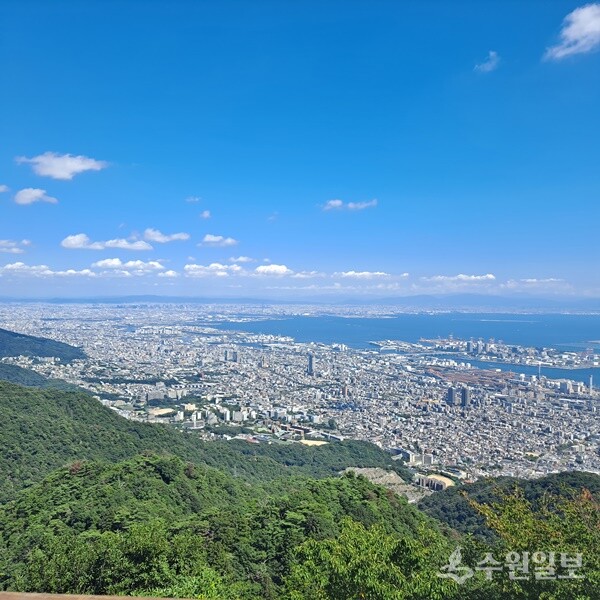
The first destination of this journey was Maya Mountain in Kobe. Here, I could see that Japanese cable cars and Korean cable cars are different. In Korea, a cable car is a transportation vehicle that hangs from cables and floats in the air to climb a mountain, while in Japan, a cable car is an electric railway pulled up by cables. What is called a cable car in Korea is called a ropeway in Japan.
The weather that day was very clear, so we could see the coastline of the Osaka area far into the distance from Kakuseida. From Kakuseida, the summit of Maya Mountain, one can glimpse the coast of Kobe and Osaka, located at the easternmost point of the Seto Inland Sea. In the photograph, the city area spreading widely to the west corresponds to Kobe, and the place on the upper right across the sea is Osaka.
Both of these places were also included in the route taken by the Joseon Envoy Mission. The final anchorage of the Joseon Envoy Mission delegation while navigating the Seto Inland Sea is said to be Hyogo Port (兵庫津). That is, in the sea spreading broadly on the right, they would have anchored and prepared to land. At that time, six ships including cargo ships carrying gifts related to the envoys' route from Joseon, the Jeongsa-seon, Bussa-seon, and Jongsagwan-seon, as well as numerous ships escorting them from various ports along the way, would have been lined up at this location—what a spectacular sight it must have been! After preparation at Hyogo Port, the delegation transferred to a Japanese ship at Kawaguchi in Osaka and headed to Kyoto.
Our journey then headed to Himeji.
Here we could encounter a very special connection.
It was members of an organization called the 'Harima Hangul Research Association.' Meeting with them allowed us to feel their passion for Korea and the Korean language. There were people in the research association studying Korean because they wanted to understand what their favorite idol was saying, and there were also those who had visited Korea several times and had friends in Korea but studied Korean at the Harima Hangul Research Association to communicate with them in Korean. We could glimpse their goodwill and passion for Korean language and Korea.
And at the meeting, we also learned that this organization had been exchanging with the Hwaseong Research Institute for a long time since the 1990s.
After meeting with them, our first evening meal was chanko nabe, a dish prepared by sumo wrestlers.
The restaurant displayed sumo-related items, and the restaurant also had '力士料理' (Rikishi Ryori) written on it, so we thought in some way this restaurant would be a sumo-themed restaurant.
However, upon inquiring while eating, we learned that the owner operating this restaurant was someone who had worked as a sumo wrestler.
The chanko nabe here was served in a mortar-like bowl, and each table had a pestle-like stick attached to the bowl, which was used to grind sesame seeds, and broth was added to create a sauce.
While we were enjoying the meal, the owner, who had been a sumo wrestler, brought sumo wrestler costumes for us to try on.
Several teachers who participated in the field study together put on the costumes and experienced the activity. With the guidance of the owner who was a former sumo wrestler, we tried sumo stances and pushing techniques.
Members of the Hangul Research Association also joined us at this dining table, and by conversing with them, we could feel their passion more deeply.
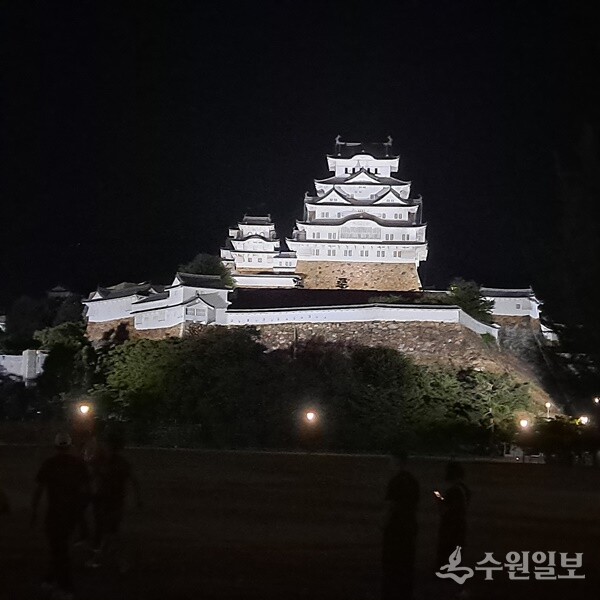
After this abundant and warm evening meal ended, we heard that Himeji Castle has lights illuminated every night and the scenery is beautiful, so we went to see it. The keep of Himeji Castle was whitewashed, and when white lights shone on it at night, the castle glowed silver.
Himeji Castle is said to have been the location of the domain offices of the Himeji Domain during the Edo shogunate period. And this Himeji Domain, which had a Joseon Envoy Mission anchorage called Murotsu (室津) nearby, is said to have served the role of entertaining the envoys when they anchored at Murotsu.
The next morning, we explored the interior of Himeji Castle that had glowed silver from the night lights. Touring the interior of Himeji Castle revealed the defense strategies of the Japanese, which differed from those of Korean castles.
This castle had a wide outer citadel, and even the inner citadel had multiple layers of castle walls leading up to the keep, allowing us to see the defense strategy centered on the domain lord.
Additionally, near the keep's gun ports (銃眼), there were openable and closable windows that allowed for concealed attacks, and inside the castle there were spaces to hide samurai and passages that could lead from the adjacent small keep. Here too we could glimpse the efforts of the Japanese to protect their domain lord.
It is said that for the construction of the castle, millstones belonging to residents and stone coffins from nearby burial mounds were also used—one can imagine what a massive undertaking it must have been.
Himeji Castle also has a garden called Kokoen (好古園). Upon inquiry, this place is said to be a garden created from a samurai's residence from the shogunate period. Hearing this made me think that this person, who could have a large mansion in the area near the keep where the domain lord worked or resided, must have been a samurai of very high status.
Upon entering Kokoen, there was a lake right away, and within it there was also a space with water flowing like a stream, so we could feel the natural beauty despite it being an artificial park. Since we visited in summer, we could only see the lake, the flowing water, and the lush green forest, which was regrettable.
However, there were spaces with seasonal flower gardens and flower gardens that would be nice to see in spring, and we heard that the autumn foliage is spectacular, so it was a garden we would like to visit again in autumn or spring.