Special Interview Dae-hee Han, Chairman of Gwangju Yeokdong Residents Council
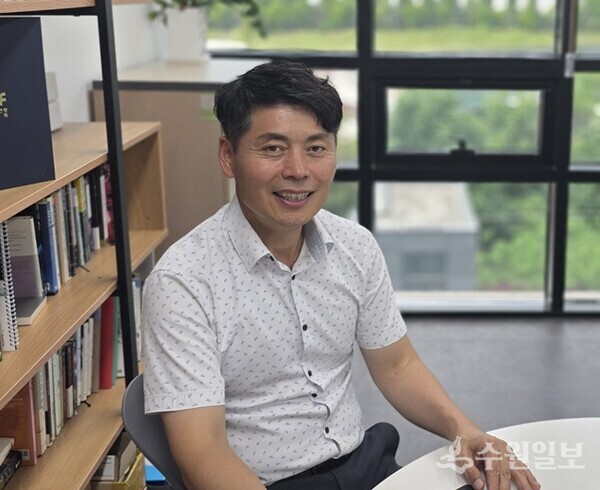
[News S = Reporter Eom In-yong] Dae-hee Han, Chairman of the Gwangju Yeokdong Residents Council, has been so busy lately that even ten bodies would not suffice. However, Han, who normally enjoys his work, believes that having abundant work is a blessing rather than a burden, and he is putting forth his utmost efforts, he hints.
A former track and field athlete, he serves as president of the Gwangju City Track and Field Federation, among various positions including chairman of the Chungju Han Clan Head Council, chairman of the "All Together Arirang" Volunteer Committee, and member of the Gwangju Jung-ang High School Board of Operators. He actively participates in and contributes to various organizations.
Recently, with the thought that original residents should not suffer damage as Gwangju continues redevelopment and reconstruction projects under the pretext of public development pursued through unilateral pressure tactics, Han, as a native of the hometown, assumed the position of chairman of the Gwangju Yeokdong Residents Council to voice residents' concerns.
We met with Dae-hee Han, Chairman of the Gwangju Yeokdong Residents Council, who is constantly engaged with citizens' lives and the field day and night.
- What is the direction for Gwangju Station area development?
▲ I believe the Gwangju Station area development should not be a bedroom town with only ultra-station-proximity apartments, but rather should reflect residents' opinions broadly, pursue long-term vision rather than nearsighted policy projects, and develop into Gwangju's core landmark to activate the local economy while looking to future generations.
- The Gwangju Station area splits into two directions. If you were to analyze it specifically?
▲ Regarding the Gwangju Station area development, I believe that from the outset, policies are needed at exits 1 and 2 to create spacious leisure areas for citizens along with parks, rather than "cramped chicken-coop apartments" concentrated with apartments. However, it is unclear for whom these policies are being pursued.
While Exit 1 is formed by commercial districts and semi-residential land development, Exit 2, centered around Kyeongan Market, the heart of Gwangju City, will deteriorate into an old urban area if only apartments are constructed without parks.
There is no linkage with the station area, and it is being upgraded to stage four, causing citizens' quality of life to deteriorate sharply. As the Yongin-Gwangju Line Gyeonggang Line extension and Seo-Gwangju High-speed Railway construction are being promoted and even new transfer stations are being created, public enterprises are still pursuing conventional station area development that goes against urban development policies. I believe such policy development must be reconsidered going forward.
- The Gyeonggi Housing and Urban Development Corporation (GH) is pursuing the project as public development?
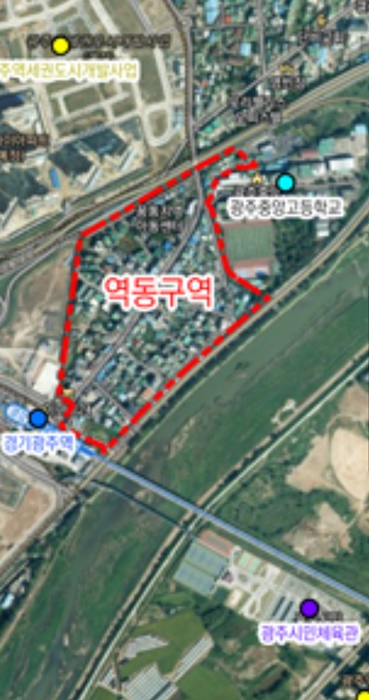
▲ Yes. The Gyeonggi Housing and Urban Development Corporation (GH) is promoting the Yeokdong Redevelopment Project in the Yeokdong area, Lot 141-6, Gwangju City, covering 111,000 square meters for public development. Currently, it is informing landowners of major contents including the project implementation process, redevelopment plans, estimated contributions, and future schedules.
In this process, most residents believe that if ultra-station-proximity sites are filled only with apartments without self-sufficient facilities, it will become a "bedroom town." Moreover, while the expression "chicken coop" may seem humorous, constructing only apartments will make the center of the city feel cramped and cut off connectivity with neighboring areas. While green parks should be installed in the surrounding area to provide more comfortable rest spaces, the relevant authorities seem focused on profit pursuit rather than residents' convenience. In the long term, I believe this goes against the purpose of local economic development and station area development.
Furthermore, in the first briefing, GH composed the complex as a mixed-use residential and commercial type unit with commercial facilities in front of the station, but in this second briefing, it changed to comprise entirely apartment complexes (35-45 stories) with some commercial-residential buildings in the back. This inconsistent policy and proceeding with the project through government convenience is simply incomprehensible.
- What are residents' opinions? Please elaborate specifically.
▲ If Gwangju Station area development, which is the face of Gwangju City, is accomplished simply by filling it with apartments, it will inevitably become a bedroom town. Green spaces should be boldly secured around the station. Through consultation with residents and land contributions, green spaces should be created to enhance not only the station's image but also its brand value.
Since the Yeokdong area in Gwangju is a border region with nearby Seongnam City, Icheon City, and Yongin City, it should be developed as a landmark facility for job creation and local economic revitalization through coexistence of commercial and business facilities. This will raise the city's dignity and value, and future generations will take pride in it.
- However, regarding the Gyeonggi Province ordinance proposal to lower the Urban and Residential Environment Improvement Act from the existing 67 percent to 50 percent—what does this mean?
▲ It means taking away residents' property. Because if the resident consent rate is lowered, residents lose their right to defend themselves. According to the superior law, the Urban and Residential Environment Improvement Act, the existing resident consent rate is 67 percent. However, if Gyeonggi Province creates an ordinance allowing the project to proceed with only 50 percent resident consent, I do not understand for whom this policy is intended. It greatly violates fairness, and if regulations change according to circumstances, it is unfortunate that innocent citizens end up suffering damage.
- There are accusations that land compensation was initially set absurdly low?
▲ The Yeokdong area of Gwangju is where residents have lived for hundreds of years, generation after generation. Taking the land at a mere 150 million won per pyeong during the first phase of the station area project and demanding sacrifice only from landowners in the name of public development is an undeniable major problem.
In a situation where land prices are rising throughout Gwangju City recently, how can original residents who receive low land compensation go elsewhere to live?