Port Special Pyeongtaek Regional Maritime Affairs & Fisheries Administration Operates 'Port School' as Communication Hub Between Government and Industry Playing Key Role
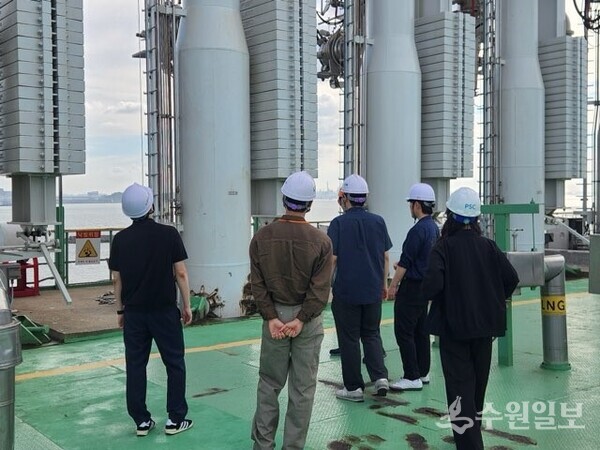
[News S=Reporter Kim Jong-sik] The field experience-type 'Port School' recently launched by the Pyeongtaek Regional Maritime Affairs & Fisheries Administration is receiving strong responses from staff and industry stakeholders.
This is because it has created a new 'field experience-type' communication platform that breaks away from the previous method of understanding the field through reports and data within office walls.
'Port School' is a format where 5 to 10 staff members from the relevant department directly visit licensed businesses, tour their facilities, and have discussions.
This program, which also brings freshness, is drawing attention as a new communication model for port administration.
◇ 'Port School' Finding Answers in the Field
Port School is conducted by conducting advance surveys of needs among Pyeongtaek Maritime Affairs & Fisheries Administration staff, and selecting the company that receives the most votes.
Through this process, it is highly effective in that it is not a 'unilateral visit' but rather staff directly select companies they actually want to learn about and gain knowledge on.
On July 22, the first program was held at the Korea Gas Corporation Pyeongtaek Base.
Staff from the relevant departments of the Maritime Affairs & Fisheries Administration received a briefing on the situation at the base, then toured the LNG storage tanks, cargo handling facilities, and LNG dock in succession.
On-site staff explained the complex facility operations and safety management in detail, and the officials built practical business knowledge by directly asking questions about matters they were curious about regarding licensing and regulatory processes.
In the process, Pyeongtaek Maritime Affairs & Fisheries Administration listened to on-site challenges while checking areas that could fall into regulatory blind spots and identifying policy improvement points.
On July 30, they visited Hyundai Glovis Pyeongtaek International Auto Terminal.
Walking around the dock and storage yards, they directly experienced the automobile logistics site handling over 1.5 million vehicles annually.
In particular, by observing the loading and unloading procedures of automobile carriers (car carriers) and safety management processes, they were able to understand how the logistics system operates.
Hyundai Glovis also had an opportunity to frankly convey the challenges arising between regulation and operations through Q&A sessions with government officials.
◇ Differentiated Attempt from Existing Public Service Culture
In the past, field visits related to licensing in port administration have often been conducted by a single official checking and verifying documents.
However, Port School at Pyeongtaek Maritime Affairs & Fisheries Administration introduced a method where entire department staff visit the site together.
As a result, knowledge and experience that had been concentrated on licensing and permit officials is being spread throughout the organization.
Industry officials also responded positively, saying "Unlike meeting government officials in their offices, being able to speak face-to-face at the site allows us to express opinions much more honestly."
In particular, since the purpose is 'learning and communication' rather than 'regulation-focused' inspections, there is less burden for companies.
◇ Will It Become a Model for Port Administration Innovation?
Ports are at the forefront of national logistics competitiveness and are critical sites for safety and environmental management. However, there has still been a distance between administrative agencies and industry characterized by 'regulator' and 'regulated entity.'
Pyeongtaek Maritime Affairs & Fisheries Administration's Port School breaks down these barriers and presents a new cooperation paradigm of 'public officials learning in the field and companies speaking from the field.'
If this program is established in the future, it is expected to develop beyond simple education or field tours into an innovative model where the voices of the field are reflected more actively in the port policy-making process.
Do Kyung-sik, Director of Pyeongtaek Maritime Affairs & Fisheries Administration, said "We will further activate Port School in the future to strengthen communication between staff and industry."