Kim Woo-young's Gwanggyo Column This Spring Day, Hwaseong Becomes 'Hwaseong, the Flower Palace of Colors'
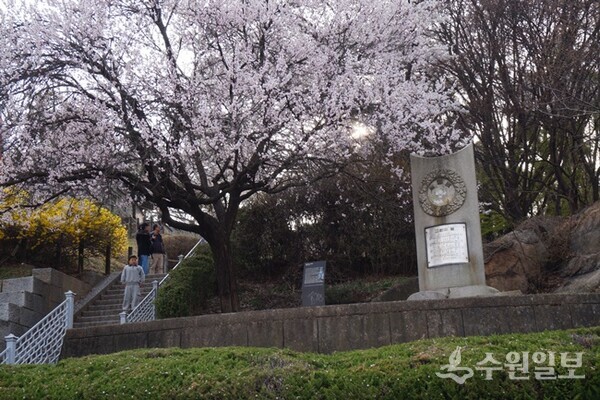
Sigh, I'm not even a spring beauty but an aging, dull man—why do my eyes keep being drawn to the flowers blooming profusely around the Hwaseong Fortress walls?
On an afternoon stroll, my steps naturally lead toward the Hwaseong fortress wall where cherry blossoms, apricot blossoms, forsythia, and azaleas are in full bloom.
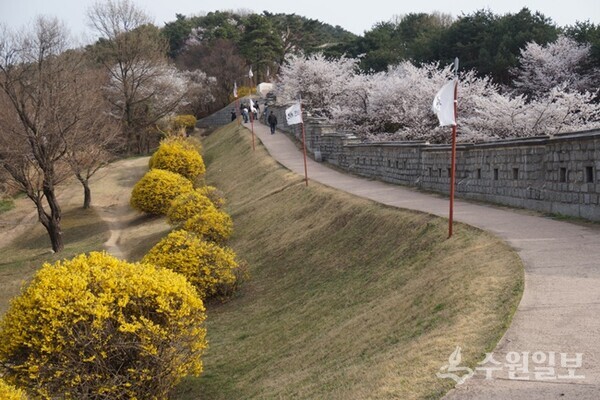
It's spectacular. Between the Southeast Corner Tower and Bongdon, the inside slope of the fortress wall features brilliant yellow forsythia forming another magnificent wall of color.
In front of Samil High School, inside Bukammun Gate and Gakgjeondae, cherry blossoms are in full bloom creating a grand sight.
Along the outer path from the Southwest Corner Tower up Paldal Mountain, cherry blossoms bloom abundantly. Inside the fortress, forsythia shines brightly. In the houses of the village below, towering magnolias blossom, capturing the eye.
Still, the best spots for spring cherry blossom viewing are Paldal Mountain's Hoiju Road and the waterside promenade of Gwanggyo Reservoir in Yeonmu-dong.
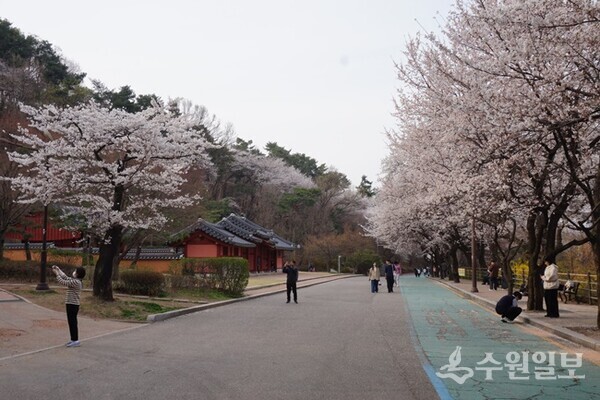
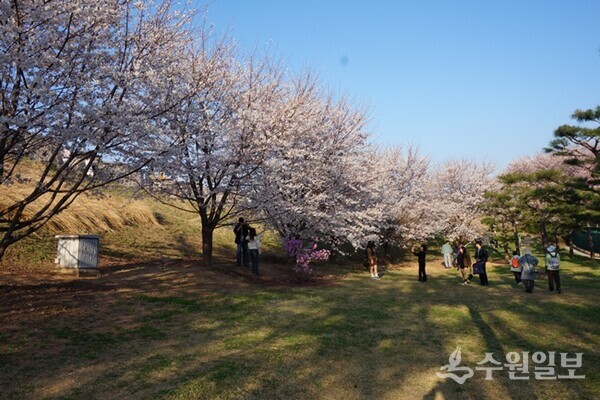
The early-blooming cherry blossoms are already shedding petals like rain.
I recalled poet Gu Hyang-soon's "Mourning the Flowers," published recently in Korean Poetry 2026 Spring Issue. Poet Gu is a dedicated poet who currently serves as executive director of the Suwon Poets' Association.
'The earth's heat suddenly rose / Cherry trees writhing in unseasonably early spring / It's a difficult birth / Premature infants bursting out like popcorn / Thick silence / While honeybees who would enjoy the flower feast sleep / On the first day, a downpour poured / Like a heartless hand weaning infants / All day the wind cries / Pitiful mothers weeping with engorgement / The disarrayed festival banner guards an empty parlor alone / After mourning the flowers, I suddenly ran a fever / Abruptly, living feels so strange.' -Gu Hyang-soon "Mourning the Flowers" (complete poem)
Poets certainly see what ordinary people cannot.
Seeing petals that never fully bloomed and fall in heavy rain and wind, they recall 'the heartless hand weaning infants' and 'pitiful mothers weeping with engorgement.' They 'mourn the fallen flowers.' That is why the sound of wind is 'weeping.'
But what can one do? I, who never gave birth and never experienced engorgement, find falling petals a blessing. I am a heartless poet who deliberately seeks them out when petals rain down.
That is why my favorite poem is "Fallen Flowers" by poet Lee Hyung-gi.
When is the time to go? / How beautiful is the back of one / who clearly knows and goes / In one spring / My love, having endured passion / is falling / Amid the scattered petals of parting / Blessed by separation / Now is the time to go / Toward the dense green foliage / And autumn bearing fruit not far away / My youth dies like a flower / Let us part / Waving delicate hands / On a day when petals fall, swaying and drifting / My love, my parting / Like water pooling at a spring / My soul grows mature / With sad eyes.' -Lee Hyung-gi "Fallen Flowers" (complete poem)
It is one of only a few poems that moved me, following "A Preface" by Yun Dong-ju, which first touched my heart when I came into this world, and "Early Spirit" by Kim So-wol. And it needs no explanation—it is a masterpiece.
Not lamenting but positively accepting the natural providence of birth, aging, sickness, and death; humbly accepting parting; and thus calmly accepting even death and going one's own way—what a beautiful back to behold.
Surely such a person is a saint.
Blooming, falling, bearing fruit, and dropping—all are predestined. So this one named Kim Woo-young, absorbed in flower-gazing while walking through Hwaseong, must surely be part of that destiny too...
Today as well, I shall simply walk my usual path. Occasionally turning to look back.