Kim Woo-young's Gwanggyo Column Jeon Hyeon-seok: The Unsung Partner of Independence We Must Not Forget
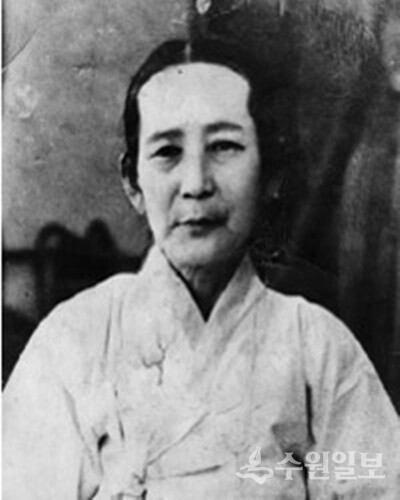
The wife of Suwon's independence activist Pildong Lim Myeon-su, 'The Mother of the Great Independence Army'
I visited Suwon City Hall as a special municipal city after a long time. Suwon has been publicly recruiting and selecting suppliers to provide return gifts for donors of the Hometown Love Donation Program, and this is my fourth year serving as a committee member of the Return Gift Selection Committee.
After the review ended, I stopped by Olympic Park across from City Hall. It is because there is a statue of independence activist Pildong Lim Myeon-su there.
Since June 13th is also Pildong's birthday, I wanted to pay my respects in advance.
I came to know Lim Myeon-su well after meeting with Lim Byung-moo, a poet and his grandson. Shamefully, in my younger days, I was ignorant of the activities of independence activists from our hometown.
"During the March 1st Movement, Suwon gisaengs shouted banzai," "Cheers echoed from Paldalsan," "Japanese brutally massacred our people in Jeam-ri"—that's about all I knew.
Then, in the 1980s, when I participated in the first compilation of the Suwon City History, I began to take an active interest in Suwon's history of the independence movement.
After that, I grew closer to Poet Lim. After writing an explanation for Lim's first poetry collection, we became friends, and we often spent time together with late dramatist Kim Seong-ryeol and others.
One day, Poet Lim showed me a bundle of materials. They were about his grandfather, independence activist Lim Myeon-su. These materials were introduced as articles in the media I worked with, and it became an opportunity to take even deeper interest in Lim Myeon-su.
Lim Myeon-su was a great independence activist who dedicated his entire life, his entire fortune, and even his family for independence.
He was also an educator who illuminated the darkness of the era.
Born in June 1874 as the second son in the household of a regional notable at 299 Bugsuri, Suwon-myeon, Suwon-gun, in Suwon.
With the determination to nurture talent in his hometown Suwon, he cooperated with regional notables and contributed to the establishment of Samil School. He served as vice principal and principal of Samil School, and devoted himself to educational activities by supporting the establishment of private schools. In 1907, he played a central role in spreading the National Debt Repayment Movement, which began in Daegu, to Suwon.
When the Japan-Korea Annexation Treaty was concluded in 1910, he led his family into exile to Manchuria in February 1912 to build an independence movement base.
To raise funds for the maintenance of Shinheung Military Academy and military training costs, he toured compatriots and worked diligently, and participated in Korean self-governing organizations in Manchuria such as Gyeongja Society and Bumin Group. In the mid-1910s, he also served as principal of Yangseong Middle School, a national school established in Hap-ni, Tonghua County. It is also said that Yangseong Middle School served as a branch of Shinheung Military Academy.
In 1920, he was captured by Japanese military suppression forces, but escaped during transportation. However, in 1921, he was captured again in Jilin City and transported to a prison in Pyongyang.
Torture left him partially paralyzed, but upon returning to his hometown, he continued his social and educational devotion. However, he ultimately passed away on November 29, 1930, at the age of 56, without witnessing liberation.
The great independence activist Lim Myeon-su had a great family.
Jeon Hyeon-seok (1871–1932), the wife of Lim Myeon-su, was called the "Mother of the Independence Movement." Madam Jeon supported the independence movement in Manchuria. While operating an innkeeping business in areas such as Tonghua County and Haeryong County in Manchuria, she cooked 5 to 6 meals in a single evening for independence soldiers who frequented the place, and made medicinal brews for sick soldiers. She changed bandages for the wounded, mended torn clothes, and even safeguarded the soldiers' weapons. It was not simply an inn but a secret base that served as a liaison point for the independence movement.
There are records stating that "among those engaged in the independence movement at that time, there were few who did not sleep at Madam Jeon's house, and there were none who did not eat the rice she personally cooked."
Lim Oo-sang (1893–1919), the eldest son of Lim Myeon-su and Madam Jeon, also devoted himself to the independence movement.
At a young age, he assisted his father in raising military funds and carried out activities such as supplying military provisions. It is said that Martyr Lim Oo-sang returned to Suwon in 1919, secretly met with Kim Se-hwan and others, raised military funds, and was heading back to Seogando when he succumbed to the bitter cold of the Manchurian plains.
Lim Myeon-su was registered as a person with services to independence in 1980 by receiving a Presidential Commendation, and in 1990, he also received the Order of Merit for National Foundation, Patriotic Service Medal.
In 2015, the "Committee for Promoting Memorial Projects for Independence Activist Pildong Lim Myeon-su" was organized in Suwon, centered on academics and civic organizations. With nearly 100 million won in citizen donations, a statue was also erected in Olympic Park across from Suwon City Hall.
In 2018, he was also honored in the "Suwon City Hall of Fame" in the lobby of Suwon City Hall.
However, the achievements of his wife, Madam Jeon Hyeon-seok, and his son, Martyr Lim Oo-sang, remain little known.
In 1963, in "A Brief History of the Late Pildong Lim Myeon-su, Patriot of Liberation," compiled by Heo Young-baek from testimonies of those who worked together in Manchuria, the content about Madam Jeon Hyeon-seok is as follows:
"...(omitted)...Always with a smiling face, she served food to sick comrades and comforted them, encouraged soldiers returning from battles, made medicinal brews for the wounded and bandaged them while consoling them that independence would come soon...(omitted)...As she prepared meals 5 to 6 times in a single evening for special units and special envoys who frequently arrived unexpectedly...(omitted)...How can one express in words the seeming unbelievable hard work and suffering of safeguarding soldiers' weapons, mending their torn clothes, and personally touching their wet foot wrappings...(omitted)...Everyone bowed their heads before the patience, gentleness, and propriety of Madam Jeon Hyeon-seok, and she earned the reputation of being the Mother of Independence. Therefore, among those engaged in the independence movement at that time, there were few who did not sleep at the Master's house, and there were none who did not eat the rice that Madam Jeon Hyeon-seok personally cooked. Indeed, the Master's house was a resting place for independence activists, a weapons storage, a conference room, a staff room, a supply depot, and a maintenance facility, and for ages they sacrificed and served...(omitted)"
Madam Jeon Hyeon-seok passed away in 1932, two years after her husband Lim Myeon-su departed this world.
There was a great family in Suwon that gave everything.
I hope that beside the statue of Lim Myeon-su in Olympic Park in front of Suwon City Hall, statues of his wife Madam Jeon Hyeon-seok and his son Martyr Lim Oo-sang will also be erected. In this way, I hope the story of this family will become widely known and long remembered.
This is also the final wish of my friend Poet Lim Byung-moo, the grandson of Lim Myeon-su and Madam Jeon Hyeon-seok.