Editorial What Will 'Direct-Line Mayor Park Gwan-yeol's' Gwangju City Administration Look Like After Four Years?
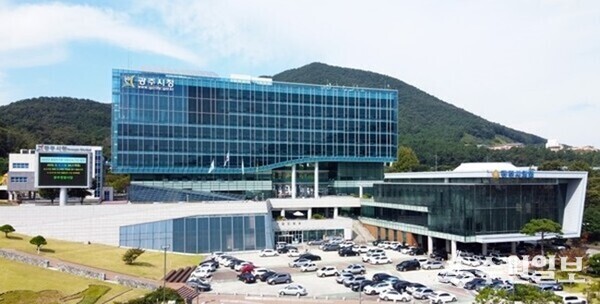
Gwangju City in Gyeonggi Province was one of the regions that drew attention in the 9th nationwide simultaneous local elections held on June 3rd. In this region, Democratic Party candidate Park Gwan-yeol and People Power Party candidate Bang Se-hwan faced off. Pre-election forecasts suggested that candidate Bang might have a slight advantage, positioning his administrative experience and track record of policy implementation as a sitting mayor as his greatest strengths. However, the result was a victory for candidate Park, who garnered 105,926 votes, recording a vote share of 56.18%. Candidate Bang Se-hwan received 82,611 votes, achieving 43.81%. The gap between the two candidates was 23,315 votes.
Mayor Park Gwan-yeol held his inauguration ceremony on July 1st at the Namhansanseong Hall of the Gwangju City Culture and Arts Center and began his duties. (Related article: News S, July 1st, 'Mayor Park Gwan-yeol of Gwangju: "Realizing 'Direct-Line Gwangju' where administration directly connects with citizens"') His opening remark was, "I will create a city where administration does not come before citizens, but where administration first reaches into the lives of citizens." He pledged, "I will not be a mayor who only receives reports, but become a direct-line mayor who directly connects with citizens." He also proclaimed his 9th term city administration slogan: "My life that directly works, Direct-Line Gwangju."
Additionally, he stated he would realize customized welfare tailored to each life cycle stage. In this process, he also shared his own life story. Mayor Park is a self-made individual who rose to his position through his own efforts. Mayor Park's childhood was marked by poverty. After completing elementary school, he did not pursue formal education. After farming, he came to the city on impulse and became a child laborer. He worked at bakeries, tailoring shops, and collecting waste paper. After working diligently, he established a company and became its representative, but the regret of "not having received an education" was deeply embedded in his heart like a large nail.
Only after turning forty did he resume his studies, completing middle and high school through the qualification examination, then enrolling at Kangnam University where he majored in economics and obtained a bachelor's degree. Subsequently, he enrolled at Korea University's Graduate School of Public Policy and received a master's degree in political science.
It is only natural that welfare focusing on "the lives of ordinary citizens" is one of Mayor Park's concerns after going through such a journey. His city administration policy is: "Since welfare is not merely support but the act of preserving people's dignity, I will implement life-cycle-oriented welfare that seeks people out through a welfare navigation system, rather than welfare that requires application."
"Citizens' lives" occupy a prominent place in the five major city administration goals for the 9th term that Mayor Park announced at his inauguration. These include: △Innovative administration co-created with citizens and foundational social city △A citizen-happiness city where learning and care become daily life △A future economic city integrating artificial intelligence, energy, and cultural tourism △An innovative transportation city based on smart technology △Creating a 30,000-unit artificial intelligence smart self-sufficient city centered on transit-oriented development. These are the city administration goals presented by Mayor Park.
His three major transportation pledges announced during the election process are: △"Gwangju Dream Pass," providing full transportation fare support for children and youth △Expansion of the "100-won Filial Piety Taxi" for transportation-disadvantaged groups △Introduction of the "Gwangju-type Night Owl Bus" operating during late-night hours. These pledges also reflect consideration for ordinary citizens and transportation-disadvantaged groups.
Regarding the water supply issue for the Yongin Semiconductor National Industrial Complex, a recent regional concern, Mayor Park states, "While cooperation for national strategic industries is necessary, Gwangju's sacrifice should not be taken for granted," and is confidently demanding government projects for Gwangju's future, including designation as a special support area for semiconductor and artificial intelligence co-prosperity, attraction of advanced industry and research and development functions, and expansion of metropolitan transportation networks and educational infrastructure. We look forward to seeing what "Direct-Line Mayor Park Gwan-yeol," who says "I will be a mayor preparing for the next generation, not a mayor preparing for the next election," will achieve in Gwangju's city administration over the next four years.