Editorial Governor Choo Mi-ae's Directive for 'Overresponse' in Preparation for Heavy Monsoon Rains Is Justified
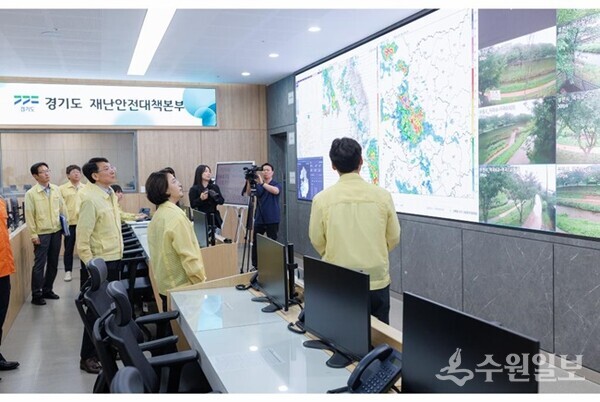
After reviewing comprehensive measures for wind and water disasters on the 6th, Governor Choo Mi-ae of Gyeonggi Province posted the following on her social media: "There is no such thing as 'overresponse' when it comes to the lives and safety of provincial residents." This expressed her determination to respond proactively to anticipated disasters such as heavy monsoon rains.
Governor Choo stated, "Disasters can destroy someone's day and the lives of an entire family in an instant," citing last year's Gapyeong floods as an example, and said, "This year, we will prepare more thoroughly and proactively to ensure that such suffering is not repeated."
In the summer of last year, record-breaking heavy rains poured down on the Korean peninsula, causing simultaneous occurrences of river flooding and landslides. In the early morning of July 20th, heavy rains fell on Gapyeong County. Within four hours, about 200mm of rain fell. As the river rapidly overflowed, a considerable number of buildings, roads, and bridges near the river and valleys were lost or damaged, and landslides occurred simultaneously. As a result, 10 people died and 1 person went missing.
Prior to this, on the 16th, a retaining wall collapsed at the Gajanggyo intersection in Gasan-dong, Osan City, burying two vehicles passing by, and the driver of one of the completely buried vehicles died. What is tragic is that on September 1st, an employee of the Korea Land and Housing Corporation (LH), the commissioning agency, ended his own life, saying he was lonely and struggling because of the Osan retaining wall construction project. The deceased was a senior-level employee who had overseen on-site construction supervision when the western bypass road section (4.9 km) from Yangsan to Gajeong, which included the problematic retaining wall, was constructed between 2006 and 2012.
At the venue where she reviewed comprehensive wind and water disaster measures, Governor Choo emphasized that disaster response systems should be strengthened by city and county, and high-risk areas for casualties should be intensively managed. She instructed that a preparedness posture be established by city and county centered on deputy heads of local government, and that pre-surveillance and safety inspections be strengthened for the three major high-risk areas with significant casualty risks: landslides, rivers, and underground spaces.
Governor Choo stated that access to areas where danger is anticipated will be restricted in advance, support systems for priority evacuation targets such as the elderly will be reorganized, and response systems will be strengthened so that residents can quickly evacuate in advance when signs of emergency situations appear.
Governor Choo, who pledged to "do our best to protect every single life and the daily lives of every family," demonstrated her determination to "take the lead in observing, controlling first, and acting first in Gyeonggi Province." For her determination to be realized, vigilant field administration by Gyeonggi Province and public officials of each local government within the province is absolutely necessary. Now that the monsoon season has begun is precisely the time when 'overresponse' and 'proactive response' are required.