Kim Woo-young Gwanggyo Column Forgetting the Heat in the Fragrance of White Lotus and Chicken Baeksuk at Tapdong Citizens' Farm
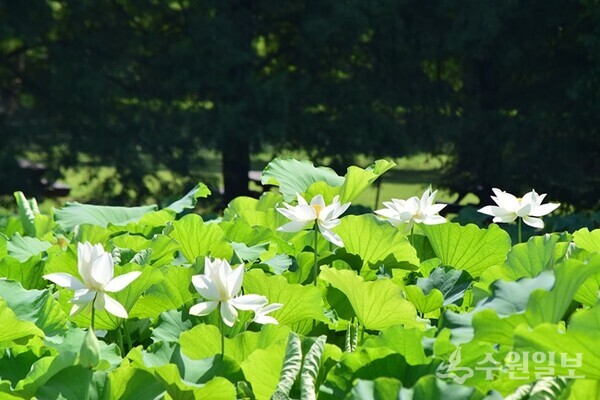
The temperature that day was 35 degrees Celsius.
I thought it might have been the hottest day of the year so far.
Yet for some reason, I suddenly felt the urge to visit Tapdong Citizens' Farm. In truth, I had been thinking about it for several months, but it was difficult to carry out. Tasks that earn no money, or rather most of which require spending, hung heavily from my schedule like bunches of fruit.
I was planning to walk slowly from Suwon Station through Gyeonggi Sangsang Campus when a call came from my younger brother living in Bongdam.
He said he was making chicken baeksuk loaded with various medicinal ingredients and told me to come down.
I had called out my older brother, who had fallen into despair at home after losing his appetite for food and drink following the recent death of a nephew whom I had raised like a son in childhood. There is a saying, after all, that people become a comfort to one another in difficult times.
I also invited my old friend C, who had been lounging at home, foregoing his vegetable garden in the scorching heat.
Fortunately, C brought his car, so the journey was easy.
Before heading to Bongdam, I stopped by Tapdong Citizens' Farm first.
I arrived around 10 a.m. Given the oppressive summer heat, I expected no one to be there.
But throughout the citizens' farm, I noticed people reading books under the shade of trees, people with camera lenses like cannons photographing the scenery, and citizen farmers sweating profusely while tending and harvesting their crops.
An elderly couple trimming a lush heap of Welsh onions in the shade said they had arrived at 5 a.m. When I asked how they managed to cultivate it so well, they replied with seeming nonchalance, "We just planted it and it grew, you know," yet could not hide their satisfied expression.
In place of the harvested Welsh onions, they would plant more to use for kimchi preparation.
Though I am not in a position to farm here, I do envy this sight each time. I find myself wanting to grow fresh lettuce and other vegetable wraps, as well as tomatoes, eggplants, cucumbers, potatoes, and peppers.
But no, let it be. They say crops grow listening to the farmer's footsteps, and I have no confidence in visiting frequently to check on them.
While watching crops grown by citizen farmers has a great effect in healing the stress of city life, sitting on the vast, open lawns of this nature-friendly space in the heart of the city and in the tree shade surrounding them is itself a beautiful form of healing.
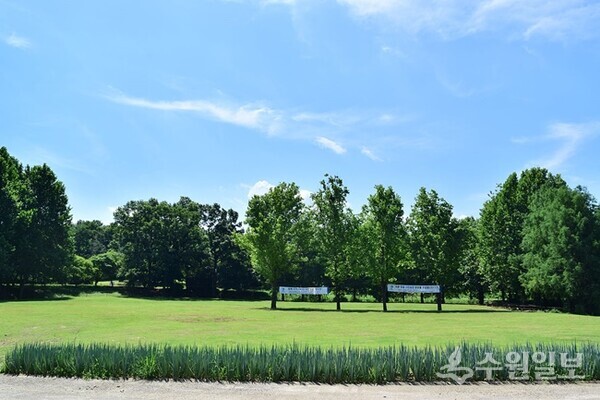
Tapdong Citizens' Farm, spanning a total of 37,635 square meters, consists of vegetable plots in three zones, an ornamental garden where flowers are cultivated, and a lawn.
Among these, the area where seasonal flowers are tended is the most beloved by visitors.
According to officials at the Suwon Agricultural Technology Center, the citizens' farm attracts 450,000 visitors annually.
It is also beloved as a photo spot where visitors can capture life's memorable moments, presenting different scenery with each season.
Tapdong Citizens' Farm has become an established destination loved by citizens, with seasonal flowers including lotus, buckwheat, poppies, bachelor's buttons, sunflowers, and cosmos blooming throughout the year.
I recently heard that yellow cosmos had bloomed in full, but they have all withered, and now young cosmos shoots are growing.
Instead, white lotus has begun to bloom in abundance.
While not quite as renowned as Korea's most famous lotus destinations, the white lotus garden spanning 1,320 square meters beside the central lawn plaza displays pristine white lotus flowers in a pure and elegant form, emanating a subtle fragrance, making it worth visiting on a day when the intense heat subsides a bit.
Tapdong Citizens' Farm was established in 2019 on the site of the former Seoul National University of Agriculture's experimental livestock facility in Tapdong, Gwonseon-gu. It was created as a replacement for Dangsoo-dong Citizens' Farm, which was closed in 2018 due to urban development (Dangsoo public housing district development project).
Tapdong Citizens' Farm is smaller in scale than the former Dangsoo-dong Citizens' Farm.
Still, it is closer than Dangsoo-dong. Located adjacent to Gyeonggi Sangsang Campus, which occupies the former Seoul National University of Agriculture site, it offers convenient transportation. It is an easily accessible walking course that can be reached in 20 minutes on foot from Suwon Station (by my pace, of course).
It is not easy to find such a wide-open and beautiful landscape in Suwon.
I recommend not only visiting Tapdong Citizens' Farm but also stopping by Seodun Night School, located at the southwestern end of the farm. Three classrooms of Seodun Night School still remain.
From 1965 to 1983, this was where students from Seoul National University's College of Agriculture and Life Sciences and College of Veterinary Medicine taught young people in the western regions of Suwon. Poet Yi Jong-gu, from Gosaek-dong, who passed away last month, also studied here starting in 1978.
The site was purchased with donations from college student teachers at the night school, and the buildings were constructed by teachers and students themselves. Even the desks and chairs were reportedly made in-house.
It was a day so hot that white salt from perspiration was visibly formed on my forearms.
Yet my mind felt refreshed. It seems my body felt better too. The eye infection that had troubled me all last week began to heal, and my cough subsided. After visiting Tapdong Citizens' Farm.
The herbal chicken baeksuk that my younger brother in Bongdam and chef B had lovingly prepared together must have also played a part in the improvement.