Kim Woo-young Gwanggyo Column 'Hwaseong Golden Coast Road', This Was the Path My Heart Had Always Dreamed Of
Perhaps the wind that day was blowing from the western sea. Looking at how my heart and then my body were drawn there.
But the sunlight was too scorching. It's natural that summer is hot, but the wind blowing from the sea was also a heat wave.
When I was young, I preferred summer to the cold winter. Whenever I had a chance, I would roam around mountains, fields, rivers, and the sea.
But at some point, the summer heat became unbearable. In the cold winter, people can wear padded jackets and thermal underwear that keep warm and go about, but with heat, there's no way around it. Even taking off clothes, it's still hot.
That said, I don't prefer spending all day indoors with the air conditioner on, as it makes me concerned about electricity bills and it's not good for my health either.
On top of that, I'm a person who can't sit in one place for long. Except when I'm concentrating on my manuscript.
It seems like the character for wind (風) is definitely in my fate.
Heat... In fact, I've experienced extreme heat beyond imagination.
In the summer of 2017, I traveled to parts of the Silk Road including Urumqi, Dunhuang, Yumen, Shanshan, Hami, and Turpan.
That's when I encountered the 'record-breaking' heat of my life.
In Turpan, where Flaming Mountain is located, I finally understood what 'fiery heat' was like. I could now understand why the ancient Chinese novel 'Journey to the West' has Sun Wukong borrowing a palm-leaf fan to extinguish the flames of Flaming Mountain as he passes through. It was only natural that the mountain, whose shape and glowing appearance evoked flames, was given such a name.
I heard from a guide that the geothermal temperature exceeded 80°C, and I actually saw merchants burying and cooking eggs in the soil to sell them. It was truly a 'fiery inferno'. (It's said to be listed in the Guinness World Records as one of the hottest places on Earth with surface temperatures reaching as high as 89 degrees.)
In the desert, some people struggled as the soles of their shoes melted.
The daytime temperature in the city exceeded 50°C. At 1 a.m. in front of Turpan Station, even the temperature of the strong winds coming across the desert exceeded 40°C.
If you asked me now if I would go again, well, I think I would need to think deeply about it. Back then, I didn't know it was that extreme and went on a whim... It's been 10 years already.
Though not to that degree, recently when the afternoon temperature was 35 degrees Celsius, I walked the 'Hwaseong Golden Coast Road' on the west coast.
It was an outing I went on with a high school senior, a classmate, and one other person, saying let's just get some fresh air.
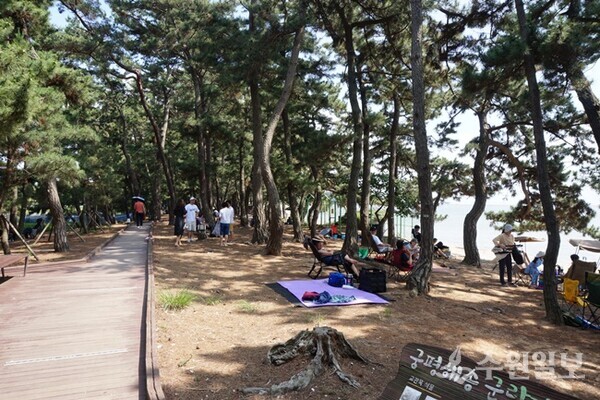
After briefly looking at the sea scenery at Gungpyeong Harbor, we moved our steps to the northern deck road. We wanted to see at least part of the 'Hwaseong Golden Coast Road' recently developed by Hwaseong City.
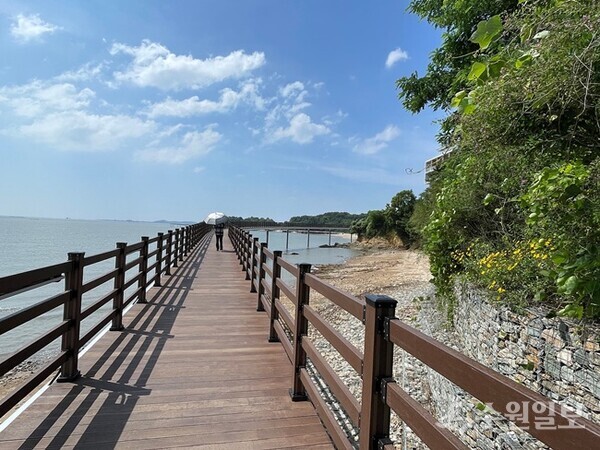
The 'Hwaseong Golden Coast Road' is a pedestrian path with a total length of 17 km that follows the Hwaseong coastline from Jebu Island through Baekmi Harbor to Gungpyeong Harbor. It was given this name because you can see the spectacular sight of the sunset turning the sea and mudflats golden at dusk.
Walking this path, you can appreciate the majestic and enchanting sunsets of the west coast, vast mudflats, fishing village scenery, and dense maritime pine forests. In addition, you can feel the fresh sea breeze on your entire body and hear the stories of seagulls as you walk along this pleasant path.
Section 1 (5 km) is the 'Sunset Scenic Road' starting from Jebu Island, where you can appreciate coastal scenery while watching the setting sun. Section 2 (4.5 km) is the 'Salt Sea Road' in Songkyo-ri where you can walk over the sea and enjoy the horizontal landscape of the sea and salt fields. Section 3 (7.5 km) has been developed as a 'Coastal Tourism Deck Road' around Gungpyeong Harbor from Baekmi Harbor, with photo zones and other facilities.
The group started from Section 3 at Gungpyeong Harbor.
Unable to endure the strong sunlight and heat, one of my friends stopped walking in the maritime pine forest and moved by car, but the remaining two of us kept saying "let's go a bit further" and "let's just go to that corner and come back," and eventually walked all the way to Baekmi Harbor.
But this path showed us scenery magnificent enough to endure the scorching 35-degree heat. Though not quite on the level of Geumgangsan's Haegeum Peak or Samil Falls, it was a premium path worth taking time out of your schedule to walk.
Of course, since it's not an officially opened path, there are still no information signs showing the current location or the entire course, but among the paths I've walked in recent years, it was certainly the finest.
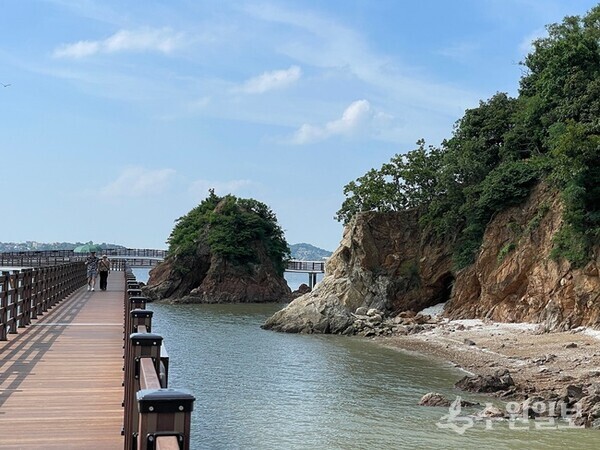
In fact, this path was already quite famous among walking enthusiasts before the Golden Coast Road development. It was selected as one of 52 'nice coastal paths to walk' by the Ministry of Maritime Affairs and Fisheries.
I heard from a Hwaseong City official that the city invested a considerable budget in developing this path to 'make it Korea's representative marine tourism resource.'
They also mentioned that they expect positive ripple effects such as boosting the local economy through tourist inflow and spending.
Though only partially, my thoughts after actually walking the Hwaseong Golden Coast Road were the same. Once this heat passes and autumn comes, this path will be overflowing with visitors.
They will open their wallets at Gungpyeong Harbor, Baekmi-ri, Jebu Island, and at cafes and restaurants in villages along the way.
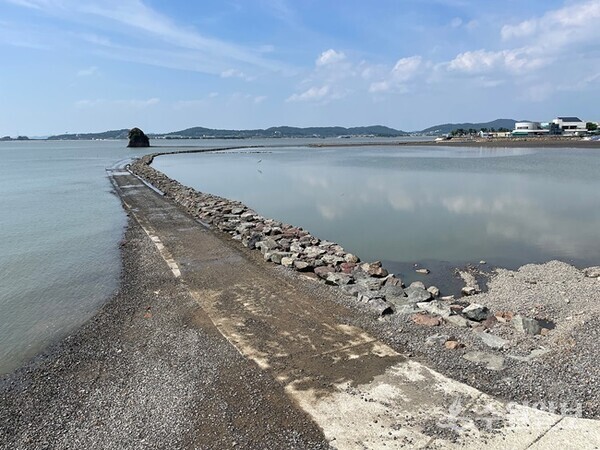
Hwaseong City's plan is to make this path a marine tourism resource not only for Hwaseong City but for the entire nation and, further, the world.
Once the path is officially opened after addressing its shortcomings, pedestrian travelers from the Seoul metropolitan area and across the nation will flock there. And the Hwaseong Golden Coast Road will be recorded as one of the important achievements of Mayor Jeong Myeong-geun.