Professor Shin Hee-baek of Daelim University Publishes New Technique for Speech-Language Pathology Treatment of Parkinson's Disease Patients in SCI-Class International Academic Journal
[News S=Reporter Um In-yong] The incidence of Parkinson's disease patients has increased significantly in recent times.
In line with this trend, the nation's leading expert in treating language disorders accompanying Parkinson's disease has signed a memorandum of understanding with the Korean Parkinson's Association and is delivering special lectures at various universities, garnering attention.
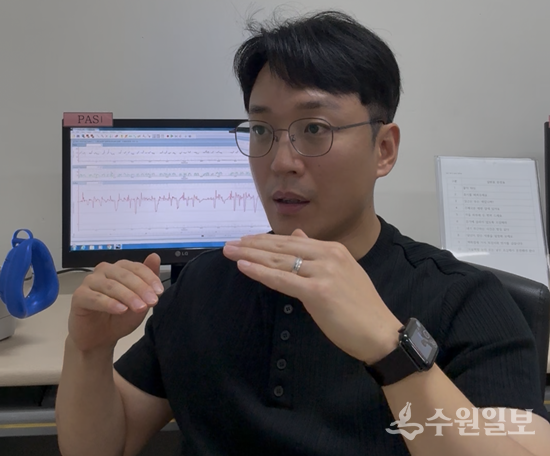
The person in question is Professor Shin Hee-baek of the Department of Speech-Language Pathology at Daelim University.
This newspaper met with Professor Shin to intensively examine the current state of Parkinson's disease.
The following is a Q&A session
- Your doctoral dissertation on new techniques for treating speech-language pathology in Parkinson's disease patients was published in an SCI-class international academic journal?
"To put my research simply, it is 'how to deliver the speech of Parkinson's disease patients to the listener in a clear state.' During my doctoral program, I developed CSIP, or Clear Speech Intervention Program in English. The first study involving fifteen Parkinson's disease patients was published in 'International Journal of Speech-Language Pathology' Volume 24, Issue 1 in 2022.
The journal is indexed in both SCIE and SSCI. Over four weeks with a total of eight sessions of intervention, speech intelligibility, intonation, intensity, and articulation all improved statistically significantly. Last year, I published a follow-up clinical study in the journal 'Communication Sciences & Disorders' Volume 30, Issue 4, where eleven Parkinson's disease patients underwent eight sessions over four weeks, showing positive improvements in variables contributing to enhanced speech intelligibility."
- What kind of disease is Parkinson's disease?
"Parkinson's disease is a neurodegenerative disorder in which the nerve cells in the brain that produce dopamine gradually decrease. People commonly know it by hand tremors or slowed gait, but in fact it affects speech and voice equally. The voice becomes quieter, intonation becomes flat, and speech accelerates and becomes slurred. Often the voice sends signals even before tremors, but this is not captured in the scale that divides the stages of progression. I compared this to an iceberg. What is visible above water is tremor and rigidity, but submerged below water is the quieted voice and slurred pronunciation. What makes it more difficult is that patients often are not aware of it themselves. A patient may feel they are speaking at a volume of 100, but actually only 30 comes out. So when they come to treatment, they say things like, 'People ask me if I'm angry.' 'My grandchild won't come to me saying Grandpa is scary.' Since even the facial muscles become rigid, all pathways through which emotions can be conveyed to the outside world are blocked. You can think of it as a voice gauge being calibrated incorrectly, and speech-language rehabilitation is the work of recalibrating that gauge."
- The incidence of Parkinson's disease patients has been increasing significantly recently. If you compare the global trend with the domestic trend?
"Since age is the greatest risk factor for Parkinson's disease, it follows the pace of aging. According to a global burden of disease study published in the British Medical Journal last year, the global patient population is projected to increase from 11.9 million in 2021 to 25.2 million in 2050, an increase of approximately 112 percent.
89 percent of the increase is due to aging, and East Asia in particular is expected to account for 10.9 million, the largest share. South Korea is no exception. According to data from the Health Insurance Review and Assessment Service, Parkinson's disease treatment patients increased from approximately 125,000 in 2020 to 143,000 in 2024, an increase of nearly 14 percent in four years. As we have entered a super-aged society, the pace will accelerate further going forward.
However, what concerns me more is not the numbers themselves. Patients are increasing like this, but the workforce and systems to address speech and voice remain largely unchanged. Medications and surgeries to solve movement problems are advancing, but there is no one to handle the 'speech problems' that remain afterwards."
- I understand that you recently signed an MOU with the Korean Parkinson's Association and are giving special lectures at various universities?
"I signed a memorandum of understanding with the Korean Parkinson's Association on August 29, 2025. It was a comprehensive agreement encompassing low-cost speech-language rehabilitation services, research participation, student volunteer linkages, and expert special lectures.
The patients who participated in the clinical research last year were also recruited through the association, and an announcement on the association's website for 'Recruitment of research participants for Parkinson's disease voice speaking research (Daelim University)' was posted.
This year, twenty-four undergraduate students conducted mentoring activities with the association, and students also engaged in voluntary service activities. I gave a special lecture on May 8 at Daejeon Han-Bang Hospital of Daejeon University.
On June 10, I signed the AC3 project agreement with MindHub, an AI cognitive and language solutions company, and Anyang Senior Comprehensive Welfare Center.
AC3 is an acronym for 'Aged Care Communication Center,' a project aimed at improving the quality of life of the elderly through communication.
We plan to operate it as a pilot starting in the second semester. At such gatherings, I always convey one message: voice problems are not a subsidiary symptom of the disease but the most significant factor affecting quality of life. My heart grows heavy each time patients say, 'I'm hearing this for the first time now.'"
- Korea's large hospitals have well-established medical administrative services for insurance and diagnostics, but what about the speech-language therapy sector for children and adult treatment?
"To be honest, it is quite unbalanced. The pediatric sector has a voucher system and increasing community centers and private facilities, so while not perfect, there is a path. The problem is the adult sector. Patients with stroke or Parkinson's disease receive speech-language therapy in hospitals, but the moment they are discharged, it stops. There are almost no places in the community to continue treatment. Speech actually recovers over several years after discharge, but the system ends in a matter of weeks. Having many large hospitals is completely different from having places for patients to continuously receive treatment near their homes. That's why Gyeonggi Province opened the Adult Language-Cognitive Integrated Service, an adult voucher system, and when I was operating a center in Yangpyeong, many adult patients received speech-language rehabilitation from me through community vouchers. Like these attempts, diverse social support for adult speech-language rehabilitation is urgently needed."
- Then, in advanced countries like the United States, Japan, England, Germany, and France?
"Systems vary by country, but in the United States, speech-language pathologists (SLPs) are placed not only in hospitals but also in schools, care facilities, and home visits. In England, rehabilitation pathways are established within the national healthcare system, and Japan, having experienced aging earlier, incorporated swallowing and speech rehabilitation into senior care. There are multiple programs: LSVT LOUD for voice, LSVT BIG for body movement, and SPEAK OUT!, among others. Among these, LSVT LOUD is on the speech-language therapy side and LSVT BIG is on the physical therapy side. What matters more than the name is that whichever it is, the final goal is 'arrival in daily life.'
However, I believe that if comparison ends in envy, it only adds to exhaustion. Comparison should be guidance, not judgment, and through that guidance, we must find our way and create small links that we can bring about in our own circumstances."
- You mentioned, 'We need to create small links that we can bring about in our own circumstances.' What small links are you currently creating?
"The Department of Speech-Language Pathology at Daelim University is currently actually operating speech-language rehabilitation services for Parkinson's disease patients. Since last year, student speech-language rehabilitation interns have been directly providing speech-language rehabilitation services to Parkinson's disease patients under the guidance and supervision of the department faculty. During the semester, I teach, and during breaks, I recruit Parkinson's disease patients and directly provide CSIP. Over the three breaks—last summer and winter, and this summer—I have met with approximately thirty Parkinson's disease patients in total. Based on that data, I am confirming improvements in the speech intelligibility of patients, and I am preparing these results as a separate paper."
- I understand you were elected president of the Korean Language-Speech Pathology Majors Student Council and shaved your head for the speech-language pathology national examination, leading national university student representatives numbering 1,000 to 2,000 in protests going back and forth between the National Assembly, Ministry of Health and Welfare, and Press Center?
"That was in 2012. In August of that year, the Disability Welfare Act was amended and speech-language pathologists finally became a national credential. But students strongly opposed how this credential would be managed.
There were various issues raised, including who would create and evaluate the examination, and whether prescriptions from other professions were necessary for treatment, but the core that we held onto till the end was one thing: who would ensure and how the quality of the credential. Our students prepared for this credential by attending thousands of hours of lectures and completing clinical practice, and we believed that if the threshold became loose, ultimately the patient would suffer. So students majoring in speech-language pathology from across the nation gathered in the streets, and as council president, I shaved my head at that gathering. I still remember the faces of those students in their early twenties who skipped classes and came up to Seoul. I learned one thing from that time: professionalism is not recognized automatically but must be proven and maintained by oneself. That's why I continue to write papers and books today."
- Do you think Korea's speech-language pathology-related academic societies and associations are fulfilling their functions and roles?
"They are active. The Korean Speech-Language Pathology Clinical Society and the Korean Speech-Language Pathology Association are representative examples. They publish academic journals and hold annual academic conferences, serving as a bridge between research and clinical practice. My paper from last year was published in the journal of the Korean Speech-Language Pathology Clinical Society, and I am serving as publicity director of the Korean Speech-Language Pathology Association and preparing for this year's academic conference. This year's Korean Speech-Language Pathology Association academic conference will be held in November at our school, Daelim University."
- I heard that a book helpful for treatment will also be published soon.
"I am currently in the editing phase and expect it to come out around September or October. I wrote it not as a professional textbook for therapists but as a book patients and families can read at home. So I start not with theory but with stories I have heard from patients I've met."
- Finally, the app development you have planned?
"It's a speech training app adapted from my research, CSIP, so patients can practice and train at home.
However, I want to make one thing clear: this tool is not a medical device for making diagnoses. I want to show patients that they can reflect on their own voice and that there are ways to improve. The final judgment is made by people, and while I'm not sure when it will be completed, recruiting Parkinson's disease patients to participate in the initial pilot is also an important task."