Editorial Anticipating Suwon City Ballet's 'Echo of Cell 8, Seodaemun Prison'
Suwon City Ballet (SCB), founded in 2007, is Suwon's first private ballet company. With the vision that 'ballet can breathe and remain in the daily life of the city,' it is an organization that continues to perform despite difficulties, making ballet an art form that is more accessible and naturally reaches more people. Every year, through charity performances and outreach performances and collaborations, it provides cultural enjoyment opportunities for people with developmental disabilities and the culturally underprivileged.
A distinctive characteristic of Suwon City Ballet is that while cherishing the refined aesthetics and depth inherent in classical ballet, it has created works through which audiences can relate without burden via stages where stories and emotions come alive.
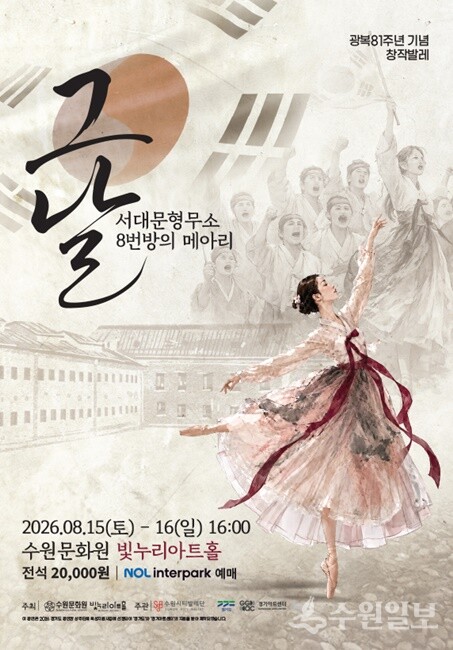
The original ballet 'That Day, Echo of Cell 8, Seodaemun Prison,' to be performed on August 15 and 16 at 4 p.m. at Suwon Cultural Center's Bit Nuri Art Hall, is one such effort. This work is a creative piece that combines local history and artistic excellence, expressing the courage and solidarity of female independence activists through movement and music. (Related article: News S, 21st, 'Stories of Female Independence Activists Revived Through Ballet on Liberation Day') Selected as the '2026 Gyeonggi Province Performance Venue Resident Group Development Support Project,' this work depicts the story of female independence activists who were imprisoned in Cell 8 of Seodaemun Prison during the Japanese colonial period.
In particular, it centers on the story of Kim Hyang-hwa, a prominent female independence activist from Suwon. Kim Hyang-hwa was a first-class gisaeng (female entertainer) at the Suwon Gisaeng Association, excelling most among her peers in dance, singing, and other performance arts. When Emperor Gojong passed away, she dressed in mourning attire on the day of his funeral and led about 20 fellow gisaengs to Seoul, where they wept in lamentation in front of Daehan Gate at Deoksugung Palace, expressing their sorrow over the nation's fall.
During the March 1 Movement in 1919, she led mass demonstrations with about 30 gisaengs from the Suwon Gisaeng Association in front of Suwon Jahye Clinic and Suwon Police Station. Arrested at the scene and tortured, she served time in prison. In 2009, the Korean government awarded her a Presidential Citation.
Kim Moon-shin, artistic director of Suwon City Ballet, explains that they 'expressed through a stage combining classical ballet, creative movement, music, and video imagery the figure of women who, even in prison, relied on each other and maintained their will for independence.'
This is not the work's premiere. It was first performed last year to critical acclaim and has been presented to audiences through invitation to the Suwon Ballet Festival and performances organized and invited by the Cultural Foundation. This year, with improvements to choreography, direction, video, and stage composition, it is planned to convey the emotions and narratives of the characters with greater depth, so expectations are high.
The reason we cherish Suwon City Ballet's 'That Day, Echo of Cell 8, Seodaemun Prison' is that it has developed a historical figure from Suwon into a creative cultural product of a local arts organization. As Director Kim says, 'the history of the independence movement is not a record that remains in the past, but a story that we, living today, must continue to remember.' Therefore, this work should not be forgotten after one or two performances. We hope that Suwon City and Gyeonggi Province will maintain continuous interest and provide active support.