"Don't want to take my house"…OGQ CEO Shin Chul-ho's residence forced auction begins
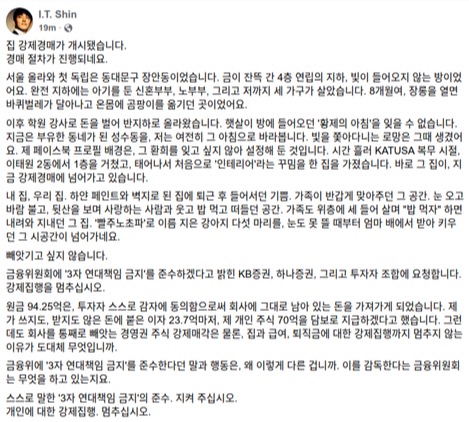
Forced auction proceedings have been initiated on the residence of Shin Chul-ho, CEO of digital content platform company OGQ. The so-called "OGQ incident," in which a founder personally bears approximately 12 billion won in debt through the "interested party" clause in a venture capital investment contract, has entered a new phase with home foreclosure.
CEO Shin announced on the 4th through his SNS, "Forced auction of my house has begun. The auction proceedings are underway," and stated, "I don't want it to be taken away."
He said, "I request KB Securities, Hana Securities, and the investor syndicate, which have stated to the Financial Services Commission that they will comply with 'prohibition of joint liability on third parties,' to stop forced enforcement," and added, "The principal of 9.425 billion won remains in the company as investors themselves have agreed to capital reduction, and I have agreed to pay interest of 2.37 billion won, which was incurred on money I never used or received, using my 7 billion won in personal stock as collateral."
He continued, "Yet, despite this, why doesn't the forced sale of management rights shares, and forced enforcement against my house, salary, and retirement funds stop? I want to ask what the Financial Services Commission, which supposedly oversees this, is doing."
12 billion won personal debt caused by "interested party" clause
The incident began in 2021 when OGQ raised over 9 billion won in investment from a New Technology Business Investment Syndicate while pursuing the acquisition of Getty Images Korea. When the acquisition fell through, the investment syndicate demanded the return of investment funds from CEO Shin personally, as an "interested party" under the investment contract. With a Supreme Court ruling confirming the investors' victory in April, CEO Shin has become responsible for paying approximately 12 billion won including the principal and 12% annual interest.
The court determined this to be a separate payment obligation borne by CEO Shin in accordance with the investment contract, rather than traditional joint guarantee. However, venture capital industry experts point out that such contracts that place responsibility for corporate business failures directly on founders personally constitute a structure that circumvents joint guarantees. Current venture capital regulations principally prohibit venture capital syndicates and similar entities from imposing the obligations of invested companies jointly on founders and other third parties.
As the controversy spread, President Lee Jae-myung mentioned in a "conversation with small business owners" in March that the structure of shifting responsibility to founders while merely changing the form should be examined. In July's National Assembly Politics Committee, Democratic Party member Min Byeong-deok raised concerns about the roles of financial companies such as KB Securities and Hana Securities using the OGQ case as an example. Financial Services Commission Chairman Lee Eok-won responded at the time, saying, "The prohibition on imposing joint liability on interested parties has been in effect since March this year," and said he would look into the matter. Democratic Party member Kim Han-gyu is pushing for legislative amendments to restrict even "circumventing joint guarantees" through separate payment obligations or share purchase request rights that shift company risk to founders.
Forced enforcement continues despite receiving capital reduction consent document
On the 28th of last month, the investment syndicate with KB Securities and Hana Securities participating as LPs (limited partners) sent a capital reduction consent document to OGQ, appearing to provide a breakthrough. The plan to return the remaining investment principal in the company through fair value capital reduction and have CEO Shin take responsibility for the shortfall with his personal stake entered the implementation phase. However, according to CEO Shin's side, even after sending the capital reduction consent document, the investors did not stop forced sales and collection procedures regarding management rights shares, residence, salary, and retirement funds, ultimately leading to the initiation of home forced auction.
CEO Shin again appealed, "Please keep the commitment to comply with the 'prohibition of joint liability on third parties' that you yourselves stated," and urged, "Please stop forced enforcement against individuals."