Kim Woo-young Gwanggyo Column Dokdo Called Takeshima? Lee Jong-hak Would Be Furious!
Not long ago, Professor Seo Kyung-duk of Sungshin Women's University revealed that "When 'Dokdo' is translated into Japanese on Google Translate, the result comes out not as '独島' (Dokdo) but as '竹島' (Takeshima), a designation claimed only by Japan. This is a clear error."
I do not hate Japan. Let me say this again. Apart from far-right and Korea-hating politicians with distorted views on historical issues such as the Japanese colonial period and Dokdo, I have favorable feelings toward many kind and conscientious Japanese people.
In fact, the Japanese people I have met are truly kind. Their consideration for others is particularly remarkable. Prime examples are members of the Himeji City Harima Korean Studies Research Society, an overseas sister organization of the (Corporation) Hwaseong Research Society to which I belong.
Every time we exchange visits, their sincerity demonstrated through action has moved us.
However, the behavior of the groups mentioned above provokes not only my anger but also the people's fury. What further added to this anger was Google's search result for 'Takeshima'.
If Professor Lee Jong-hak were alive, he would have immediately gone to Google headquarters and strongly protested.
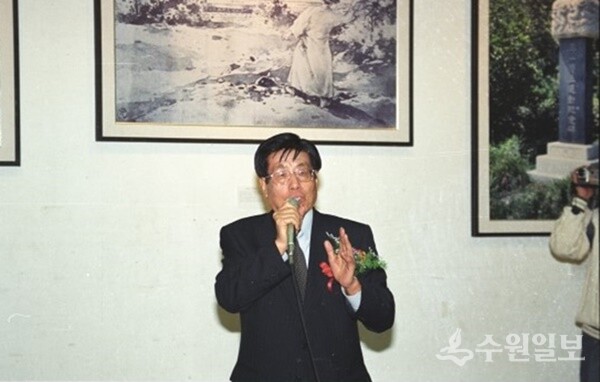
Professor Soun Lee Jong-hak (李鍾學, 1927–2002) was a bibliographer and collector of materials who devoted his entire life to the collection of materials on Dokdo, Admiral Yi Sun-sin, the history of Japanese invasion, and the anti-Japanese resistance movement. He was a figure from Suwon.
He is listed in the 'Hall of Honor of Suwon City' established at the entrance of Suwon City Hall, and at the Suwon Gwanggyo Museum, there is the 'Soun Archive (史芸室)' where precious materials donated by the professor are collected.
In particular, to prove that Dokdo is our territory, he traveled to Japan more than 50 times and discovered various materials. Professor Lee, who passed away in November 2002 during the FIFA World Cup held in Korea, donated an enormous amount of related materials to the Dokdo Museum, the Independence Hall of Korea, the Hyungchongsa Shrine, and Suwon City.
Ahead of March 1st in 2018, I recalled the professor as follows in an editorial for Gyeonggi Shinmun.
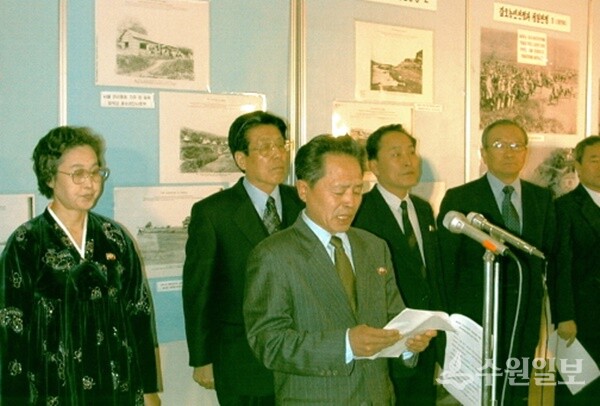
"During his lifetime, the professor emphasized to those around him his conviction that 'the mission to protect Dokdo knows no division between North and South, so we must unite our efforts.' In March 2001, he also held Korea's first-ever inter-Korean historical materials exhibition at the People's Study Hall in Pyongyang, North Korea. At that time, the exhibition materials were also made public to our people through special exhibitions at the Dokdo Museum. Last October, the Suwon Gwanggyo Museum, which displays and preserves materials donated by Professor Lee Jong-hak, jointly held a special exhibition with the Ulleungdo Dokdo Museum titled 'Dokdo, Recording and Remembering.' On this March 1st, I hope we will remember not only the sublime anti-Japanese spirit of the patriots but also Professor Lee Jong-hak, who collected and donated Dokdo materials throughout his life to protect Dokdo."
I first met the professor in 1986 during the compilation process of the Suwon City Chronology. My first impression, which I still remember, was of 'a very principled and uncompromising, stubborn person.' The professor participated as an editorial committee member, and I, as a writing committee member, wrote on culture and arts and some administrative matters.
Since we met on official business and there was a 30-year age gap between us, we were not particularly close.
In 1990, while working as a culture section reporter at Joongbu Ilbo, a daily newspaper headquartered in Suwon, the professor visited me at the newspaper office. The professor handed me materials related to independence movement activities in this region during the Japanese colonial period, and the article I wrote occupied the top of the front page. After that, whenever he discovered new materials, he would summon me to a Chinese restaurant called Godaebanbjeom in front of Suwon Girls' High School. These were mainly materials about Japanese oppression and the activities of independence fighters who resisted it. Most of those articles occupied the top of the front page or the social section.
Once, he handed me a thick document envelope. It contained materials related to the first-ever inter-Korean historical materials exhibition held at the People's Study Hall in Pyongyang on March 1, 2001. There were exhibition pamphlets, clippings from articles in the North Korean newspaper 'Rodong Sinmun' praising the exhibition, and photographs of the exhibition.
The professor generally did not drink. However, on that occasion, he drank a couple of glasses of strong baijiu.
"I said this in North Korea. Based on this evidence, even if it's North Korea, you must properly receive the apologies and reparations we couldn't receive. The mission to protect Dokdo knows no division between North and South, so we must unite our efforts."
These words have not been forgotten even now, 25 years later.
As mentioned before, the professor devoted his entire life to proving that 'Dokdo is Korea's inherent territory.' To find materials related to Dokdo, he frequently visited Japanese libraries and rare book dealers at his own expense.
These precious historical materials collected in this way are displayed in the Soun Archive at the Suwon Gwanggyo Museum.
Some of the materials related to Dokdo were donated to the Dokdo Museum (Ulleung County), Korea's first territorial museum, which opened in 1997.
The Suwon Gwanggyo Museum has the 'Map of Three Kingdoms Under One Rule (三国接養地図)' with Ulleungdo and Dokdo clearly marked as Korean territory, along with materials related to Dokdo, as well as Admiral Yi Sun-sin's 'Complete Works of General Yi,' and precious materials on Suwon Hwaseong, Gando, and Mount Geumgang.
The historical records clearly indicate that Dokdo is Korea's territory.
However, in 1905, the Japanese government unilaterally changed Dokdo's name to Takeshima (竹島) and incorporated it into Shimane Prefecture. The Shimane Prefecture Assembly passed an ordinance designating February 22 each year as 'Takeshima Day' starting in 2005. Korean anger reached a peak, and in response, our government fully permitted Korean citizens to visit Dokdo on March 17 of the same year.
Japan's historical distortions and claims of sovereignty over Dokdo are becoming increasingly blatant.
In response, there is growing consensus on the voice calling for the establishment of 'Dokdo Day' as a national commemorative day.
To reiterate, Google's error in marking Dokdo as Takeshima must be corrected immediately.
Only then will Professor Soun in the other world feel somewhat relieved of his concern.
This coming weekend, I must visit the Soun Lee Jong-hak Archive at the Suwon Gwanggyo Museum and at least meet the professor's relics.