Choi Hyung-kuk's Historical Essay (12) Crown Prince Sado, Catastrophe Made by Alcohol
Alcohol...
This troublesome thing causes much talk and problems, yet when a cup is poured over a sorrowful heart, the worries of life fade away for a moment, and when meeting an old friend and clinking glasses, the generous heart doubles in warmth. It is a grateful thing indeed.
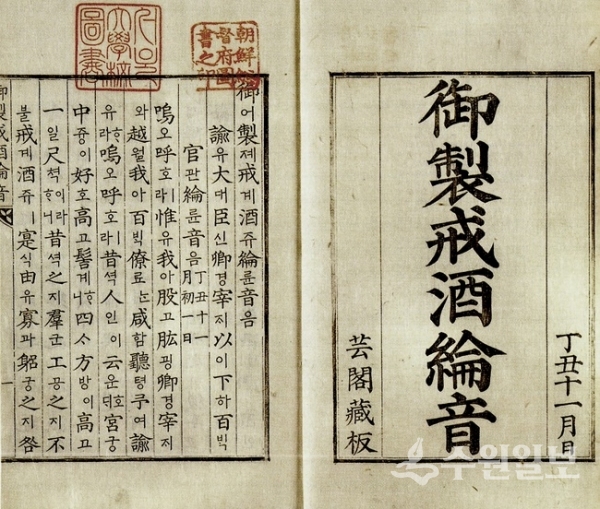
Yet this grateful alcohol was never to be made nor consumed—a liquor ban (禁酒令) proclaimed from a monarch's lips spread like an abstraction throughout the Joseon Dynasty. If drunkards whose noses turn red every morning these days were to hear this, their blood would run cold.
But such was the Joseon era. When drought and famine struck, tens of thousands to hundreds of thousands of starving people died nationwide, so using precious grain that could not fill hungry bellies for brewing alcohol was considered a grave injustice worthy of universal condemnation. Ordinarily, when such droughts or famines ended, liquor bans were naturally lifted, and people brewed alcohol in their homes for ancestral rites, or at large-scale distilleries, taverns nearby overflowed with intoxicated patrons from midday.
But it was different in King Yeongjo's reign. Different indeed, very different. Entangled in poisoning theories about his predecessor King Gyeongjon from the early days of his reign, in 1728, the fourth year of his reign, Lee In-jwa's rebellion, the Musin Rebellion (戊申亂), added a fatal wound to the king who dreamed of sagely rule. Moreover, his biological mother, Sukbin Choi, came from the lowly position of a concubine maid, so Yeongjo was filled with complexes about his own status.
For these reasons, King Yeongjo resolved to live a more "exemplary" life as a monarch than any other king. Should courtiers whisper behind his back, he felt as though he were the target of gossip, and like elementary school children's daily schedules during vacations, he created a daily itinerary without a single moment's deviation, living each day with such precision. King Yeongjo's days were characterized by extreme thoroughness.
Indeed, King Yeongjo went so far as to proclaim the worst liquor ban: that sacrificial wine (醴酒) alone would be used in all rituals, all other alcohol was prohibited, and violators would face severe punishment. Sacrificial wine (醴酒) was a type of sweet rice drink with almost no alcohol content, a watered-down, bland liquid that was alcohol in name only. In particular, those who violated the liquor ban were threatened with execution—a terrifying blade—so drinkers throughout the realm were as good as dead men.
It was in such circumstances that Crown Prince Sado drank alcohol. And the moment he appeared smelling of liquor while studying in the Nakseondang, King Yeongjo caught him red-handed. Following severe reproach, this incident became the starting point of the event where the Crown Prince would be confined in a chest and die. On May 1, 1756 (the 32nd year of Yeongjo's reign), Crown Prince Sado, studying in the Nakseondang, set fire to that space. As the place where the royal heir was studying burned fiercely, attendant officials around him called for the Geupsuggun (汲水軍), the Joseon-era firefighters, to extinguish the flames, but King Yeongjo spoke only one phrase: "置之!(Translation: Leave it be!)"
After that, the relationship between the current king, Yeongjo, and the designated successor, Crown Prince Sado, deteriorated into catastrophe. A line had been crossed. And Crown Prince Sado was shunned in actual politics. As an alternative, Crown Prince Sado immersed himself in compiling a new military treatise called "Muyae Sinbo (武藝新譜)" (New Martial Arts Manual). He sought to gather a new rising military bureaucratic class in the process of compiling this military arts text.
Before the calamity of Imowon arrived, he even undertook a secret journey to Pyongyang Provincial Government. In fact, Crown Prince Sado made a secret journey to Pyongyang from April 7 to May 1, 1761, nearly a month in length. The "Haenghaeng Ilgi (幸行日記)" (Record of the Secret Journey) well captures his cautious movements. The diary's author at the time was Ham Dae-il (咸載一: 1738–1771), a low-ranking military officer in Pyongyang, who was recognized for his abilities and attended the Crown Prince from April 7 to May 1. The diary records specific activities of that period, making it possible to confirm Crown Prince Sado's secret Pyongyang journey that was not recorded in history. Crown Prince Sado mainly moved around Pyongyang's scenic sites, meeting people. When returning to the capital, he held a banquet at Wolpa Pavilion in Hwangju and held archery competitions. Then, on the 13th of the intercalary 5th month in 1762, he was confined in a chest and died in the Imowon Incident. In this manner, through his death, the Crown Prince received the posthumous name "Sado (思悼)" from his father, King Yeongjo.
Subsequently, after many twists and turns, Jeongjo, the son of Crown Prince Sado who ascended the throne, sought to dispel his sorrow by changing his father's title to "Jangheon (莊獻)" on March 20, 1776, the year of his enthronement. Jeongjo directly stated: "Though 'Sado (思悼)' is a sacred meaning, only grief and longing are contained in that name, so I change it anew." He named the shrine dedicated to his father "Gyeongmogung (景慕宮)" and built it in a place accessible directly from the rear garden of Changdeok Palace. Whenever Jeongjo felt troubled or faced policy concerns, even past midnight, he would visit Gyeongmogung to hold a silent conversation with his father in his heart.
He also expressed deep affection for people and policies related to his father. One of these was martial arts. In the "Byeonggi Chongseo (兵技總敍)" section of "Muyae Dobo Tongji" (Comprehensive Illustrated Manual of Martial Arts), the story of compiling the "Muyae Sinbo (武藝新譜)" during Crown Prince Sado's regency is recorded in the greatest detail. The compilation of "Muyae Dobo Tongji" was the finest gift Jeongjo as a son could present to his father, Crown Prince Sado. Since Jeongjo had promised his grandfather King Yeongjo that as king he would never discuss the matter of Crown Prince Sado's death, he chose this indirect approach. The relevant passage reads as follows:
"In the 35th year of Yeongjo (1759), Crown Prince Sado (小朝) ordered the compilation of 'Muyae Sinbo (武藝新譜)' while handling state affairs in his stead, added twelve weapons including longsword, halberd, ceremonial sword, Japanese sword, combat techniques, crescent moon blade, narrow sword, double sword, commander's sword, Korean sword, bare-hand techniques, and cudgel, and with six original weapons (from 'Muyae Jebo (武藝諸譜)') set the total at eighteen. The name 'Eighteen Martial Arts (武藝十八般)' of the Joseon Dynasty originated from this."
Subsequently, on April 29, 1790, Jeongjo inherited his father's legacy and compiled "Muyae Dobo Tongji" containing "Muyae 24 Skills (武藝24技)" by adding six mounted martial arts practiced by cavalry. In this way, even within martial arts texts, Jeongjo sought to resemble his father. In fact, Jeongjo was a monarch who demonstrated exceptional archery skills, earning him the title of "Divine Archer (神弓)" of Joseon. He did not merely expound martial arts through theory or policy, but set an example himself through training and steeling his resolve.
According to historical records, Crown Prince Sado's drinking capacity initially did not appear to be great. However, after that day, Crown Prince Sado's heavy drinking increased beyond imagination. And Crown Prince Sado ended his life in a chest amid countless incidents and misunderstandings that occurred with alcohol. Whether for that reason or not, his son Jeongjo also favored strong alcohol. Jeongjo's famous saying "Buduemuigui (不醉無歸)" — "Those who are not drunk shall not return home" — was created in that process.
As a jest, there is a fable that when a drunken frog becomes thoroughly intoxicated, the first thing it says with a slurred tongue is "Hey! A snake!" So it is when one serves 'the spirits.' Alcohol is meant to be enjoyed moderately, taking the situation into account, flowing smoothly. But if one drinks to the point where it is unclear whether a person drinks alcohol or alcohol drinks the person, then it is not alcohol but poison. If one keeps falling into the alcohol jar, the next thing may be receiving only perfumed wine cups year after year.