Choi Hyung-guk's Historical Essays (13) King Yeongjo Orders the Offering of 'Dragon Head, Phoenix Tail'
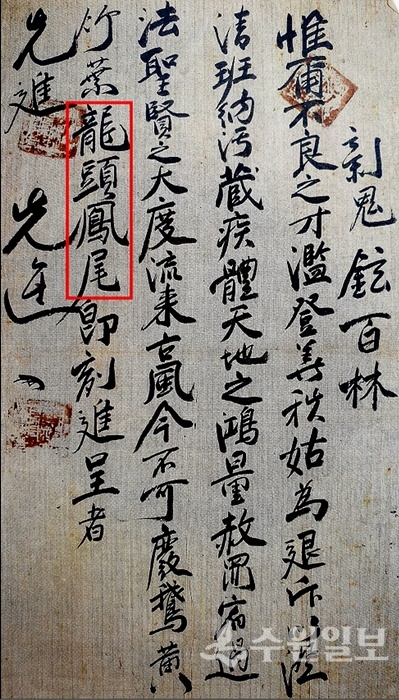
용두봉미(龍頭鳳尾).
Literally, it means "the head of a dragon (龍頭) and the tail of a phoenix (鳳尾)." At first glance, it feels like an extraordinarily precious treasure. In fact, King Yeongjo (英祖) himself ordered his officials to offer this, so common people would think it must be something so expensive they could never dream of possessing it.
However, "dragon head" refers to pork, and "phoenix tail" refers to chicken. It is truly an amusing concept. During the Joseon period, meat was scarce. Unlike today's large-scale farming, people raised only a few animals at home, and even large-scale farming produced limited numbers.
To supplement insufficient protein, common people roasted grasshoppers and ate them as snacks, or caught fish through river hunting to satisfy their hunger. Beef was unimaginable, and pork or chicken were precious foods served only on holidays or ancestral rites. Furthermore, since cattle were valuable animals used in farming, cattle slaughter was managed directly by the state during the Joseon period, treated as extremely precious.
The phrase "rice and meat soup" (이밥에 고깃국), frequently heard during the wave of modern industrialization, held considerable significance for people of that time. First and foremost, people needed to eat their fill to feel alive. Thus, it makes sense that a pig's head on a sacrificial table would be called a dragon's head, and a plump chicken compared to a phoenix's tail.
In the "Military Techniques General Narrative" (兵技總敍) section of the "Illustrated Manual of Military Training" (武藝圖譜通志), there appears a passage related to King Yeongjo.
"In February of the 45th year of Yeongjo's reign (1769), the king visited the inner garden and personally shot arrows at targets, firing five times and hitting all five. Following this, the king's father-in-law (國舅), the king's sons-in-law (儀賓), royal relatives (宗臣), officials of the Six Ministries (六曹堂郎), the Seoul magistrate (京兆尹), military officers (將臣), royal secretaries (承旨), and historians shot arrows. [Those who hit the target were promoted in rank or given horses that the king kept for riding. Military officers and sons-in-law who failed to hit the target were ordered to voluntarily offer 용두봉미(龍頭鳳尾).]"
To explain the above record simply, King Yeongjo held a friendly archery competition and ordered underperforming officials and sons-in-law to "voluntarily" offer "용두봉미(龍頭鳳尾)." Since they failed to shoot arrows properly, the message was to treat everyone to pork and chicken. Thus, "용두봉미(龍頭鳳尾)" contains humorous meaning. With a lavish spread, people joked about "dragons" and "phoenixes," "kings" and "subjects," conversing and laughing together in a camaraderie gathering.
King Yeongjo frequently held archery meetings with royal relatives, and in the late Joseon period, he actively pursued political activities through archery, even conducting the Great Archery Ritual (大射禮), a ceremony of the king and officials shooting that had not been practically performed before. During this, the king shot at a target called "bear target" (熊侯) with a bear's face drawn on it. After the king finished shooting, officials would change targets and shoot arrows at the "deer target" (麋侯) with a deer's face. And during military training, soldiers used the "wild boar target" (豕侯) with a wild boar's face. Different targets were needed to mark different ranks at that time.
The Great Archery Ritual was a type of military ceremony, the most political ritual announcing the king's military achievements. At this time, officials who could not shoot arrows had to drink penalty alcohol (罰酒). So if archery skills did not improve, only drinking skills would. The reason Jeongjo was called a "divine archer" (神弓) may have been because the image was deeply imprinted from frequently witnessing it since childhood.
However, the term 용두봉미 appeared most frequently in documents related to "Face-Recognition Ceremony" (面新禮). The Face-Recognition Ceremony was a ritual in the Joseon period where newly appointed officials who passed the civil service examination showed respect to senior officials.
This was because, having now become a formal official receiving stable salary (祿俸), it was customary to treat senior colleagues respectfully in advance. Usually, on the first day of work, a simple "Permission to Participate Ceremony" (許參禮) was conducted with brief self-introduction and greeting, accompanied by simple hospitality. The full-scale Face-Recognition Ceremony was held about ten days later, after becoming somewhat familiar with faces, and was conducted lavishly.
The period of about ten days from the Permission to Participate Ceremony to the Face-Recognition Ceremony was "Face-Recognition" (面新), the time to shed one's newcomer status. During this period, senior colleagues would harass newcomers by finding all sorts of fault, because this made the variety of side dishes and types of alcohol on the Face-Recognition Ceremony table more diverse. After successfully completing the Face-Recognition Ceremony, newcomers became members of the organization, sharing hardship and joy together.
However, the Face-Recognition Ceremony for officials appointed as military officers (武官) was particularly notorious for being harsh during the Joseon period. This may have been even more so because the military was a unique organization where people had to carry firearms, bows, and swords daily and live rough lives.
For example, in the case of the Tiger-Catching Army (捉虎軍), which specialized in hunting tigers, it was common for newcomers to engage in direct combat with seniors using weapons, being beaten nearly to death. If one could not endure that situation, there was a high chance of becoming "tiger food" soon after. Thus, after harsh initiation rites, people would form new bonds over a hearty cup of alcohol.
However, just as not everything in life goes smoothly, there were many truly malicious seniors. Even today, under the guise of "initiation ceremonies," some people are satisfied only by inflicting violent assault or providing excessive entertainment. Occasionally, such incidents are even mentioned in newspapers involving sexual harassment—they resemble beasts more than old fogies.
In fact, during the Joseon period, there were cases where newly appointed military officers could not endure the harassment during the Face-Recognition Ceremony and took their own lives. To officially address these vicious customs, discussions were raised at court meetings to establish laws. Official directives prohibiting harsh physical abuse or excessive money and gifts related to Face-Recognition Ceremonies were indeed issued, but the vicious custom continued in secret.
The Face-Recognition Document (免新帖) of Lim Baek-hyeon (林百鉉), who was appointed as a military official in the late Joseon period, contains such content well. It is a type of certificate proving that one has completed the Face-Recognition Ceremony, with senior colleagues writing and stamping it personally. The content reads as follows:
"To the junior Baek-hyeon Lim (read from bottom to top. Amusing, isn't it?), reflecting deeply, despite your poor talent, you have risen to a noble position. ...(middle omitted)... Immediately offer 용두봉미 (pork and chicken). Your seniors."
To rectify these abuses, King Jeongjo created "Regulations for Face-Recognition in Each Department" (各廳免新節目), a type of rule, and officially disseminated it to all military-related institutions. The first sentence of the regulation begins: "Unnecessary expenditures for newcomers in the Three Inner Guard Units (內三廳—the king's close guard—Inner Guards, Combined Cavalry, and Right Guards) are serious. Long ago, we intended to correct this thoroughly, but following only old vicious customs and being preoccupied, this has continued until now." The directive ends by reminding the highest commanders to ensure such incidents never occur again.
Such initiation ceremonies for newcomers continue today in various forms, each organization emphasizing its own characteristics. "Vicious customs" return in disguise as "traditions," continuing to torment someone. From now on, we must break this chain of oppression. Just as King Jeongjo did...