Choi Hyung-guk's Sword Dance (13) King Yeongjo Orders the Offering of 'Dragon Head and Phoenix Tail'
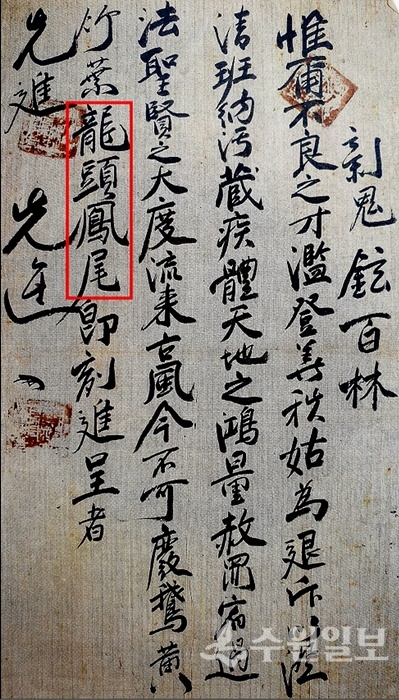
Dragon Head and Phoenix Tail (龍頭鳳尾).
Literally, it means 'the head of a dragon (龍頭) and the tail of a phoenix (鳳尾).' At first glance, it feels like an extraordinarily precious treasure. Even King Yeongjo (英祖) himself ordered his officials to offer it, so common people might think it was something so expensive they couldn't even dream of it.
However, 'dragon head' refers to pork, and 'phoenix tail' refers to chicken. It is indeed an amusing concept. Meat was precious during the Joseon era. Unlike today's mass farming, common households would raise only a few animals, and even large-scale farming had limited numbers.
To supplement their inadequate protein intake, people would roast grasshoppers as snacks or catch fish through river hunting to ease their hunger. Beef was unimaginable, and pork and chicken were so precious they appeared only on holiday and ancestral tables. Moreover, since cattle were valuable animals used for farming, cattle slaughter was managed directly by the state during the Joseon era as something greatly treasured.
The phrase 'rice and meat soup' frequently heard during the wave of modern industrialization carried considerable significance to people of that time. First and foremost, one needed to eat their fill to enjoy life. Thus, the pig's head on the ancestral table would naturally be called the head of a dragon, and it would be fitting to compare a plump chicken to the tail of a phoenix.
In the "Military Techniques Overview (兵技總敍)" section of the 『Martial Arts Illustrated Manual』, such content related to King Yeongjo appears.
"In February of the 45th year of Yeongjo's reign (1769), the king came to the inner garden and personally shot arrows at targets, shooting five arrows and hitting all five. Then the king's father-in-law (國舅), the king's son-in-law (儀賓), royal relatives (宗臣), officials from the six ministries (六曹堂郎), the magistrate of Seoul (京兆尹), military officials (將臣), senior officials (承旨), and historians shot arrows. [Those whose arrows hit the target were promoted in rank or given horses raised for the king's use, while military officials and the son-in-law who failed to hit the target were ordered to voluntarily offer 'Dragon Head and Phoenix Tail' (龍頭鳳尾).]"
To explain the above record simply: King Yeongjo held a friendly archery contest and ordered officials and his son-in-law who lacked skill to 'voluntarily' offer 'Dragon Head and Phoenix Tail.' Since they failed to shoot arrows properly, the message was to treat everyone to a feast. In this way, 'Dragon Head and Phoenix Tail' contains humorous meaning. With a lavish spread, they would jokingly exchange remarks about 'dragons,' 'phoenixes,' 'kings,' and 'officials,' enjoying camaraderie and laughter at these friendly gatherings.
Yeongjo particularly frequently held archery gatherings with royal relatives, and in the late Joseon period, he often engaged in political actions through archery, even conducting the Daesakye (大射禮), an archery ceremony between king and officials that had not actually been performed in substance. At this time, the king would shoot at what was called the 'Bear Target (熊侯)' with a bear's face drawn on it, and after the king's archery ended, officials would change targets and shoot arrows at the 'Deer Target (麋侯)' with a deer's face. During military training, soldiers used the 'Wild Boar Target (豕侯)' with a boar's face as the target. Different targets were needed to distinguish by rank.
The Daesakye was a type of military ceremony and the most political ritual announcing the king's military achievements. During this, officials who failed at archery had to drink penalty alcohol. So if one's archery skills did not improve, only one's drinking skills increased. The reason Jeongjo was called the 'Divine Archer (神弓)' may have been because the image, frequently witnessed from childhood, became imprinted in his mind.
However, the word 'Dragon Head and Phoenix Tail' appeared most frequently in documents related to the 'New Official Exemption Ceremony (面新禮).' This ceremony referred to the ritual practice where officials who had passed civil service examinations and began their official career demonstrated respect to senior officials.
This was because, having now become official civil servants receiving stable salaries (祿俸), it was customary to treat senior colleagues respectfully in advance. Usually, on the first day of work, a simple introduction and greeting ceremony called 'Permission to Participate Ritual (許參禮)' was held with simple hospitality. The full New Official Exemption Ceremony was then conducted about ten days later with an elaborate spread.
The roughly ten-day period between the Permission to Participate Ritual and the New Official Exemption Ceremony was called 'New Official Exemption (面新),' meaning removing one's status as a newcomer. During this time, senior officials would find all sorts of faults and harass newcomers, because this would result in a greater variety of side dishes and types of alcohol appearing on the table during the New Official Exemption Ceremony. After successfully completing the New Official Exemption Ceremony this way, one became a full member of the organization, sharing hardship and joy together.
However, the New Official Exemption Ceremony for military officials (武官) who entered service was particularly notorious during the Joseon era for being harsh. This may have been especially true because of the unique nature of military organizations, where people carried guns, bows, spears, and swords daily and had to live rough lives.
For example, members of the Tiger-Catching Corps (捉虎軍), which specialized in hunting tigers, would frequently engage in direct armed combat with senior members, being beaten to near death. If one could not endure this situation, there was a high likelihood of becoming 'tiger food' shortly thereafter. Thus, after such harsh initiation, people would bond over a strong drink and start fresh relationships.
However, as worldly life is not always smooth, there were truly wicked senior members. Even today, under the name of 'initiation (申告式),' there are people who can only be satisfied by inflicting cruel beatings or providing excessive hospitality. Sometimes sexual harassment issues are even mentioned in newspapers, resembling beasts more than stubborn old-timers.
In fact, during the Joseon era, there were cases where newly appointed junior officers undergoing the New Official Exemption Ceremony, unable to endure such harassment, took their own lives. To officially address such malicious practices of the New Official Exemption Ceremony, discussions arose about establishing laws in state council meetings. Official directives prohibiting harsh beatings or excessive financial demands related to the New Official Exemption Ceremony were indeed issued, but the malicious practice continued secretly.
The face document notebook (面信帖) of Im Baek-hyeon (林百鉉), registered as a military official in the late Joseon period, captures such content well. It was a kind of certificate confirming passage through the New Official Exemption Ceremony, with senior members personally writing messages and affixing their seals. The content reads as follows:
"To the new official Hyeon Baek-im (read from bottom to top; also humorous), upon deep reflection, despite your poor talents, you have risen to a noble position. ...(middle part omitted)... Immediately offer Dragon Head and Phoenix Tail (pork and chicken). From your senior colleagues."
To remedy such abuses, Jeongjo created what amounted to a set of rules called 'New Official Exemption Regulations for Each Ministry (各廳免新節目)' and officially distributed them to all military-related institutions. The opening sentence of the relevant regulations (節目) states: 'The unnecessary expenses for newcomers in the Inner Three Guards (內三廳—palace guard units including the Inner Guard, Ceremonial Guard, and Right Guard)—are severe. We have long wished to correct this thoroughly, but following only old vices and lacking time, this has continued to the present day.' The relevant commanding officers are urged to be mindful so such matters do not occur again.
Such initiation ceremonies for newcomers continue today in various forms, each organization emphasizing its particular characteristics. The 'malicious practice' goes round and round, donning the mask of another 'tradition' and harassing someone. Now we must sever these chains of oppression. Like Jeongjo...