Choi Hyung-guk's Swordplay (14) Chundangdae of Changdeokgung: A Sacred Ground for Martial Arts
Chundangdae (春塘臺).
Gyeongbokgung, the main palace of Joseon, burned to the ground, leaving only its foundation stones. In the year of Imjin, the suffering inflicted by Japanese invaders left the palace in ashes, a scar that remained for a long time. And so began the era of the Eastern Palaces—Changgyeonggung and Changdeokgung. In the rear garden of those palaces lay Chundangdae.
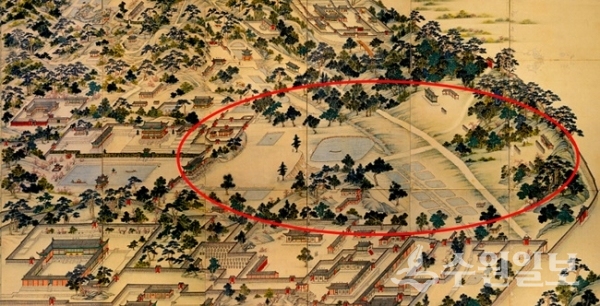
Chundangdae is clearly depicted in the painting "Donggwoldo (東闕圖)." In the larger picture, it is located in the upper right portion. Looking at that area, there is a rectangular pond called Buyongji (芙蓉池), and across from it stands a two-story building, Juhapru (宙合樓). The name of the first floor of Juhapru is the "Gyujanggak (奎章閣)" that we often hear about.
All those who led the scholarly traditions of the Jeongjo era studied books in this place. Serving as a kind of royal library, this was where rare books one wished to see were neatly organized. Scholars like Yi Deok-mu and Park Je-ga studied here, opening books. Not only works from Joseon but also books published in China could be reviewed through this place.
On the stairs leading up to Juhapru, there is a small gate: Eosumun (魚水門). Fish and water—the feelings of fish meeting water come to mind. Yes, the officials are fish, and the king symbolizes water. No fish in the world can live without water. It means to swim freely and live within the king's embrace. Water must be clear and clean for fish to thrive. If the water becomes dirty, so do the fish.
On the south side of the pond is Buyongjeong (芙蓉亭), which has a cruciform layout shaped like the character "十" (ten), and to the east is Yeonghwadang (暎花堂). (In the diagram, the circular marking on the left shows Gyujanggak and the rectangular pond, Buyongji.) And on the stone wall at the south corner of the pond, there is a sculpture of a carp leaping from the water. The legend of "Deungyongmun (登龍門)"—a carp leaping up to become a dragon... The dream of advancement in life remains humbly there as a fish.
Most buildings in palaces face south to receive winter sunlight well. However, Yeonghwadang uniquely faces precisely eastward, unlike other buildings. There is a reason. The spacious area visible from Yeonghwadang is precisely "Chundangdae (春塘臺)." While some typically refer to the somewhat smaller courtyard in front of Yeonghwadang as Chundangdae, the broad expanse from Yeonghwadang all the way to the eastern palace wall in the distance can be considered part of Chundangdae's domain.
Within that area are buildings such as Gwandeokjeong (觀德亭) and Gwanpunggak (觀豐閣), a pond called Baekyeonji, and various facilities including fields and farmland. Gwandeokjeong was a place for practicing various martial arts including archery, and Gwanpunggak was related to agricultural promotion, including the fields and farmland of the palace's rear garden. The Chingyeongnye (親耕禮), a ritual in which late Joseon kings directly engaged in farming, took place in this location.
The eastern boundary of Chundangdae is the rear garden wall. Beyond that, at the high palace wall, stands the gate Jipchunmun (集春門). And beyond that gate is the Sungkyunkwan (成均館). When late Joseon kings went to make offerings at the Munmyo (文廟) shrine or conducted surprise inspections of Sungkyunkwan students, they quietly passed through Jipchunmun.
As its name suggests, Chundangdae was a raised platform built with stones, from which the king could view far to the eastern palace wall and observe soldiers' martial arts training. In fact, in several pictorial records including "Yeonghwadang Chinnim Sason-do (暎花堂親臨賜膳圖)," one can observe scenes of martial examination grounds being set up in the broad space below Yeonghwadang and martial arts tests being prepared. Looking eastward from Chundangdae, beyond the distant pond, past the fields and farmland, one could see soldiers riding horses and shooting arrows at targets called Gichchu (騎芻) and at enormous straw targets.
Therefore, the place name "Chundangdae (春塘臺)" appears particularly frequently in the <병기총서> section of "Muyedobotongji (武藝圖譜通志)." Most of the entries record things like "Archery tests were held at Yeonghwadang" or "The king came to Yeonghwadang and held cannon-firing tests for the palace guards." Particularly in the record from the 17th year of King Injo's reign (1639), Injo states, "This place is convenient for martial arts examinations, so from now on, let it be established by law that archery and cannon-firing tests shall be held regularly—in spring during the second and third months, and in autumn during the eighth and ninth months." Thus Chundangdae became an officially recognized location for state martial arts examinations.
For this reason, the term "Chundangdae-si (春塘臺試)"—meaning an examination held at Chundangdae—became established. Jeongjo frequently came to this place to directly observe soldiers' martial arts training at Chundangdae. He even personally presided over the "Yeolbyeong (閱兵)" military ceremony held here. He felt through his body the rough breathing of soldiers and steeled his resolve for national reform. Through martial examinations and various promotion tests held at Chundangdae, core personnel for Jeongjo's elite guard unit, the "Jangyongnyeong (壯勇營)," were selected.
Moreover, at Yeonghwadang, which overlooks Chundangdae, Jeongjo held the personal and regular examinations for Chogye-munshin (censorial trainees) and sometimes gifted pheasant roasts to the Seonjeon-gwans (royal ceremonial attendants) who accompanied him. He would set up braziers at that location and provide warm meals to the officials and soldiers present.
Civil service examinations were also conducted there in the form of "Byeolsi (別試)," a type of special examination. Yi Mong-ryong, the protagonist of the famous "Chunhyangjeon," which we know well, also took the civil service examination at Chundangdae here and achieved the top score. In the pansori complete edition of "Chunhyangga," the passage where Yi Mong-ryong takes the examination at Chundangdae is described as follows:
"...At this time, the young lord of Seoul studied day and night the classics and various schools of thought, becoming as accomplished as Li Bo in poetry and as skilled as Wang Xizhi in calligraphy. When the nation held an auspicious examination, the grand examination, he carried his books to his chest and entered the examination hall, looking left and right as all the multitudes of people bowed at once. In the auspicious wind and refined sounds, parrots danced. The great scholar was selected and the royal prompt was issued; the document was hung on the red silk. The examination topic read: 'Spring at Chundangdae echoes ancient and present times.' The young Yi examined the topic and found it familiar. Spreading out the examination paper, he pondered the interpretation, ground ink on the inkstone, wielded his brush half-loaded with pale color in the manner of Wang Xizhi and received the style of Zhao Mengfu, completing his essay in one brilliant stroke. The attending officials, seeing the writing, noted each character with approval and annotation. The brush rose lightly and descended gracefully. It was the great talent of this age. In a moment, he was summoned, offered three cups of royal wine, and received the certificate of top-ranked graduate. When the new graduate emerged, his head adorned with an official flower, his body clothed in silk, and a jade belt around his waist. After three days of celebration, he paid respects at the shrine and made obeisance before the throne. The king, observing him personally, said, 'Your talent is foremost at court.' The Doseungji was summoned and appointed him inspector of Jeolla Province—a lifelong aspiration realized. A royal order and token were presented to him. Taking his leave of the throne and heading home, his appearance of iron-bright bearing was like a tiger from the deep mountains...."
Thus Yi Mong-ryong set off on a secret journey to Namwon to find love. However, sadly, that broad field embraced by Chundangdae no longer exists today. Following the Japanese colonial period's strategy of destroying the palaces, the area fell into near ruin. Its surroundings were transformed as Changgyeonggung became a zoo called "Changgyeongwon." The space where kings once resided became filled with exotic animals. After liberation, the zoo relocated to the Seoul Grand Park and several buildings were restored, but the area in front of Chundangdae barely maintains a small courtyard. Beyond that has vanished from the map entirely. Each time I visit Changdeokgung, this place weighs on my mind. I hope that now we might have time to appreciate the significance of Chundangdae and to restore its space. That place—Chundangdae—was a space where martial artists were cherished and cared for, preserving Joseon.