Choi Hyung-kuk's Column (15) 'Blind Men Touching an Elephant' and 'Truth'
The affairs of the world are always complex. So intertwined and tangled are they that it takes considerable time to grasp them properly. The big picture is difficult to understand, and details are not easy to examine closely. In a sense, the big picture can be the outward appearance or result, while details can be seen as essence or cause. By examining the overall outline and addressing each detail one by one, we can understand the flow.
There is an old story called 'Blind Men Touching an Elephant.' The story goes like this: Several blind men went to see an elephant. Or rather, to touch one. An elephant is an enormously large animal. A blind man named A touched only the elephant's legs, while B touched only its body. C touched the elephant's ears, and D touched only its long trunk.
Afterward, they gathered to discuss what kind of animal an elephant was. A said the elephant was shaped like a thick, sturdy pillar. B said it was wide and solid like a wall. C said it was wide but moved somewhat softly. Finally, D explained that it was not so thick and moved quite softly.
Then each spoke loudly, insisting their claim was correct, and they quarreled. Even after three days and four nights of debate, they could not narrow their differences. Thus parting ways, A, B, C, and D failed to understand the elephant as a whole and spent their lives picturing their own version of the elephant in their minds. Each lived thinking a 'part' was the 'whole.'
Each of their individual accounts was true. What they truly felt with their fingertips about the elephant was a 'fact,' or 'Fact.' That fact never changes until they die. However, though each account represents their own 'fact,' none can be the overall 'truth.' Thus fact and truth can be different. Because they lacked the mental flexibility to understand that fact and truth could differ, they could never approach the complete truth. Their 'elephant' thus became divided limbs, passed down through generations as separate elephants to their descendants.
For those without mental flexibility, any philosophy or ideology is merely part of the elephant the blind man touched. They conclude that only what they have directly experienced, only what they have touched with their own hands, and only what they have confirmed with their own eyes is genuine 'fact.' And for them, this develops into a 'belief' that transcends 'fact' and becomes the substantive 'truth' of everything. When this happens, different opinions become absolute evil that contradicts their 'noble belief,' and they close their hearts to others.
We are all blind men touching an elephant. It is all too common for us to mistake partial understanding for understanding of the whole. We must read the details within the whole and examine the whole through the details, yet this is not an easy task.
Lee Deok-mu (李德懋), the court official in charge of verification when 『Muye Dobo Tongji』(『Illustrated Manual of Martial Arts』) was compiled, emphasized that even in martial arts, one must examine the whole while precisely identifying details. He explained this by comparing it to the medical art of treating people.
“Your Majesty possesses the virtue of humility and modesty, and has previously discussed the movement of formations in the 『Byeonghak Tong』(『Comprehensive Military Manual』), and in the 『Muye Dobo Tongji』 has taken technical striking (技擊) as the core. To 'comprehend' means to be clear and erudite. Its principles and applications must be mutually employed, its roots and branches must correspond and connect. How could a scholar discussing military strategy set aside these two military texts and employ something else? If we compare it to medicine, the examination of meridians (經脈) that verifies qi circulation (運氣) is the formation, plants and minerals are weapons, and boiling, roasting, slicing, and grinding are striking and thrusting. If a physician were to say, 'I need only know the great matter of examining meridians related to qi circulation; why should I employ subordinates to assist with the detailed materials of medicine?' then he is but a mediocre physician.”
『Byeonghak Tong』(『Comprehensive Military Manual』) is a text on formations completed in the 9th year of King Jeongjo's reign (1785) for unified group formation training of soldiers, while 『Muye Dobo Tongji』 is a martial arts manual created in the 14th year of his reign (1790) for the standardization of individual martial arts training for soldiers. These two military texts played complementary roles—finding the small individual body movements of each soldier within the overall movement of formations, and thereby optimizing the formation movements through the detailed body techniques of individual soldiers.
This is explained more simply through analogy to the medical art of treating people. The examination that checks a person's overall physical condition is the formation (陣法). It involves inspecting the meridians to ensure the body functions well and communicates organically through the circulation of qi. When problems arise in the body, medicine is prescribed, and the medicinal materials used—grasses, trees, and minerals—are like weapons. Indeed, soldiers do not fight with bare bodies within formations but conduct combat while wielding various spears, swords, and other weapons.
What makes the analogy even more interesting is that the various methods of boiling, roasting, slicing, and grinding diverse medicinal materials to enhance their efficacy are like the training methods of martial arts. A sword must be wielded well, a spear must be thrust well, and a cudgel must be struck well for their power to manifest effectively. Various training methods employing weapons are expressed as one would handle medicinal materials.
And finally, a physician treating people who merely examines a patient's overall physical condition and delegates the handling of medicinal materials to assistants is but a mediocre doctor. After examining the patient, a good physician carefully prescribes medicine down to each individual medicinal ingredient to treat the illness.
In a military camp, the physician is the commander. To tactically operate vast formations, one must understand the characteristics of weapons possessed by individual soldiers and the nature of martial arts employing those weapons. Only then can proper tactics be deployed. If one observes only the outward movement of formations while ignoring the weapons and martial arts of the soldiers within, one becomes a mediocre commander. Taking such an army to war results in defeat in every battle (百戰百敗). One must know the enemy and know oneself; but how can one conduct proper battle when one knows neither the enemy nor oneself?
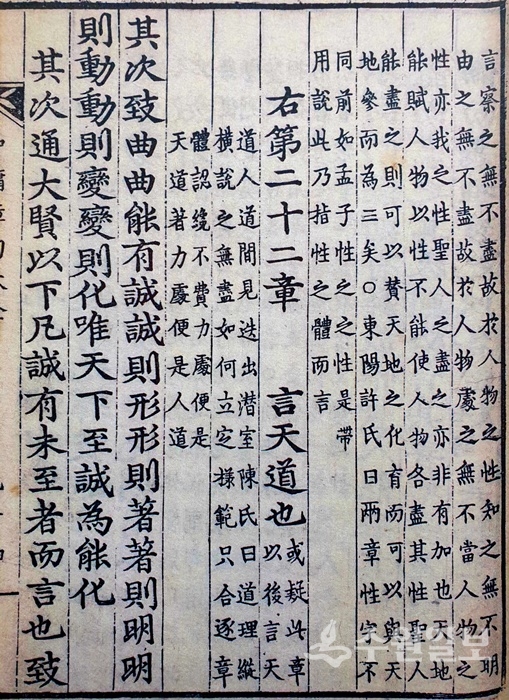
The classical text King Jeongjo most enjoyed reading was the 『Doctrine of the Mean』(『中庸』). It was also a manifestation of his will to govern the state by maintaining the center without leaning to either extreme. Among its contents is this passage:
“其次 致曲 曲能有誠 誠則形 形則著 著則明 明則動 動則變 變則化 唯天下至誠 爲能化”
(The next is to dedicate sincerity to small matters. When sincerity is dedicated to small matters, each small thing possesses sincerity. When sincerity exists, the inner correct principle of that thing takes concrete form. When formed, it manifests externally. When manifested, it becomes clear. When clear, it moves. When it moves, it changes. When it changes, it transforms. Only the utmost sincerity under Heaven can accomplish this transformation.)
<Chapter 23 of 『Doctrine of the Mean』, 其次致曲章>
Briefly interpreted, it means this: The next matter requiring effort is that of dedicating oneself to small matters (致曲). This means extending utmost sincerity to all things, down to the smallest. When one does so, each small thing comes to possess sincerity (誠). When sincerity exists, the correct inner principle of that thing takes concrete form (形). When formed, it manifests outwardly (著). When manifested, it becomes clear (明). When clear, it moves (動). When it moves, it transforms (變). When it transforms, it undergoes change (化). Only the sage of utmost sincerity can accomplish such transformation. To explain very simply: 'By dedicating all sincerity even to small matters, one can move others, and these accumulated small sincerities can change oneself and the world.' In a word, 'sincerity moves Heaven.'
It is impossible to receive good evaluation from all people in the world. However, if one accumulates small sincerity and reads the whole by examining small things first, there will come a day when Heaven itself understands that intention. Living such a life, even when entering the grave, one will have no shame.