Choi Hyung-guk's Column (20) Chojeong Park Je-ga, a Friend Met in Hardship and Filled with Poverty
- Missing a Friend Like Spring Sunshine
Here is a classical poem.
The scene of unfolding a precious painting in a room and gazing at it, letting one's eyes wander as the heart wishes. Let us pause to hold a moment of inner peace and slowly read it as if we were that person.
“秋陽照室 (Autumn light illuminates the room)
展卷遊神 (Unfold the scroll and the spirit wanders)
觀其花木之幽深 (Observe the deep mystery of flowers and trees)
烟水之縈紆 (Mist and water wind around)
新林嘉石之窈窈 (The quiet beauty of new forests and fine stones)
與夫開樽拓窓之人焉 (With those who open wine and expand their windows)
噫 安得與斯人共享此樂也 (Ah, how to share such joy with this person)”
Autumn light shines upon the room.
Unfolding the painting, the spirit roams free.
Gazing at the image, the flowers and trees grow profound.
The misty river coils around us.
In the spring forest, beautiful stones rest quiet and deep.
Within that painting, we see a person with wine jar and open window.
Ah~! How can we share such joy together with this soul?
This poem appears in a postscript written by Chojeong Park Je-ga (朴齊家, 1750~1805) on the back of a painting album by Mun Hyeong-san. The fierce summer heat retreats, and gentle autumn sunlight creeps through the window. Though the room is not spacious, such a day is perfect for sleeping late wrapped in that sunshine.
In the center of that room, a precious painting album is unfolded and the mind is gathered. The eye turns to the profound flowers and trees in the picture. Dense mist follows the river, winding around the flowers and trees as it flows. Beside them sits a large moss-covered rock in quiet repose. Below it, in a small house, a person waits for someone unknown, a wine jar barely visible through the open window.
It need not be wine. It is simply a friend with whom one's heart can rest that is longed for. Is there a way to share joy with that figure in the painting? Such a brief imagination passes through one's mind. On a sunny autumn day, a painting unfolds in the room as one yearns for a friend. A friend whose very glance conveys understanding without words.
This is one of Park Je-ga's poems found in the 『Jeongyugak Collection (貞蕤閣集)』, expressing longing for such a person. Park Je-ga too was of mixed birth. His talent was so exceptional that he was rumored in Seoul to be a "gifted child." His calligraphy and paintings, and especially his poetry, left deep impressions on people. Yet the world did not treasure him. Resentment accumulated in his heart. But he had a friend. The martial artist Baek Dong-su.
Park Je-ga was born in 1750, Baek Dong-su in 1743. Though Baek was seven years older, they were friends bound by the shared sadness of mixed birth and a desire to learn together about Bukak, the new learning from the North. Baek Dong-su, having passed the military examination but lacking powerful connections, was sent like an exile to Girin Gorge in Gangwon Province. Watching his dear friend depart brought a deep sadness. Now the friend at his side was leaving. Poverty tightens one's breath bit by bit.
That friend who would forgive even drunken outbursts or jealous fits was leaving. No matter how talented one was, the world cared only about one's status, cared only that one was of mixed birth, and gave not even an initial opportunity to begin. Such a world must have seemed hateful.
- Pouring Heart into Letters, Meeting Again
To live, Park Je-ga wrote a long letter filled with longing to Baek Dong-su, who was leaving the world of people to head into the mountains of Inje, Gangwon Province, where only bird songs filled the air. The letter's title was "Sending Off Baek Yeong-suk to Girin Gorge (送白永叔基麟峽序)" - "Farewell to Yeong-suk Baek Dong-su departing for Girin Gorge." Though the letter is somewhat long, let us examine a few passages.
“(Omitted above) My friend Baek Yeong-suk (白永叔) takes pride in his talent and has spent thirty years in this world playing about, yet has finally fallen into hardship and received no consideration from the world. Now he intends to support his parents and make a living by entering deep valleys. Alas! Our friendship was formed in hardship, and our conversation was filled with poverty. This grieves me deeply. Yet how could I be to Yeong-suk merely a friend of hardship? Though there was not even two days' firewood left in his home, whenever we met, we would unbuckle the sword from our waist, pawn it at a tavern, and drink wine. When the wine took hold, we would sing loudly, scold and jest with each other and laugh. The joys and sorrows of heaven and earth, the warmth and coldness of the world's ways, and the sweetness and bitterness of kindred spirits were all ever present among us.
Alas! How could Yeong-suk be merely a friend of hardship? If that were so, why would he so frequently come and roam about with me? Yeong-suk's reputation had long been known at the time, and he had friends scattered throughout the land. From Prime Ministers and Ministers of State above, to Provincial Governors and Regional Inspectors, and then to eminent and famous scholars who also occasionally pushed forward in acceptance. His relatives, villagers, and those bound by marriage ties were also not few. In general, from those skilled in horsemanship and archery, swordplay and boxing, to those of calligraphy and painting, seals and engraving, go and janggi, guqin and medicine, geography and divination, down to the lowly bridge-keepers, farmers, fishermen, butchers, and merchants in the marketplace—there was hardly a day we did not meet on the road and share fellowship.(Omitted below)”
Many memories shared with Baek Dong-su appear throughout the rest of this letter. Their friendship was, as the words state, "formed through hardship and filled with poverty (其交也以窮。其言也以貧)," a friendship painfully poor. Hungry friendship always thirsts for drink. Sharing a few bowls of cheap makgeolli with a good friend soothes the cares of the world somewhat. How lonely it must have been when such a friend departed for the deep mountains of Inje, Gangwon Province.
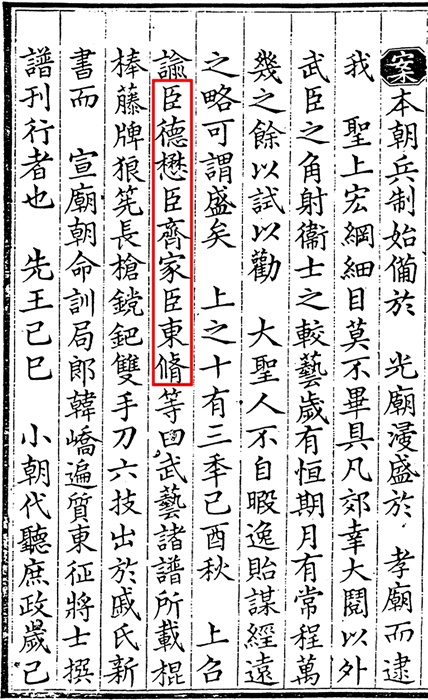
And years later, he who had set off deep into the mountains carrying a young calf returned. The longed-for friend, Baek Dong-su, had come back. Summoned by King Jeongjo and becoming a minor official of the Jangnyong Camp, he appeared in official robes to meet his friend face to face. Thus Park Je-ga wrote out every character of 『Muye Dobo Tongji』 with utmost care. Baek Dong-su directly demonstrated each martial posture, and Lee Deok-moo carefully examined and organized all historical evidence related to the martial arts.
The precious hearts of these affectionate friends are contained in this military treatise. Thus the days like spring sunshine passed. Yet two years later, on September 20, 1792, Chojeong's wife, Lee Deok-su, died. Four months after, Lee Deok-moo also passed away. The friends who had shared the Baektak community scattered to become local officials in various places. Only desolation lingered beneath the Baektak. Time makes life bitter.
Memories from youthful studies: sharing a bowl of makgeolli and dancing the mask dance with long sleeves fluttering. Memories of striking the sword powerfully in pouring rain. Those memories of young days—poor yet burning—are deeply missed. Ah, those fading memories receding into the distance... O friends...