Choi Hyung-kuk's Historical Essays (23) The Fluttering Flag—Dream, Hope, and Command
- The Philosophy and Symbolic System Embedded in Flags
“Go forth, soldiers of independence, go at once The war of liberation we have awaited has arrived
For ten years we have waited and ground our sharp blades Now comes the day to test them
Go forth, soldiers of the Korean independence army The day of freedom, independence, and liberation is today
Where the flag of justice and the Taegeuk flies The enemy forces crumble like fallen leaves”
This is a passage from the <Song of Independence>, sung by independence fighters who struggled for the liberation of their homeland during the harsh period of Japanese colonial rule. For them, the Taegeuk flag was a crystallized manifestation of dreams, hope, and abundant morale. The day the Taegeuk flag fluttered freely across the mountains and rivers of the homeland—that was the day of liberation.
Among the 24 martial arts techniques in the 『Muye Dobo Tongji』 (Comprehensive Illustrated Manual of Martial Arts of Korea), there is a technique called Gichang (旗槍), or flag spear. It was a weapon where a flag was attached to a short spear to attack enemies. However, in the military signal system, flags held extremely significant meaning. They were not merely impressive objects fluttering in the wind—they contained the very core of the military command system.
In traditional times, there were commonly designated colors symbolizing the cardinal directions and center. These were the Left Azure Dragon (左靑龍), Right White Tiger (右白虎), South Vermillion Sparrow (南朱雀), and North Black Tortoise (北玄武). Yellow or gold symbolized the center. Based on these fundamental symbolic colors, military units were distinguished. For example, the vanguard attack unit used a red flag, the defensive unit used a black flag, and the left and right wing units used white and blue flags respectively.
In the 『Gyechugjinseol』(癸丑陳說), a military treatise from the early Joseon period, there is a method of dividing each unit by flag. It states: ‘When engaging enemy forces, each unit (隊) is distinguished by a different flag: the cavalry archery unit (騎射隊) raises a blue flag, the cavalry spear unit (騎槍隊) raises a black flag, the fire gun and archery unit (火㷁弓手隊) raises a white flag, and the infantry spear and long sword unit (步槍長劍隊) raises a red flag.’
By distinguishing units in this way with flags, commanders could easily signal orders to the corresponding flag unit. Even today, in historical television dramas, we sometimes see commanders shouting "Charge!" with their throats strained before thousands upon thousands of troops. However, such a command method was impossible. The typical method was for commanders to raise a flag symbolizing the movement of the unit and display specific motions to direct the troops.
Therefore, in traditional times, when soldiers entered the military, the first thing they had to learn was understanding the movements of flags. Jung Do-jeon (鄭道傳), known as the architect of the Joseon dynasty, left behind a military treatise in which the flag signal system was recorded as a military song (軍歌) to disseminate it more easily to soldiers. This was the Flag and Baton Song (旗麾歌). Its content reads as follows:
- The Flag and Baton Song (旗麾歌)
The baton has five colors, the flag too has five colors,
With baton we command, with flag we respond.
In the center yellow, at the rear black, in front red,
To the left blue, to the right white—all in harmony.
Look to the east, west, south, and north at the batons of all four directions,
Raise it and the army moves, lower it and they halt.
Wave it and cavalry and infantry all fight,
Slow or fast—that lies with the commander.
A commander who knows this not abandons his troops,
A soldier who knows this not misses his moment.
The more who know it the better prepared,
All from carefully listening to drums and gongs and clearly seeing flags and batons.
When the flag is raised, troops must advance; when the flag is lowered, they must stop at that position. If soldiers do not understand this basic signal system, they become a disorganized rabble.
Looking more closely at methods of sending military signals using flags, there are techniques such as Li (立), Yan (偃), Dian (點), Zhi (指), Mo (磨), Hui (麾), Juan (捲), and Ying (應). First, Li (立) means the flag stands upright at normal times; Yan (偃) means laying the flag down; Dian (點) means tilting the flag in the designated direction and lifting it again before it touches the ground; Zhi (指) means tilting the flag and maintaining it at ground level where it almost touches.
Furthermore, Mo (磨) means waving the flag to the left; Hui (麾) means waving the flag to the right; Juan (捲) means rolling up the flag; and Ying (應) means receiving a superior's flag signal and repeating it to relay the message again to subordinates. Particularly in late Joseon military signals, the recognition flag (認旗), the most important flag, when Mo (磨) is performed, subordinates must rush to their commander, and when Hui (麾) is performed, they scatter and return to their original positions.
Each flag movement has pre-arranged meanings. Raising the flag means advance, lowering the flag means halt, swinging the flag from left to right means attack, swinging from right to left means defend, and continuously pointing the flag in a direction means intensively attack that direction—the flag carries various military signal meanings.
- The Flag Bearer: The Bravest Soldier
Therefore, in the Joseon dynasty, the most courageous soldiers and those with the best martial skills took the role of signal troops. The enemy's first target was always the soldier responsible for signaling. If the flag bearer fell and the military signal system collapsed, that unit often faced annihilation. Especially today, the flag symbolizing each unit remains on every battlefield, and when a unit recaptures a position, the first thing it does is raise the flag to visually communicate the occupation.
For this reason, in modern warfare, the enemy's command and communication system is attacked first. Since electronic communications systems predominate, the electromagnetic pulse bomb, or EMP (electro-magnetic pulse), pierces the sky first.
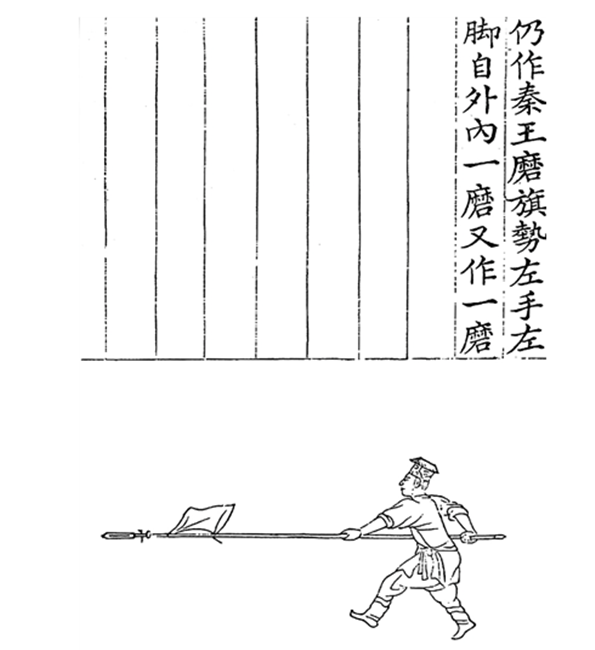
The flag spear, or Gichang, is thus created by attaching such military signal flags to a spear. For this reason, the movements of the flag spear directly apply military signal movements. A typical example is the Mo (磨) movement in the ‘Jinwang Magi Stance (秦王磨旗勢)’. The ‘Jinwang (秦王)’ that appears here is a name used by Tang Taizong Li Shimin (李世民: 559-649) during the time he earned his reputation in battle before becoming emperor of the Tang dynasty.
In general military flag operations, Mo (磨) means waving the flag to the left, and Hui (麾) means waving to the right. Therefore, the flag spear movement involves directing the spear blade to make the flag flutter, swinging from outside to inside the body. While spears are often understood as merely thrusting tools, they were frequently used by laying the spear blade sideways and slashing like a sword.
However, when a spear blade has a flag attached in the typical manner, it is difficult to execute precise attack techniques. Since the flag receives air resistance, excessive waving can produce an opposite effect. For this reason, unless it was for military signals, the flag would be removed or replaced with a very small flag.
Therefore, the final passage explaining the flag spear in the 『Muye Dobo Tongji』 adds the following: “Thus, in military formations, each commander practices holding weapons and assumes a defensive posture in sequence. Generally, attaching a blade to a spear staff with a hanging flag is intended to transmit striking and thrusting techniques. Is it not better to do this than not to do it? Agricultural implements such as hoes and flails also become weapons of war.”
In the above passage, it is metaphorically explained that agricultural implements like hoes and flails can also be used in combat, so a spear with an attached flag is not entirely useless in battle—it is expressed indirectly. While it may seem somewhat like making excuses, from the standpoint of corroborating martial arts, it is admirable how every small detail was recorded.
If it helps future generations, even the smallest detail was recorded by our predecessors, and because of them we exist today. My own study of martial arts history hopes to become even one small stepping stone in the path of someone who comes after. If they stand upon me and develop a broader and more vigorous study, the martial arts of this land will become more free.