Choi Hyeong-guk's Column (26) The Hero Must Die to Live: Di Qing and Horseback Whip-Staff
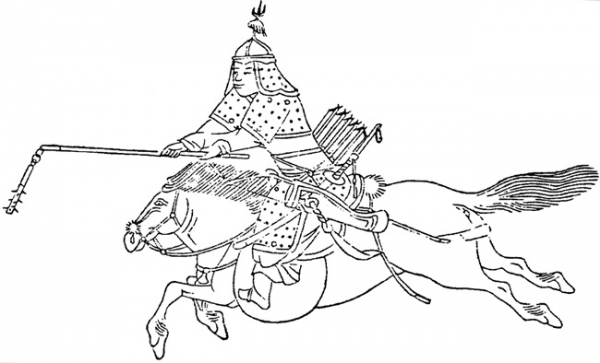
- The Horseback Whip-Staff: An Essential Weapon for Late-Joseon Cavalry
A flail. An agricultural tool used in rural areas during childhood to thresh beans. This evolved into a military weapon called the whip-staff (pyon-gon). An everyday farming tool transformed into a weapon. Within this transformation of weaponry, we can also read the vast currents of history.
After the Imjin War, Joseon recognized the limitations of cavalry tactics and established a close-combat system (short-range melee combat) adopted from the Ming Dynasty. However, as the era transitioned to the Qing period, rapid cavalry tactics became necessary again in attacks and defense against northern foreign peoples, including the Second Manchu Invasion of Korea. This trend also appears in Gwanmujae (觀武才), a type of civil service examination for martial arts in the Joseon period. Unlike the early Joseon period, the examination subjects in late-Joseon Gwanmujae tested practical skills including horseback archery (gichu) and whip-staff (pyon-gon).
Examining the battle formations of the Yong-ho Camp (龍虎營) and cavalry tactics during warfare from the "Military Treatise Compendium" (Byeong-hak-tong) published in late Joseon, we can confirm that the horseback whip-staff became recognized as the core shock weapon for late-Joseon cavalry. Furthermore, observing the diverse cavalry-exclusive formations recorded in the "Military Treatise Compendium" that were absent in existing military treatises, we can infer that cavalry still held an important tactical role in late Joseon.
Through this examination of changes in Joseon equestrian martial arts, the following picture emerges: In early Joseon, the cavalry lance was primarily recognized as the core martial art in initial shock-assault tactics. However, in late Joseon, the horseback whip-staff gained recognition as the core equestrian shock weapon due to its faster recovery time and ease of portability compared to the cavalry lance. This is clearly evident when examining the basic armament of late-Joseon cavalry. The state explicitly mandated that cavalry soldiers equip themselves with the hwan-do (ring-pommel sword) as a basic defensive weapon, the bow and arrow as a long-range attack weapon, and the horseback whip-staff for shock attacks.
For this reason, the horseback whip-staff was recognized as an essential weapon and martial art for late-Joseon cavalry. For this reason, the horseback whip-staff became a standard-issue weapon provided by the government to cavalry soldiers. Looking at the "Manki Yoram" (萬機要覽), regarding basic equipment provided to the Yong-ho Camp cavalry unit, it states: "Military equipment provided by the government to each golden soldier includes 1 war helmet (jeon-lip), 1 cylindrical piece (dong-gae), 20 long arrows (jang-jeon), 15 barbed arrows (pyeon-jeon), 1 ring-pommel sword (hwan-do), 1 horse whip (ma-pyeon), 1 quiver (tong-a), 1 hook and ring (yo-gu-geum), 1 cavalry bow (gyo-ja-gung), 1 suit of armor (gap-ju), and 1 whip-staff (pyon-gon). These are replaced every first month if damaged."
Furthermore, examining the weapons used when the Yong-ho Camp, composed of professional cavalry units, deployed cavalry-exclusive tactics confirms the importance of the horseback whip-staff at that time. Looking at the horseback whip-staff usage methods described in the "Military Treatise Compendium," a representative military treatise from King Jeongjo's reign, we can understand how crucial this weapon was in cavalry tactics of that era. The details are as follows: "When the Yong-ho Camp deploys operations and the enemy is 100 paces away, each soldier mounts horses. When the signal cannon sounds, flags one and two are raised, and when drums and flags are marked, the rear layer emerges and lines up in a row in front of the front layer. When the enemy is within 100 paces, archers simultaneously fire arrows on command. When the enemy reaches 50 paces, drums beat rapidly and the heaven-goose call sounds. At this point, the cavalry draws their whip-staffs, shout loudly, and pursue the enemy. If the enemy is defeated and retreats, a gong sounds and when the drum stops, each soldier returns to position. When the gong sounds three times, they immediately turn around, and following the signal cannon, raise the corresponding numbered flag and mark it toward the inside, returning to the original location. If the enemy approaches again, the signal cannon is fired and flags one and two are raised. When drums and flags are marked, the front layer lines up in a row, and when the enemy enters within 100 paces, they fire arrows and pursue, retreating in the same manner as before. Creating another enemy approach situation, the signal cannon is fired and flags one and two are raised. When drums and flags are marked, the middle layer emerges in front of the front layer, lines up in a row, fires arrows and pursues all in the same manner as before."
Though lengthy, the content is simple: when charging toward the enemy, cavalry drew their whip-staffs and launched at full speed. This is why the horseback whip-staff was newly added to the late-Joseon military civil service examination. Changes in Joseon military tactics can be traced to changes in weaponry. Furthermore, changes in weapons to counter the powerful Qing cavalry are directly connected to international politics. While studying physical changes of soldiers through martial arts, we can broadly glimpse aspects of international diplomacy.
- "Di Qing": A Dead Hero Is Needed, but a Living Hero Is Not
In the horseback whip-staff section of "Muye Dobo Tongji," a figure called "Di Qing" appears. When Di Qing was suppressing the Nong Zhihao rebellion, he led approximately 2,000 cavalry across the Kunlun Pass in the middle of the night. When the enemy defended from the rear with spears and shields, the situation became difficult. However, drawing his horseback whip-staff and charging, he broke through the enemy's fortification. Di Qing was born in 1008 and died in 1057—a famous general of China's Northern Song Dynasty. He continues to appear in the biographical records of great Chinese military commanders. The reason is none other than the tragic nature of his death.
To Korean people, Di Qing is not well known, but to Chinese people, he is quite famous. He is a Northern Song period general rivaling in fame "Judge Bao Zheng," once known through Chinese television dramas. In the Judge Bao stories, while wielding the fearsome dog guillotine and dragon guillotine, Bao Zheng was a civil official who pursued impartial law enforcement regardless of rank and demonstrated true fairness to the people of that time through his actions.
So in the Chinese martial arts tale "Water Margin," the phrase appears: "Why worry when there is the Star of Literary Fortune and the Star of Military Fortune!" The Star of Literary Fortune refers to the righteous judge Bao Zheng, and the Star of Military Fortune refers to the valiant general Di Qing.
Examining Di Qing's life in more detail, he was among the most honored generals of the Northern Song. He was a general who reached the position of Privy Councillor (樞密使), equivalent to today's Minister of National Defense—a rank no military officer had previously attained. Yet his beginning was humble. Born into poverty, he never properly received an education. At age 16, he was even punished in place of his brother and received a tattoo marking him as a criminal on his face before being conscripted into the army. This was called ci-zi-chong-jun.
However, he turned crisis into opportunity. In 1038, a new state called the Western Xia was established around the Northern Song, and another foreign ruler emerged. At that time, Di Qing was a junior officer guarding the frontier. In battles against Western Xia, he volunteered as vanguard commander and single-handedly destroyed the Western Xia vanguard several times with minimal forces. During one such battle, he met a new teacher and began studying. He eventually memorized all the military treatises of ancient and modern times.
Subsequently, Di Qing participated in 25 major and minor battles. Not a single battle he led ended in defeat. Though he sustained grave wounds—nearly losing his life to arrows—his subordinates experienced absolute confidence in victory. As he accumulated such achievements, the emperor began to recognize him. Whenever northern foreign peoples threatened the Northern Song, Di Qing would lead the charge and cleanly resolve every situation. By age 40 in 1052, he was finally promoted to Deputy Privy Councillor. Never before had a person of common birth been promoted so rapidly.
Afterward, the north was completely pacified. At this time, rebellion erupted in the Guangzhou region in the south. Di Qing led several hundred ethnic minority cavalry who had fought alongside him against Western Xia southward. The Northern Song forces sent as the vanguard suffered near-total annihilation, with critical casualties, but Di Qing broke through the enemy's thick defensive walls at the Kunlun Pass and pursued them relentlessly, annihilating them completely. He suppressed the rebellion entirely. The weapon he used was the horseback whip-staff. Like a returning victorious general, carrying the horseback whip-staff confidently on his shoulder, Di Qing returned to the capital and was appointed Privy Councillor, reaching the highest position in national defense. Yet Di Qing's tragedy began from this point.
Di Qing always displayed humble loyalty to the state, and his conduct and achievements were widely praised even among ordinary people. However, the more he did so, the more other power-holders grew anxious. The emperor in particular felt fear toward the nearly perfect Di Qing. All manner of rumors poured in about Di Qing. Even rumors spread that Di Qing was attempting to usurp the throne.
Subsequently, the court transferred him to serve as governor of Zhenzhou, a frontier region of Northern Song—effectively exiling him. Yet it did not stop there. The emperor's envoys visited under the pretense of condolence inquiries twice monthly to monitor him. Less than half a year after arriving in Zhenzhou, Di Qing died of depression and mental illness. He was 49 years old. The fierce general of the battlefield, the dream of soldiers, had departed unable to bear the weight of jealousy and envy.
After his death, the emperor mourned and posthumously granted him the position of Minister of State, with the posthumous name Wuxiang (武襄). All soldiers and common people grieved together. What could be done? Perhaps the impatient commanders filling that place were not the environment where Di Qing should have remained long. Not long after Di Qing's death, Northern Song military power plummeted to its worst state. Unable to conduct proper warfare, they barely endured by offering silver and silk to surrounding foreign peoples. The radiant culture of the Central Plain gradually lost its luster.
Subsequently, the Jurchen people from the north grew increasingly fierce, eventually establishing the Jin Dynasty, and the Northern Song, continuing the Han Chinese lineage, perished under horseback hooves. And Di Qing became a legendary hero to the Han Chinese.
To some, a living hero is an uncomfortable presence. Therefore, that hero only becomes a truly revered hero after death. Yet the disappearance of such a presence marks the beginning of a nation's or organization's collapse. Those afflicted by complexes and inferiority feel blind to jealousy and envy, making everything appear wrong. Such is life in this world. Admiral Yi Sun-sin, the renowned general of the Imjin War—had he not died from enemy cannon fire in the waters off Noryang, perhaps another political cannon fire would have awaited him.