Kim Chung-young's Suwon Microscope (121) A Festival Lasted Eight Days in Suwon 228 Years Ago During the Royal Procession to Hwaseong
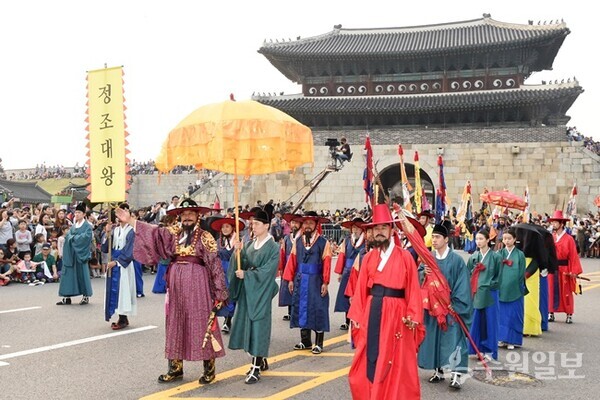
Five years after the new city of Suwon was built, construction of Hwaseong began when the new year of 1794 arrived. One year later in 1795 (the Year of Eulmyo), both Sado Sejae and Hyegyeong Gung Hong reached their sixtieth birthdays, and it was also the twentieth year since King Jeongjo ascended to the throne.
The birthday celebration banquet was scheduled for the second lunar month at Hwaseong Palace before the farming season began in earnest. To prepare for the celebration banquet, a temporary organization called Jeongniso (整理所) was established on December 11, 1794, as royal court music, court dances, and court cuisine were necessary.
The first preparation involved a large contingent of approximately 6,000 people who needed to participate in the festival, most of whom had to travel from Seoul to Suwon. Up until this time, the route from Seoul to Suwon used the Jangju Avenue (Samnam Road) passing through Gwacheon.
At that time, crossing the rugged Namtaeryeong Pass of Gwacheon required considerable effort in road maintenance, and the harsh conditions made it difficult for 6,000 people to travel to Suwon. Therefore, a new route was sought, resulting in the construction of the Siheung Road passing through Siheung and Anyang.
After thorough preparations, on the second lunar month, 4th day of 1795, they conducted a rehearsal of crossing the Hangang River on a pontoon bridge. King Jeongjo issued strict instructions to his officials at this gathering, concerned about excessive loyalty.
First, do not bring rare and exotic foods from distant places and present them.
Second, do not prepare food lavishly and ornately following the habits of common society, but keep the taste simple.
Third, absolutely prohibit each station village from privately presenting goods as personal tribute.
Fourth, do not select female entertainers and court dancers from each province; instead, select a limited number from among those serving at the Inner Medical Bureau, Hyemin Bureau, Ministry of Works, and the Royal Tailoring Office, and assign half of them as Hwaseong entertainers.
Fifth, keep the clothing of musicians and female entertainers clean, but not ornate.
Sixth, limit the royal meal to no more than ten dishes.
Seventh, since banquet music differs from regulated court music, keep it simple, and repair and reuse instruments already available in Seoul and Hwaseong.
Even after these instructions, King Jeongjo was not at ease and dispatched a secret royal inspector on the day before the procession, the 8th day of the second lunar month, to investigate conditions.
King Jeongjo's procession to Hwaseong took place over eight days.
On the first day (second lunar month, 9th day), King Jeongjo left Yeongchunheon of Changdeok Palace and went to Sujeong Hall to pay respects to his grandmother (Queen Jeongsun). Since his grandmother was at the palace, King Jeongjo left his consort (Queen Hyoui Kim) at the palace. He departed with only his mother, Hyegyeong Gung Hong, and his sisters, Princess Cheongyeon and Princess Cheongseon.
When the third bell struck at Myojeong (6 o'clock in the morning), King Jeongjo donned military dress and rode on horseback, while his mother Hyegyeong Gung Hong and his two sisters rode in palanquins. According to the procession diagram in the 'Wonhaeng Eulmyo Jeongni Uigwe,' the total number of people was 1,779, led by Prime Minister Chae Chegong, and there were 779 horses. The actual number of people participating in the festival was approximately 6,000, of which about 4,500 were soldiers, and among these, 3,000 were from the Jangnyong Garrison.
As seen in the procession diagram, hundreds of flags fluttered, and 115 cavalry musicians performing created a spectacular sight. The procession of 1,779 people would have stretched over 1 kilometer.
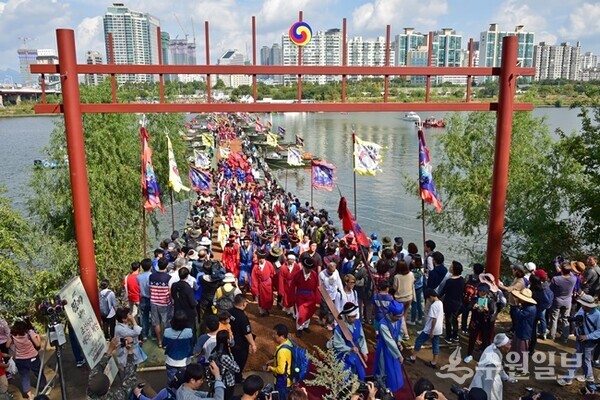
The royal procession departed from Donhwamun, the main gate of Changdeok Palace, passed through the street in front of Bosingak, crossed Daegwangtong Bridge and Sogwangtong Stone Bridge over Cheonggyecheon, and proceeded to Sungnyemun Gate. As it reached the Yongsan area, spectators gathered on the hillsides. King Jeongjo ordered that they not be stopped.
The procession then reached the Hangang pontoon bridge. When it reached the red-painted wooden gate in the middle of the bridge, King Jeongjo dismounted and went to his mother's palanquin to pay his respects. After crossing the bridge, King Jeongjo arrived first at Yongyang Bongjeo Pavilion to inspect the resting place for his mother. King Jeongjo personally served food to his mother at the pavilion. The two princesses' meals were the same as the king's, but the meals of the attendants varied according to rank.
After taking refreshment and eating at Noryang, they headed to Siheung Palace, thirteen ri away. Siheung was originally called Geumcheon. The county name was changed to Siheung when new roads were constructed in preparation for the birthday celebration.
The procession departed from Yongyang Bongjeo Pavilion, passed through Manahn County (commonly called Manyanggoggae), proceeded through Jangsaeng County (present-day Jangseungbaegi), and headed toward Banidae-bang Plain in Siheung. Upon reaching Munseong-dong in Siheung (now Siheung-daero), King Jeongjo stopped the procession momentarily. He had blue cloth tents erected around Hyegyeong Gung and personally served 'mieum dabanch' (a beverage made by boiling jujubes).
King Jeongjo called Yun Haengim, the official in charge of preparations, and instructed him to go to Siheung Palace first and conduct a personal inspection, then said he would go ahead shortly to inspect it himself. King Jeongjo arrived first, thoroughly inspected the palace, waited for his mother, and escorted her inside. Siheung Palace was newly built for this procession. When the official brought the evening meal, King Jeongjo personally served it to his mother. He repeated this action at every stop.
King Jeongjo said, "The weather is clear and my mother is in good health, so I cannot help but celebrate this good fortune," and while distributing food to his officials, he said, "This food is being given by your mother, so eat your fill."
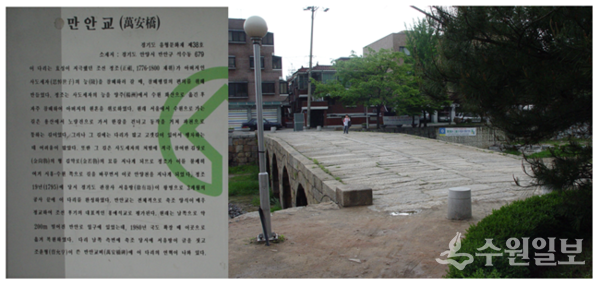
On the second day (second lunar month, 10th day), King Jeongjo, who had spent the night at Siheung Palace, headed to Sagun Station Palace (the site of the Uiwang City Hall annex) for lunch. The royal procession proceeded through present-day Siheung-daero toward Anyang. After crossing the newly constructed Manan Bridge built for the procession and stopping briefly at Anyang Station, the procession departed again and arrived at Sagun Station Palace (Uiwang City Hall annex). King Jeongjo first inspected the facilities of Sagun Station Palace, escorted his mother inside, and partook of morning refreshments called 'jucha byeolban gwa' and lunch.
At this point, rain began to fall. King Jeongjo said, "I am concerned about the civil officials and soldiers getting caught in the rain, but since Hwaseong is not far from here, we can arrive today," and prepared rain gear to continue. The procession then reached Mireuk County. Originally called Sagun Pass, as the royal visits became frequent, it was renamed Mireuk County and later changed again to Jiji-dae. King Jeongjo had the procession rest again and paid his respects to his mother. The royal procession departed again, passed through Gwoemok Pavilion Bridge, and went through the Pine Grove Area. The Pine Grove Area was created by planting pine trees along the roadsides as King Jeongjo's visits to Hwaseong became more frequent.
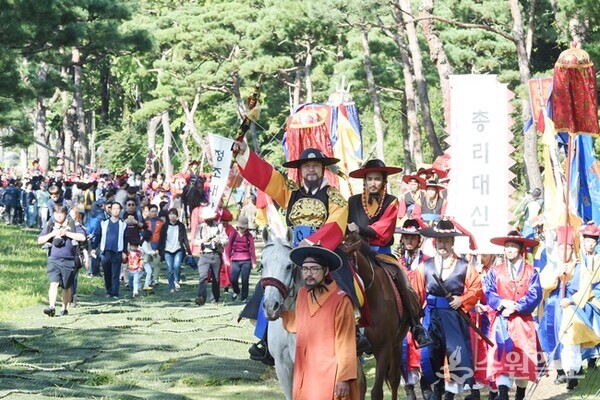
Upon reaching Jinmok Pavilion, Prime Minister Chae Jegong, who had arrived earlier, welcomed the royal procession while performing gochwi (encouraging music). At this location, King Jeongjo presented 'mieum dabanch' to his mother. King Jeongjo changed into armor at this point and entered through Jangan Gate. Several officials and Hwaseong Governor Jo Sihtae, together with military officers and soldiers, bowed respectfully on both sides of the road to greet him.
The royal palanquin passed through Jangan Gate toward Paldalse Gate, then turned right onto Jonggaro and proceeded through the front path of the Left and Right Military Camps before entering Sinpungru, the main gate of the palace. The procession then passed through Joaik Gate and Jungyang Gate, arriving at Bongsudang, the main building of the palace.
King Jeongjo escorted his mother to Jangnakdang, located next to Bongsudang, and presented 'jucha byeolban gwa' (morning refreshments), and in the evening, he presented the evening meal. The two-day journey had finally come to an end.
King Jeongjo went to his quarters, Yuyeotaek, and instructed his attending officials:
"I am sorry that everyone was caught in the rain today, but there were no major problems. One should not always expect everything to be perfect. Yesterday the weather was clear and warm, and tomorrow there will be many auspicious ceremonies. After it rained for dozens of ri, it suddenly cleared up, so that is fortunate indeed. Moreover, since this is the time when farming is about to begin, the rice paddies becoming wet is surely a blessing for the farmers."
228 years later in 2023, the royal procession of King Jeongjo is being jointly re-enacted by Seoul, Suwon, and Hwaseong.
The Seoul section will take place on October 8 from 10:00 to 18:00, the Suwon section on October 8-9 from 09:30 to 18:30, and the Hwaseong section on October 8 from 11:00 to 13:30.
As autumn deepens, do not miss the royal procession to Hwaseong, the quintessence of Joseon court culture.