Kim Chung-young's Suwon Microscope (129) Evolution of Suwon's New Year's Eve Bell-Ringing Ceremony
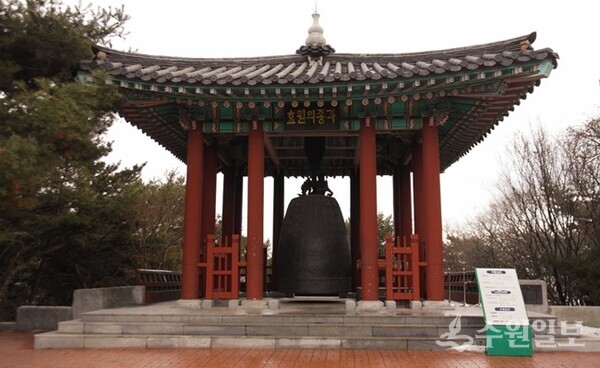
The 'New Year's Eve Bell' is rung at midnight as the year transitions from the last day of the lunar year to the new year.
Originally, it was rung 108 times in temples at morning and evening to eliminate the 108 earthly desires.
The reason the bell is rung 33 times carries the wish to reach Trayastrimsa Heaven (忉利天, the 33rd heaven). The New Year's Eve Bell is rung to pray for national prosperity and peace.
During the Joseon Dynasty, the bell-ringing ceremony began in 1396. It was rung at 4 a.m. (Ogyeong) when the four main gates and four auxiliary gates of the capital were opened, and at 10 p.m. (Igyeong) when the gates were closed to announce the curfew.
At 10 p.m., the bell was rung 28 times, carrying the meaning of wishing peace to the 28 constellations of the universe. At 4 a.m., called Paru (罷漏), the bell was rung 33 times, which means praying to Indra, the guardian deity of the 33 heavens.
The New Year's Eve Bell in Korea began in 1929 during the Japanese colonial period. Gyeongseong Broadcasting's broadcast of the 'New Year's Eve Bell Sound' in early 1929 was the beginning. After liberation, starting in 1953, Seoul City held the event as a New Year's celebration ceremony, and from this time, the public began watching the broadcast on air, establishing it as a seasonal culture for welcoming the new year.
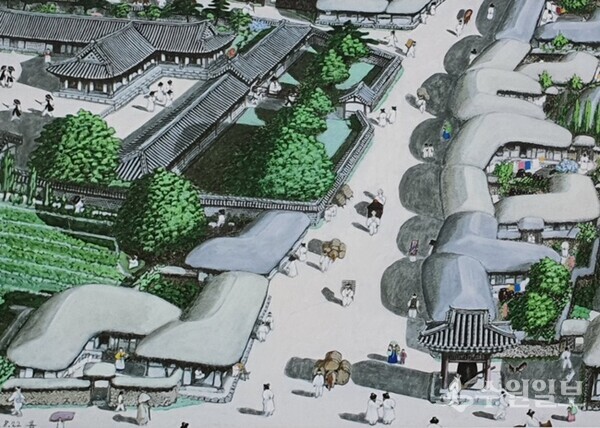
Records related to bells in Suwon can be found in the entry for the 10th day of the 2nd lunar month in the 'Wonhaengeulmyo Jeongni Uigwe' (Record of the Royal Progress to Suwon), which documented the 60th birthday celebration of Hyegyeong, Crown Princess of Suwon in 1795: "The royal carriage entered through Jangan Gate, passed through the roads in front of military camps on both sides of Jongga Street (Bell Street), Sinpungnu Pavilion, and Jwaikmun Gate, and entered through Jungyang Gate."
Another record comes from the 'Hwaseong Ilgi' (Hwaseong Daily Record) of Yi Hee-pyeong, who participated in Crown Princess Hyegyeong's celebration, which states, "The magistrate opened the door at the Bell Tower intersection (十字街) and sat in a manner similar to Seoul's Bell Tower." This confirms that a bell pavilion existed at Jongno in Suwon at that time.
"Suwon's bell pavilion was demolished in the mid-1910s during the Japanese colonial period when the road between Jangan Gate and Paldal Gate was expanded. The bell that was at this location was moved to the second floor of Paldal Gate tower."
This is the testimony of the late Master Yun Han-heum, who painted the revived old appearance of Suwon. This bronze bell, which was originally at Manui Temple in Dongtan, was placed on the second floor of Paldal Gate in Suwon and was designated as Gyeonggi Province Tangible Cultural Property No. 69 (Paldal Gate Bronze Bell) on July 3, 1976.
After attracting the Gyeonggi Provincial Government to Suwon in 1963, a groundbreaking ceremony for the new provincial government building was held on October 15, 1964, and this day was proclaimed as Suwon Citizens' Day. Suwon city held a bell-ringing ceremony on the eve, October 14, to pray for Suwon's development and celebrate Citizens' Day, viewing this day as a watershed moment in Suwon's development.
From 1966 onward, the festival was named 'Hwahong Cultural Festival (華虹文化祭)' and a bell-ringing ceremony using the Paldal Gate Bronze Bell on the second floor of the Paldal Gate tower was held during the eve celebrations. As the Hwahong Cultural Festival bell-ringing ceremony continued, problems arose.
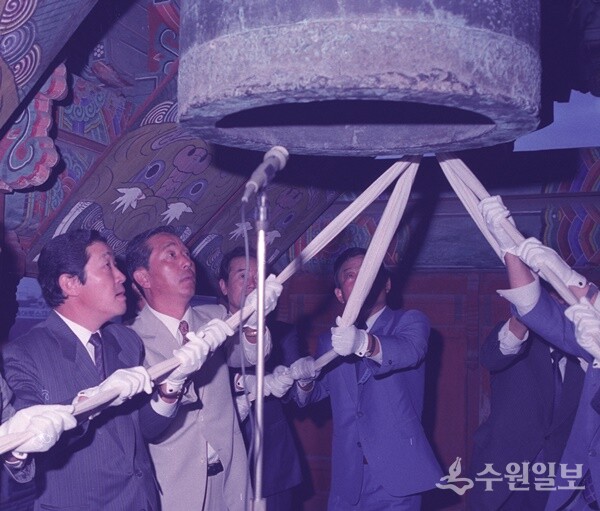
First, ringing the bell from the pavilion caused structural damage to the building through vibrations. Consequently, public opinion began to emerge calling for the suspension of the bell-ringing ceremony.
Second, since the bell was made in 1687 and over 300 years old, there was a risk of deterioration and damage. Moreover, the bell sound was muffled and its size (height 123cm, mouth diameter 75cm) was too small to befit the status of the capital of Gyeonggi Province.
The person who found the Paldal Gate Bronze Bell unsuitable was Lee Ho-seon, who took office as the 18th mayor of Suwon in 1991 during the appointed mayor period. In November 1991, Mayor Lee organized the 'Hyowon Bell Pavilion Bell-Casting Promotion Committee' and began casting a new bell. Mayor Lee stepped down on May 3, 1993, before the Hyowon Bell Pavilion on Paldal Mountain was completed. The 'Hyowon Bell,' completed within a year, was rung from the Hyowon Bell Pavilion starting with the eve ceremony of Citizens' Day on October 14, 1993, under the supervision of successor Mayor Jeon Young-guk.
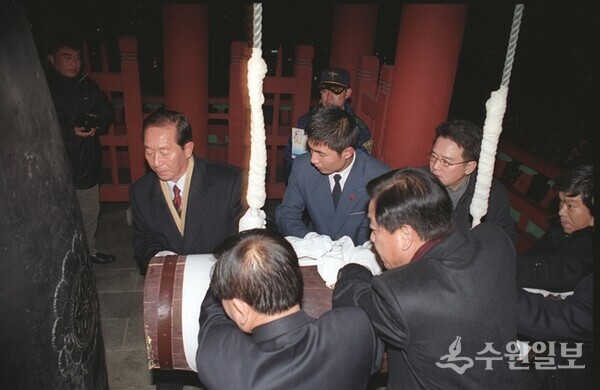
Subsequently, Shim Jae-deok, elected as the first popularly elected mayor of Suwon, began holding the first New Year's Eve Bell-ringing ceremony on Paldal Mountain on December 31, 1995. Furthermore, Mayor Shim opened the Hyowon Bell to the public and tourists, allowing them to ring the bell.
Since then, the Hwaseong Cultural Festival and New Year's Eve Bell-ringing ceremony have been held annually at the Hyowon Bell Pavilion.
However, other problems began to be raised.
First, bells should not be installed in high places, as the sound disperses upward and is not well heard by the general public.
Second, the space around the Hyowon Bell at the summit of Paldal Mountain is insufficient, preventing many citizens from participating.
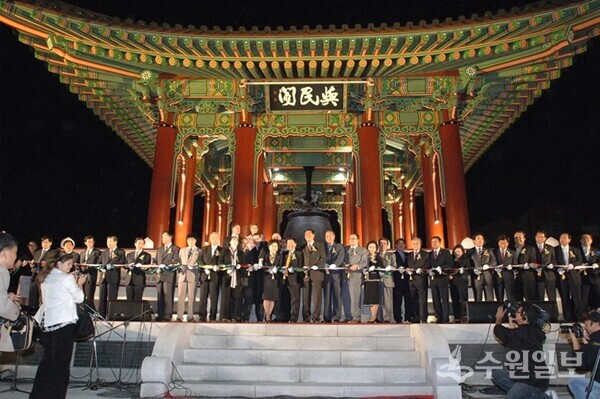
Mayor Kim Yong-seo, elected in the third popularly elected period, promoted the construction of 'Yeominagak (與民閣)' at the location of the bell pavilion originally built during the construction of Hwaseong, timed with the development of Haenggung Plaza. Yeominagak means "together with the people."
Yeominagak was initiated in January 2007 and completed in October 2008. The completion ceremony was held concurrently with the bell-ringing ceremony during the 2008 Hwaseong Cultural Festival eve event.
On all four sides of the Yeominagak bell are inscribed the phrases: "Renren HeLE (人人和樂)," "Huhu Fushi (戶戶富實)," "Suwon Wei Ben (水原爲本)," and "Sefang Changhua (世邦昌華)." The meaning is: "All Suwon citizens unite in harmony and joy; every household is prosperous and fulfilled; with Suwon as the foundation, the region will flourish and prosper in the age of globalization."
At midnight on the transition from 2023 to 2024, a bell-ringing ceremony was held with the participation of all citizens.
It is hoped that throughout this year, with the sound of the bell, all citizens will reflect on the meaning of Renren HeLE, Huhu Fushi, Suwon Wei Ben, and Sefang Changhua.